Taishokan (Former Koriyama Commercial Bank Wakamatsu Branch)



View details
[PR] Advertise with us: Contact
Suggest a correction
Highlights
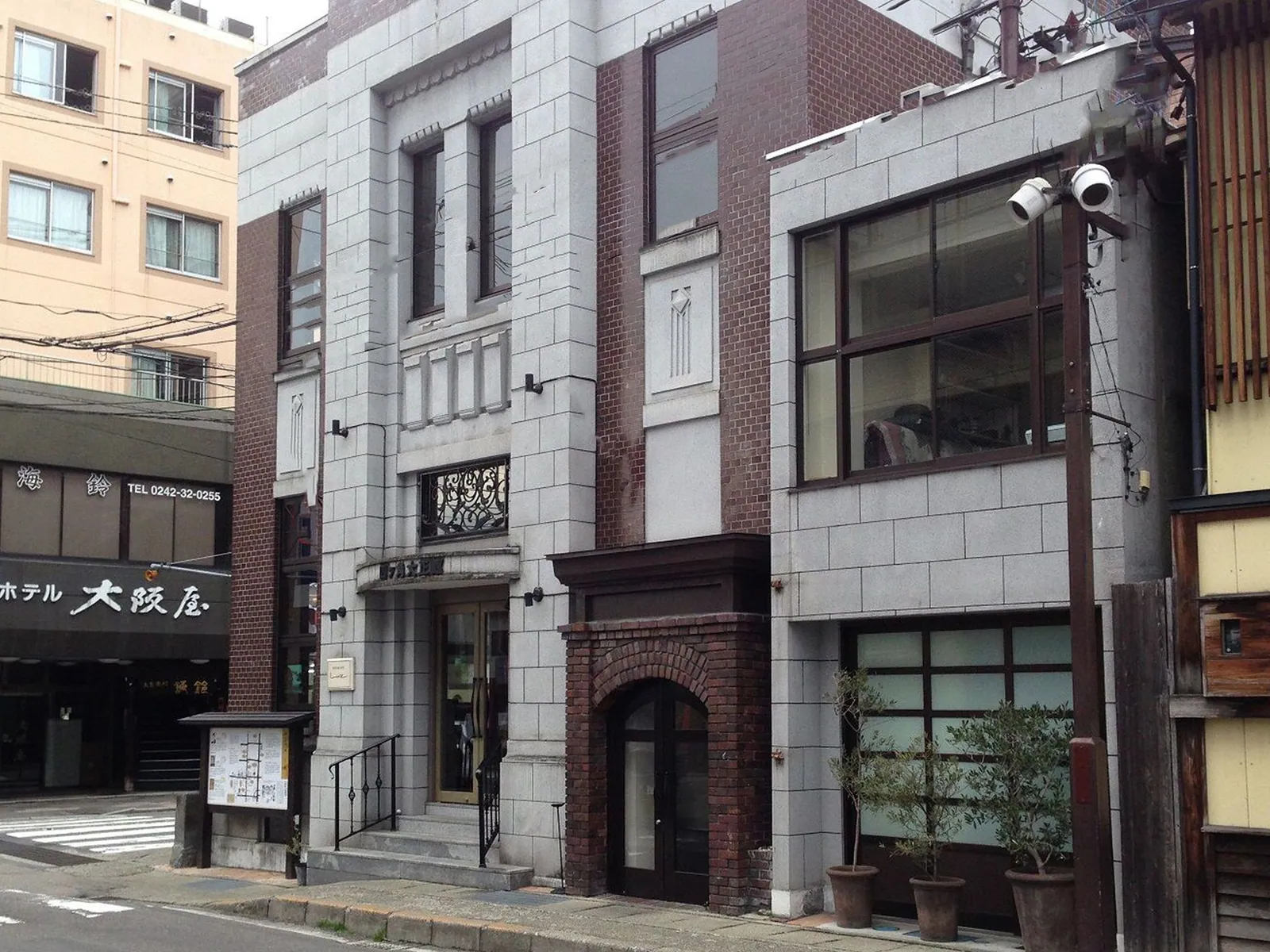
This building is the former Wakamatsu Branch of the Koriyama Shogyo Bank, standing at the Omachi crossroads (an irregular intersection peculiar to castle towns, said to be well suited to defense).
Built in Taisho 10 (1921), it was the first reinforced concrete building in Aizuwakamatsu.
It began operating as a bank on December 1, Taisho 11 (1922).
As a Western-style building of the Taisho era, its lower walls (koshi-kabe, or wainscoting) are finished in stone masonry, its exterior walls are finished with tile and exposed-aggregate concrete (a finish in which the surface is washed after the concrete is placed, deliberately revealing the crushed stone), and its windows are sash windows.
As the bank relocated, the interior was remodeled repeatedly, and the section on the right side of the front entrance was added later. Even so, the atmosphere of the original building remains today.
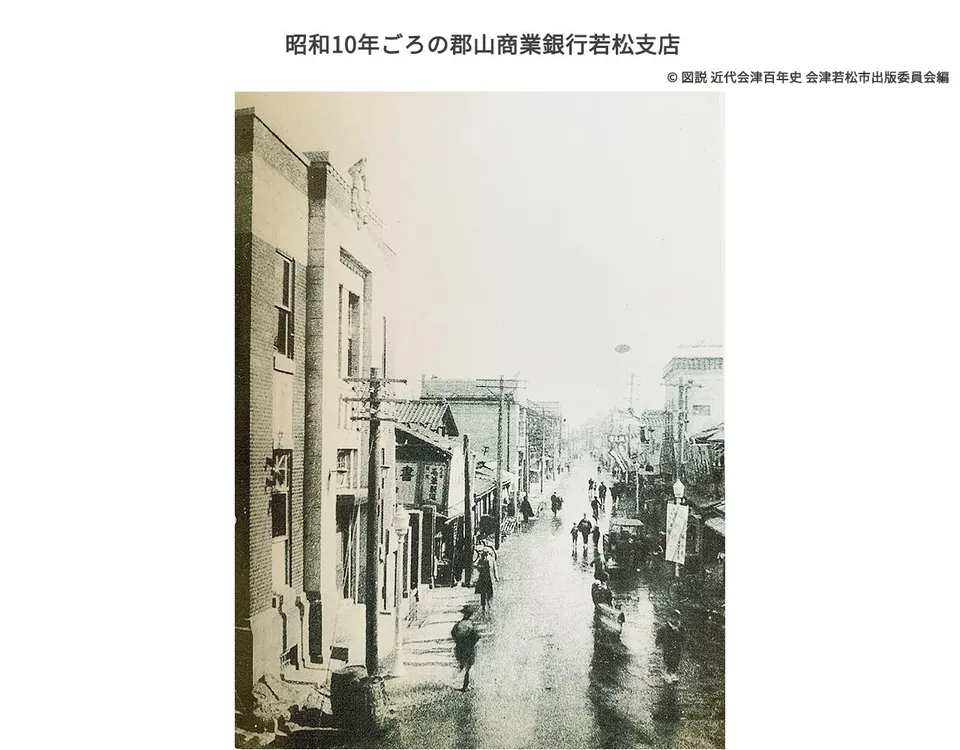 On the left is the Wakamatsu Branch of the Koriyama Shogyo Bank in Showa 10 (1935). The photo was taken on the day an Imperial Japanese Army division visited Wakamatsu for a maneuver exercise. The Japanese flag flies over the street.
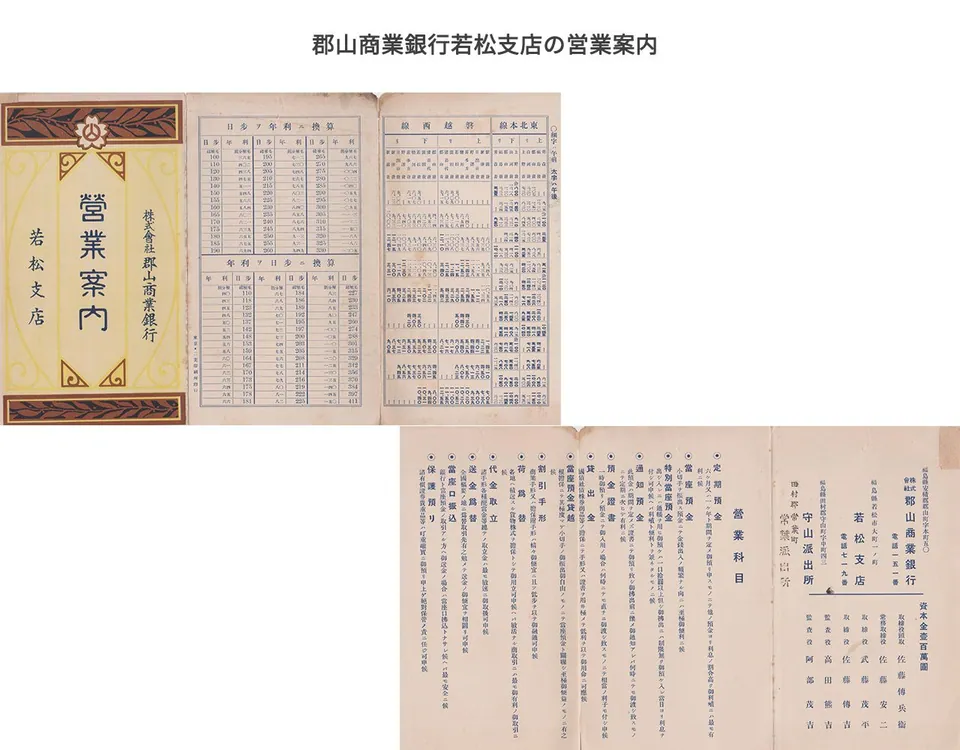 Business guide of the Koriyama Shogyo Bank Wakamatsu Branch, issued in Taisho 11 (1922). It includes financial products, annual interest rate information, and timetables.
An enlarged image can also be viewed in the Nanukamachi.com Digital Archive.
Nanukamachi.com Digital Archive: Business Guide of the Koriyama Shogyo Bank Wakamatsu Branch
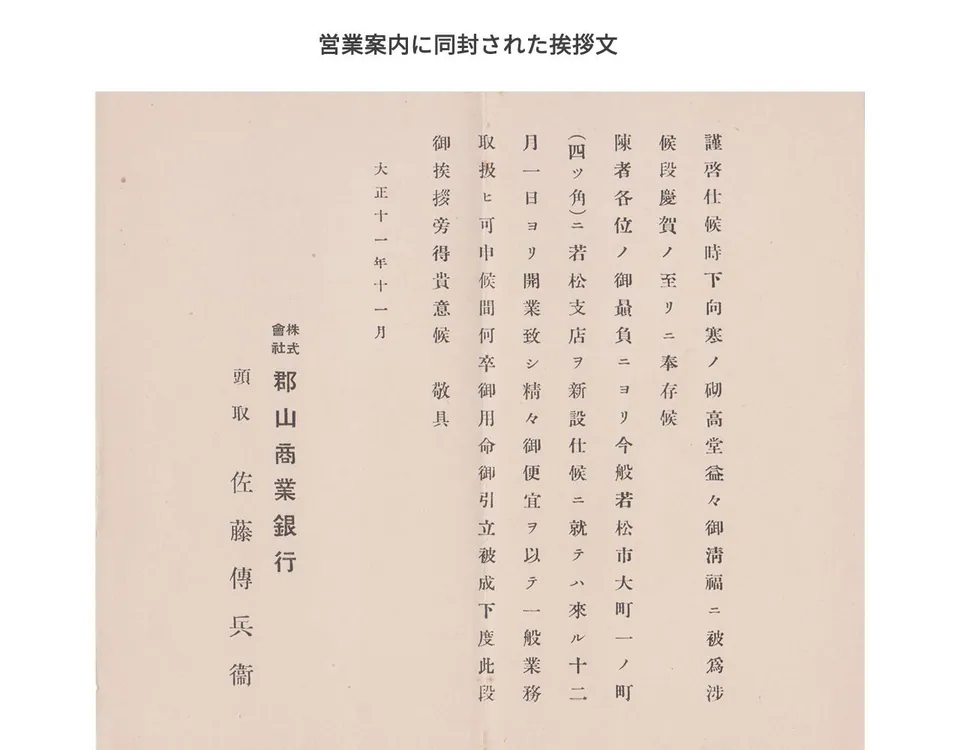 Greeting letter enclosed with the business guide of the Koriyama Shogyo Bank Wakamatsu Branch, issued at the time of its opening.
Respectfully: as the cold season sets in, we offer our heartfelt congratulations on your continued prosperity.
We hereby inform you that, thanks to your continued patronage, we are newly establishing a Wakamatsu Branch at the Omachi Ichi-no-machi (four-way crossroads) in Wakamatsu City. It will open on December 1, and we will handle general business for your convenience.
We respectfully request your continued patronage and support, and we hereby convey this greeting.
Sincerely,
November Taisho 11 (1922)
Koriyama Shogyo Bank Co., Ltd., President Sato Denbei
Respectfully: as the cold season sets in, we offer our heartfelt congratulations on your continued prosperity.
Respectfully, as the chill of the season deepens from autumn into winter, we extend our heartfelt congratulations on your continued good fortune. (Kodo is an honorific term for addressing others.)
We hereby inform you that, thanks to your continued patronage, we are newly establishing a Wakamatsu Branch at the Omachi Ichi-no-machi (four-way crossroads) in Wakamatsu City. It will open on December 1, and we will handle general business for your convenience.
With your continued patronage, we are now establishing a Wakamatsu Branch at Omachi 1-chome (the four-way crossroads) in Wakamatsu City. It will open on December 1 and handle general business to the best of our ability.
We respectfully request your continued patronage and support, and we hereby convey this greeting.
We humbly ask for your patronage and support, and we wish to convey this matter to you.
Originally owned locally for generations, this building was leased by the current owner, a native of Tokyo, who proposed preserving it and using it as a tourism resource. At first, the proposal was not welcomed locally, and some argued that only the owner would benefit even if the building were put to use. Disregarding the Aizu climate, which is sometimes described as insular, the owner restored and renovated the interior at his own expense, and thanks to that effort the building has survived to the present day. It is now also effectively used as one of the attractions of Nanukamachi-dori.
TimelineMajor History of Taishokan
Built in Taisho 10 (1921), it was the first reinforced concrete building in Aizuwakamatsu.
It began operating as a bank on December 1, Taisho 11 (1922).
As a Western-style building of the Taisho era, its lower walls (koshi-kabe, or wainscoting) are finished in stone masonry, its exterior walls are finished with tile and exposed-aggregate concrete (a finish in which the surface is washed after the concrete is placed, deliberately revealing the crushed stone), and its windows are sash windows.
As the bank relocated, the interior was remodeled repeatedly, and the section on the right side of the front entrance was added later. Even so, the atmosphere of the original building remains today.
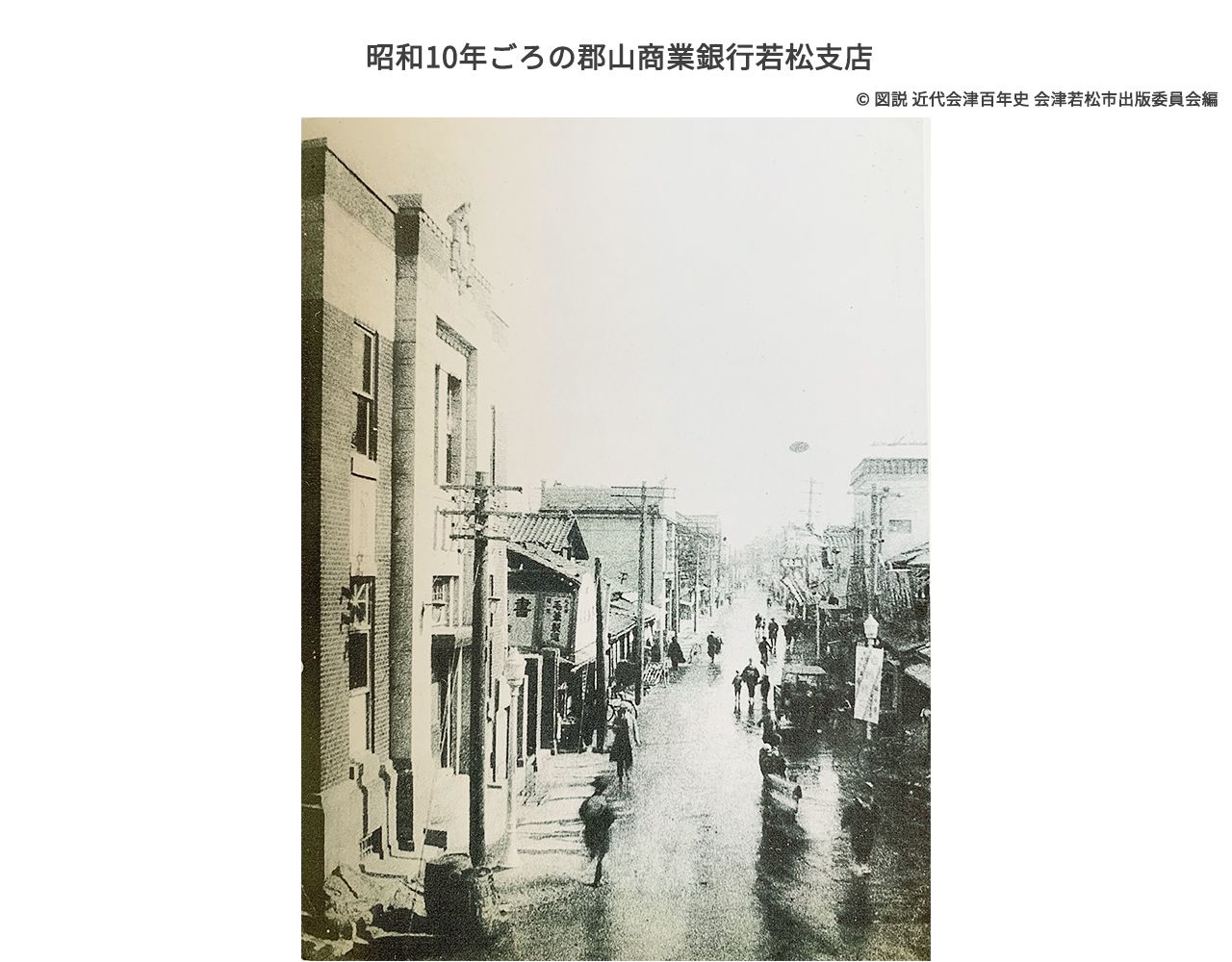 On the left is the Wakamatsu Branch of the Koriyama Shogyo Bank in Showa 10 (1935). The photo was taken on the day an Imperial Japanese Army division visited Wakamatsu for a maneuver exercise. The Japanese flag flies over the street.
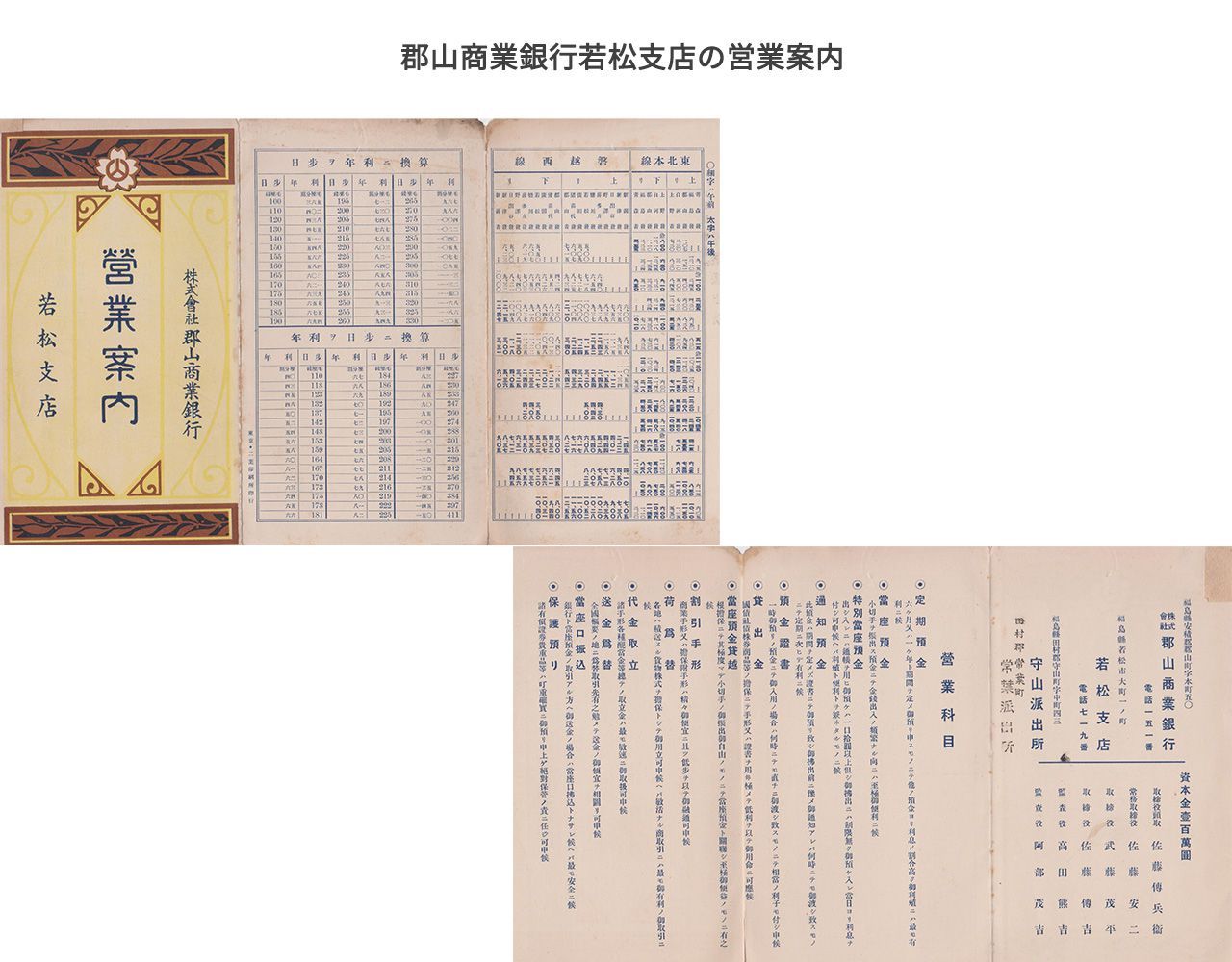 Business guide of the Koriyama Shogyo Bank Wakamatsu Branch, issued in Taisho 11 (1922). It includes financial products, annual interest rate information, and timetables.
An enlarged image can also be viewed in the Nanukamachi.com Digital Archive.
Nanukamachi.com Digital Archive: Business Guide of the Koriyama Shogyo Bank Wakamatsu Branch
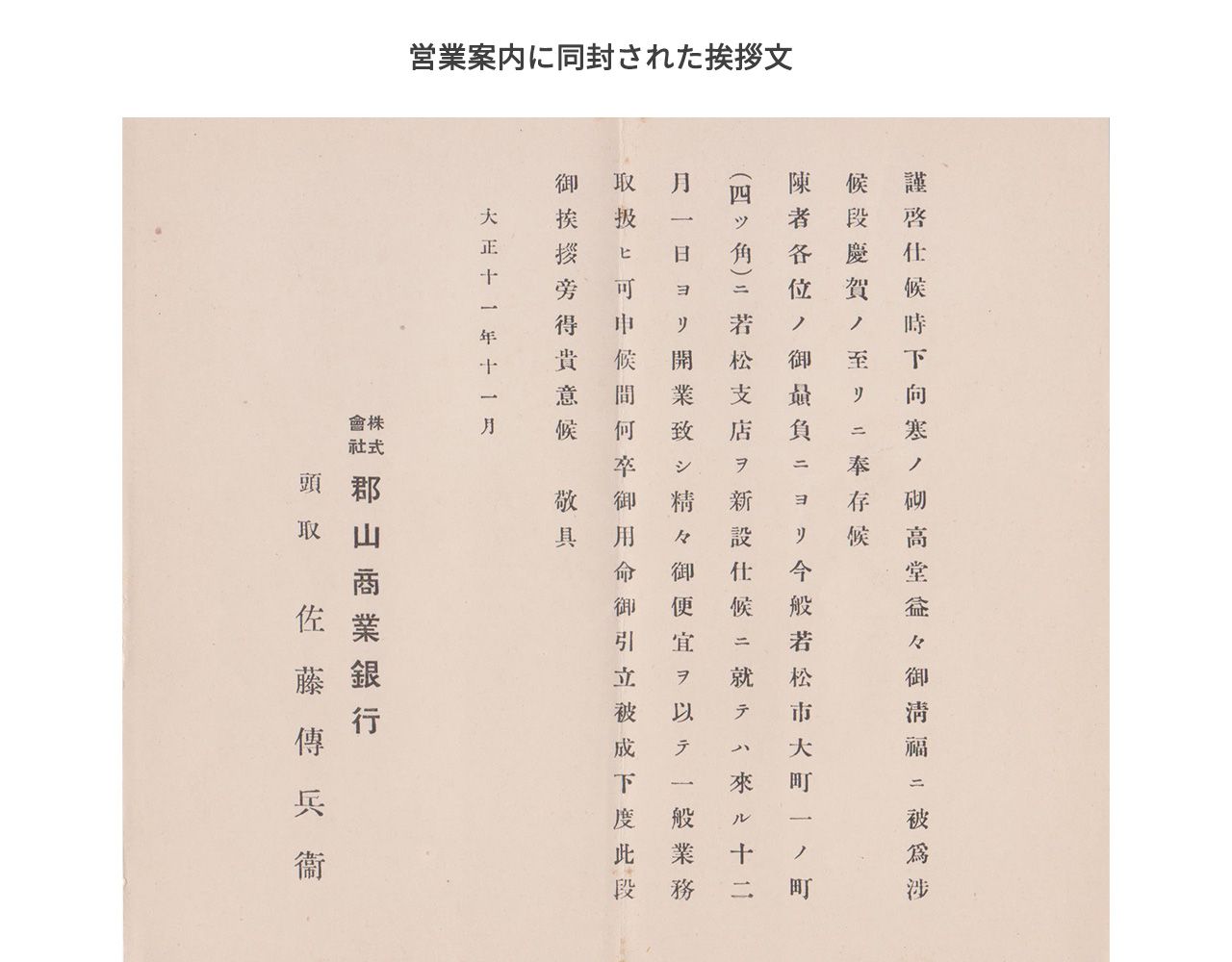 Greeting letter enclosed with the business guide of the Koriyama Shogyo Bank Wakamatsu Branch, issued at the time of its opening.
Respectfully: as the cold season sets in, we offer our heartfelt congratulations on your continued prosperity.
We hereby inform you that, thanks to your continued patronage, we are newly establishing a Wakamatsu Branch at the Omachi Ichi-no-machi (four-way crossroads) in Wakamatsu City. It will open on December 1, and we will handle general business for your convenience.
We respectfully request your continued patronage and support, and we hereby convey this greeting.
Sincerely,
November Taisho 11 (1922)
Koriyama Shogyo Bank Co., Ltd., President Sato Denbei
Respectfully: as the cold season sets in, we offer our heartfelt congratulations on your continued prosperity.
Respectfully, as the chill of the season deepens from autumn into winter, we extend our heartfelt congratulations on your continued good fortune. (Kodo is an honorific term for addressing others.)
We hereby inform you that, thanks to your continued patronage, we are newly establishing a Wakamatsu Branch at the Omachi Ichi-no-machi (four-way crossroads) in Wakamatsu City. It will open on December 1, and we will handle general business for your convenience.
With your continued patronage, we are now establishing a Wakamatsu Branch at Omachi 1-chome (the four-way crossroads) in Wakamatsu City. It will open on December 1 and handle general business to the best of our ability.
We respectfully request your continued patronage and support, and we hereby convey this greeting.
We humbly ask for your patronage and support, and we wish to convey this matter to you.
Originally owned locally for generations, this building was leased by the current owner, a native of Tokyo, who proposed preserving it and using it as a tourism resource. At first, the proposal was not welcomed locally, and some argued that only the owner would benefit even if the building were put to use. Disregarding the Aizu climate, which is sometimes described as insular, the owner restored and renovated the interior at his own expense, and thanks to that effort the building has survived to the present day. It is now also effectively used as one of the attractions of Nanukamachi-dori.
TimelineMajor History of Taishokan
-
Heisei 8 (1996) - Heisei 10 (1998)
Designated as a survey target of the "Aizu Historical Town Development Survey Project." The Aizu Branch of the Architects Association was commissioned by the Aizuwakamatsu Construction Office to prepare drawings.
-
Heisei 10 (1998)
Received the 6th "Beautiful Aizuwakamatsu Landscape Award."
-
Heisei 14 (2002)
Designated as a "Historic Landscape Building of Aizuwakamatsu City."