Yae Niijima









View details
[PR] Advertise with us: Contact
In 2013 (Heisei 25), NHK's year-long historical drama was based on the life of Yae Niijima, a woman connected to Aizuwakamatsu.
We hope you enjoy the story of Yae, who lived through an era of great change. This page introduces sightseeing information for places associated with her.
Who Was Yae Niijima?
Yae Niijima (née Yamamoto)Yae Niijima was born to Gonpachi Yamamoto and Saku Yamamoto; her father was a gunnery instructor for the Aizu Domain.
During the Boshin War she cut her hair, dressed as a man, and used the family's gunnery skills. In the siege of Tsuruga Castle she fought with a seven-shot Spencer rifle. Later she supported Jo Niijima, the founder of Doshisha, as his wife.
Afterward she served as a volunteer nurse in the First Sino-Japanese War and the Russo-Japanese War, and was awarded a silver cup for her service.
Childhood and the Beginning of the Boshin War
Yae was born on November 3, 1845 (Koka 2), in Yonedai Yon-no-cho, near Tsuruga Castle in Aizuwakamatsu.She was the third daughter of Gonpachi Yamamoto, then 39, and Saku, then 37. She was the fifth child in the family, but since one son and two daughters died young, she grew up with her brother Kakuma, 17 years older, and her younger brother Saburo, two years younger.
The Yamamoto family were hereditary gunnery instructors. Perhaps for that reason, Yae was fearless and cheerful.
As she later wrote, her interests as a young woman had nothing to do with femininity: they were guns and gunnery. Her brother Kakuma influenced her character.
Kakuma had a great influence on Yae during her formative years; she learned to handle Western firearms from him and acquired a Western-style way of thinking.
Around that time, at Kakuma's invitation, Shonosuke Kawasaki came to Aizu and lodged at the Yamamoto house. Kawasaki was from a family of physicians in Izushi Domain, Tajima, and was a capable scholar of Western learning who had studied Dutch studies and the physical sciences.
While teaching at the Aizu Domain's Western studies institute founded by Kakuma, he directed the manufacture of guns and ammunition. Before the Boshin War began, Shonosuke and Yae married.
Three years after her marriage to Shonosuke, the Boshin War began. Around the start of the war, she and Shonosuke divorced.
As the Boshin War began, the tide turned against the Aizu Domain. The new government army approached, and the bell urging people to enter Tsuruga Castle rang out. Yae girded on a sword, took up a seven-shot Spencer rifle, dodged bullets, and entered the castle.
However, the new government army's modern artillery and rifles caused heavy casualties, and Katamori Matsudaira, lord of the Aizu Domain, decided to surrender.
Later, recalling the surrender envoys leaving the castle gate, Yae said, "When I think of that day, I am so regretful that even now I want to bite my arm."
Meeting Jo Niijima and Married Life
Time passed. In February 1871 (Meiji 4), Yae left her hometown of Aizu with her mother Saku and her niece Mine and headed for Kyoto.Her brother Kakuma had by then been invited to Kyoto as an adviser to the prefectural government for his Western learning. In Kyoto, Yae began studying English under Kakuma's influence and lived as a woman in Western dress. In April of the following year, she became the matron and teacher at Nyokoba, Japan's first girls' school.
Yae met Jo Niijima around 1875 (Meiji 8). Her memoirs contain the following account.
"One day, when I went to Mr. Gordon's house to read Matthew, Jo happened to be there, polishing shoes at the entrance. I thought Mr. Gordon's servant was polishing Mr. Gordon's shoes, so I went inside without greeting him."
Jo Niijima returned to Japan at the end of 1874 (Meiji 7) and tried to establish a Christian school in Osaka, but the plan did not go smoothly, so he attempted to realize it in Kyoto. He approached Kakuma, who had become sympathetic to Christianity, and Yae began taking Bible lessons from Jo. On October 15, 1875 (Meiji 8), Yae became engaged to Jo Niijima, and on January 2, 1876 (Meiji 9), they held their wedding.
Jo was 32 and Yae was 30.
Jo's dream was realized when the Doshisha English School opened in November 1876 (Meiji 9), and in 1878 (Meiji 11) the Doshisha Girls' School officially opened. Yae taught etiquette there.
Her mother Saku was also baptized and served as the girls' school matron from 1878 to 1883. The Yamamoto family helped Jo establish a firm foundation for Doshisha.
Yae studied English, encountered Western culture, and became a Christian, but public opinion was not always kind. She was sometimes called a "bad wife."
She called her husband "Joe" without honorifics and got into carriages before him. The Niijimas were showing the world their belief in mutual respect and equality between men and women, but in the male-dominated Meiji era, society called her a "bad wife."
She was also sometimes called a "nue." Her behavior seemed to the students of the Doshisha English School to show disrespect for their teacher Jo, and the student Soho Tokutomi is said to have called her a "nue."
At the Doshisha English School, she also treated students from Satsuma and Choshu, which had attacked the Aizu Domain during the Boshin War, coldly, and she once drove a sister-in-law who had caused trouble out of the house even after her brother and Jo had forgiven her.
Thus, while she had acquired Western sensibilities, she clung to samurai pride and morality and sometimes clashed with those around her.
Yet the couple's relationship was very good.
In a letter to an American friend, Jo wrote, "She is by no means beautiful in appearance. But her way of living is handsome. That is enough for me."
Jo was also constantly attentive to Yae. Recalling a heart attack while climbing in the Alps during their trip to Europe and America around 1884, he said, "I suffered greatly then. I thought of you all and of my wife."
Yae, too, cared for her husband during his recuperations over their 14 years of marriage. She accompanied him to Hokkaido, Kamakura, Ikaho, and Kobe, nursing him devotedly whenever his busy schedule allowed.
But the time of parting came.
On January 23, 1890 (Meiji 23), Jo placed his left hand under Yae's head and left his last words: "Do not be flustered. Goodbye; we will meet again." He died at the age of 47.
After Jo's Death and Her Later Years
After Jo's death, Yae devoted herself to social welfare work.In 1891 (Meiji 24), she joined the Japanese Red Cross Volunteer Women's Association.
When the First Sino-Japanese War began in 1894 (Meiji 27), she led more than twenty members of the association in relief work for four months. During the Russo-Japanese War, though she was 58, she again directed relief activities in Osaka.
Carrying on Jo's wishes, Yae donated all of her inheritance to Doshisha. On July 15, 1932 (Showa 7), she died of acute cholecystitis at the age of 87.
Her funeral was held as a "Doshisha company funeral," with as many as 4,000 mourners. Yae still sleeps beside Jo.
Places Associated with Yae Niijima
In Aizuwakamatsu, near Tsuruga Castle, a stone monument and information board stand on the site of the Yamamoto family home, Yae's maiden home.Visitors can remember the place where Yae was born.
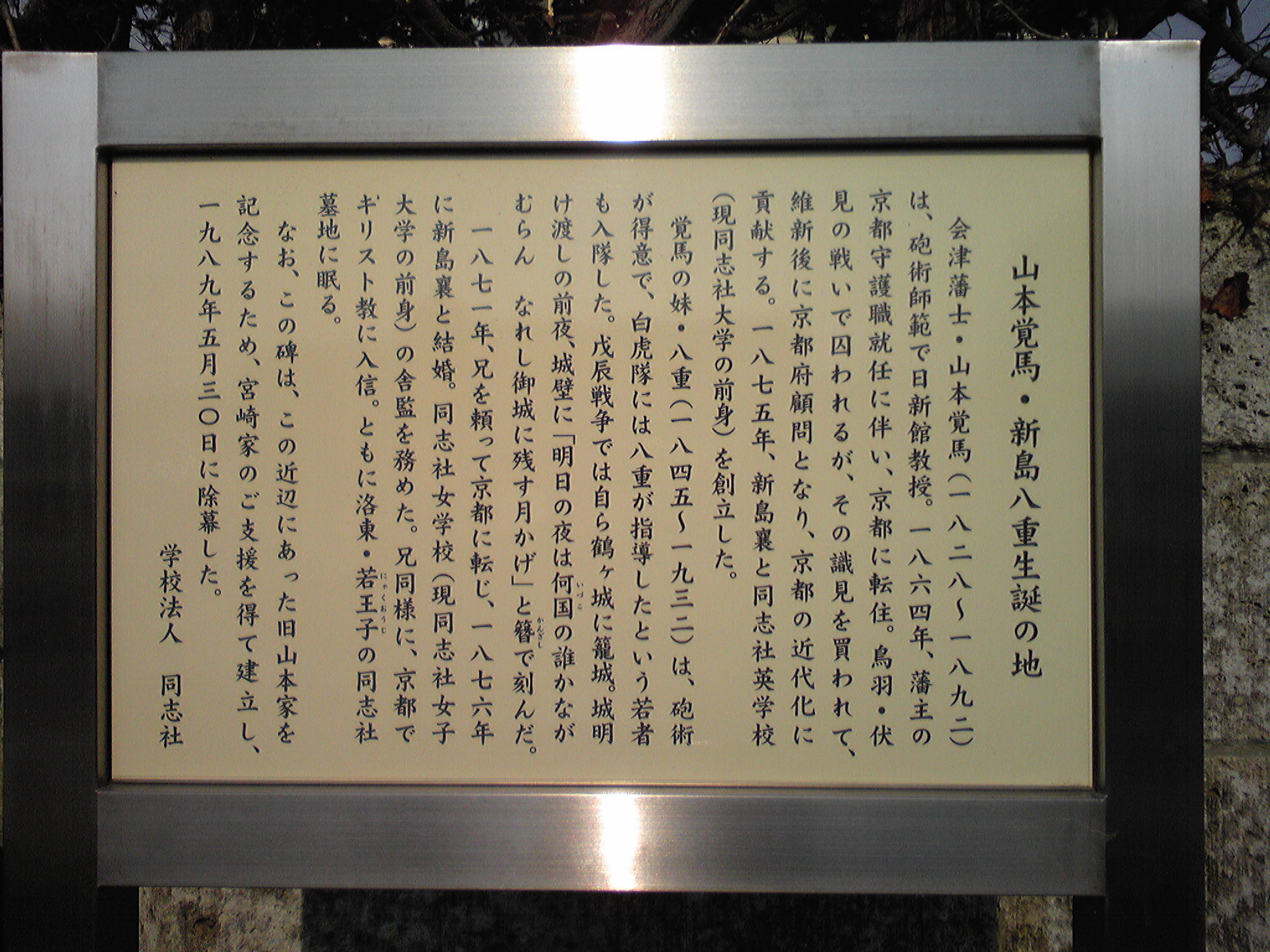
It describes Yae's early life and achievements. (Click the image to enlarge.)
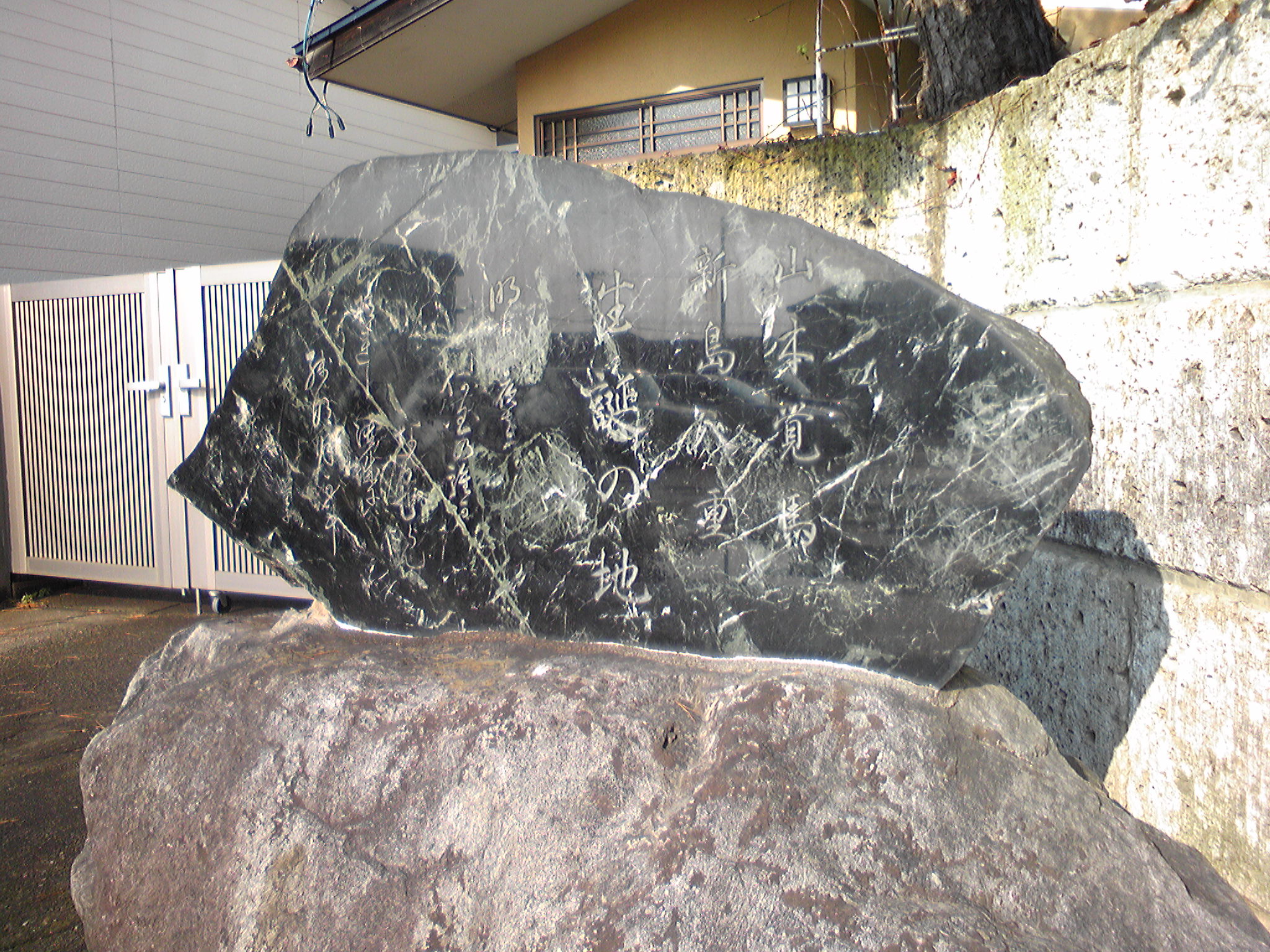
A stone monument stands at the birthplace of Kakuma Yamamoto and Yae Niijima. (Click the image to enlarge.)
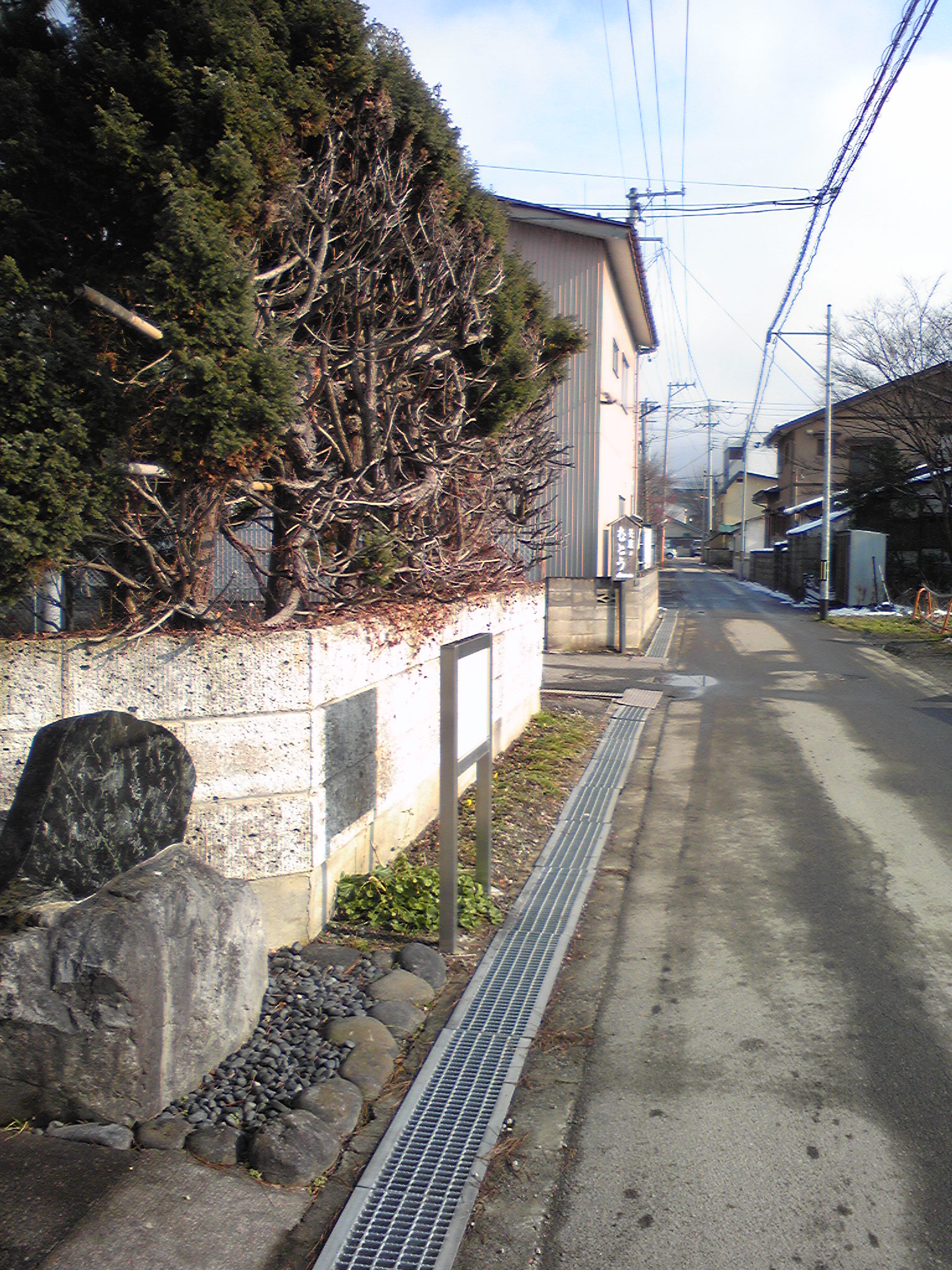
Looking toward Tsuruga Castle with the monument and information board on the left. Tsuruga Castle is just ahead along the road. (Click the image to enlarge.)
Guide Map
At the sites associated with Yae Niijima, visitors can see an information board and stone monuments.Please note
●The birthplace itself no longer stands (only the monument and information board remain). The current address has no connection with Yae Niijima, so please do not contact it.
●There is no parking lot. Please do not park on the street.
●The nearby road to the southeast is one-way.