Joko-ji Temple









View details
[PR] Advertise with us: Contact
Suggest a correction
Highlights
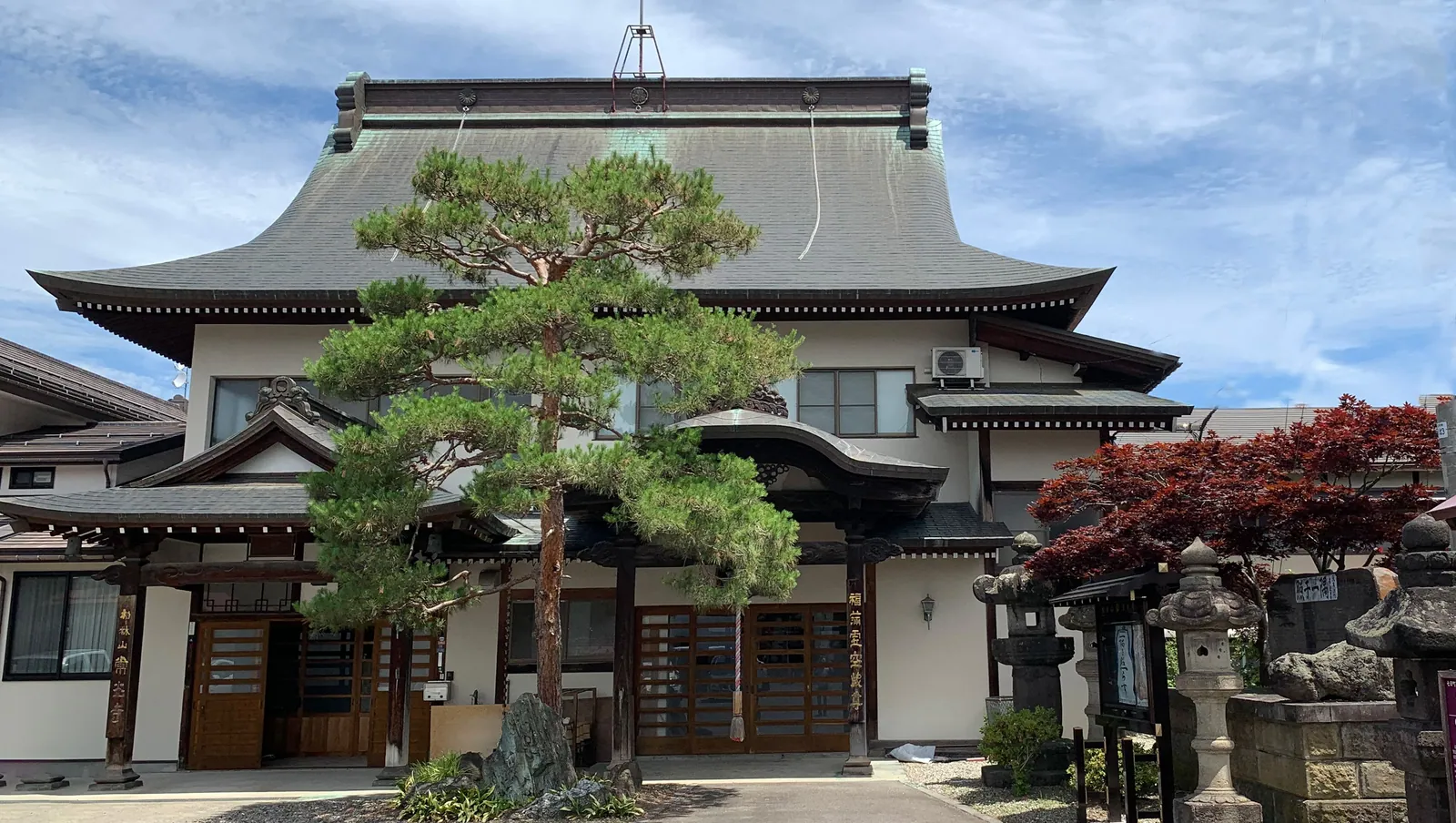
The main hall of Jōkō-ji is a large building, 8 ken (about 14.5 m) long and 10 ken (about 18 m) deep. Its principal image is Amida Nyorai, with Kokūzō on the right, and a row of memorial tablet halls behind it. The main hall has a shoin (study room) on its second floor, making it an unusual two-story main hall for a temple building.
Jōkō-ji and TenkaiJōkō-ji was founded in 706 as a temple of the Ritsu school. It later changed to the Shingon school, and then in 1623 it received a license from Great Archbishop Tenkai (a Tendai high priest active from the late Azuchi-Momoyama period to the early Edo period, born in Takada, Aizu, present-day Aizumisato Town, Fukushima Prefecture), and converted to the Tendai school.
At the time of the conversion, a monk named Zuiryūin Seishū doubted the teachings of Shingon and decided to receive Tendai teachings at Mount Hiei. Because he also received the instruction of Tenkai, who was at Nankōbō on Mount Hiei at the same time, Jōkō-ji became a branch temple of Nankōbō on Mount Hiei.
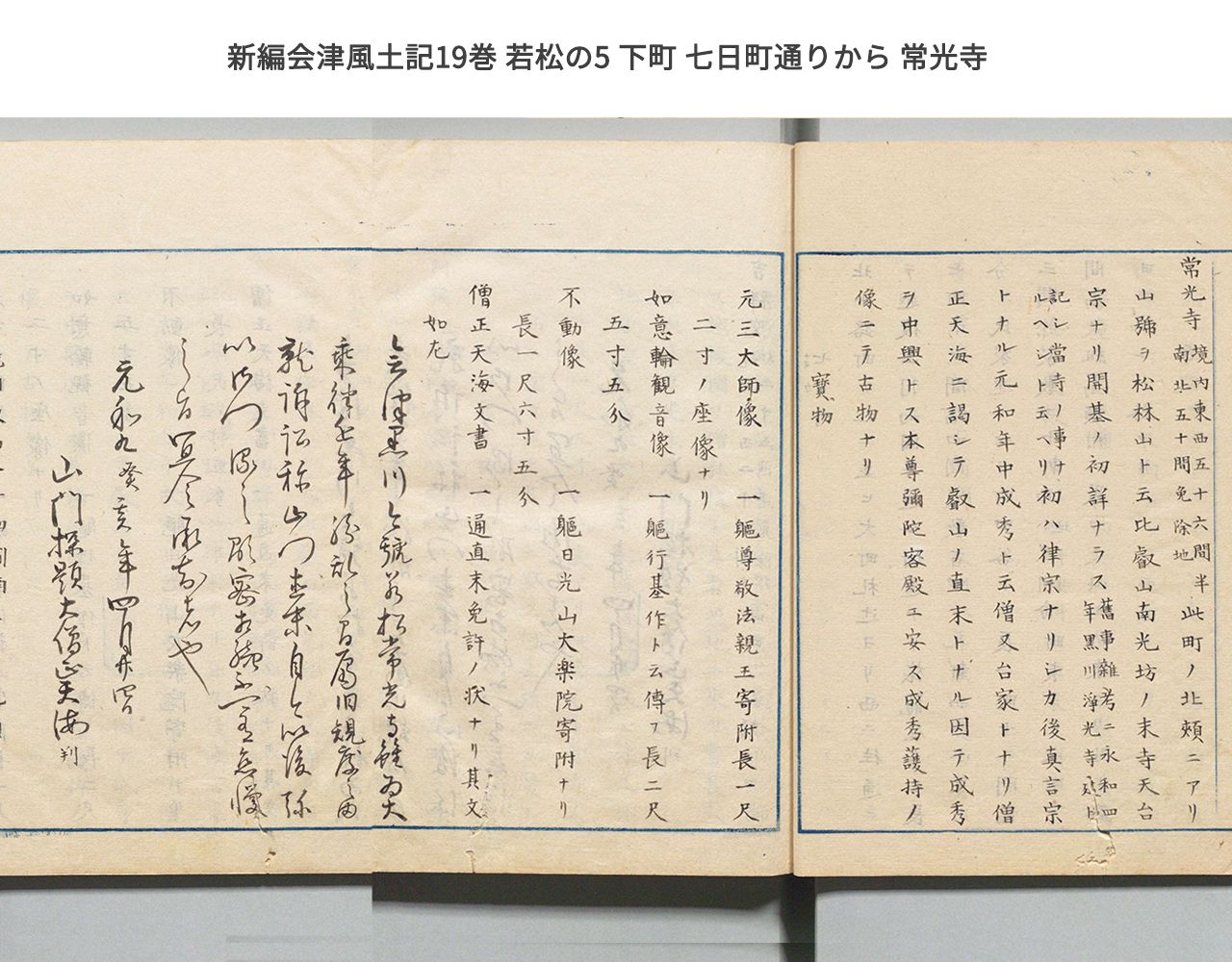
Information about Jōkō-ji is also recorded in the "Shinpen Aizu Fudoki" (New Edition of the Aizu Gazetteer), compiled between 1803 and 1809.
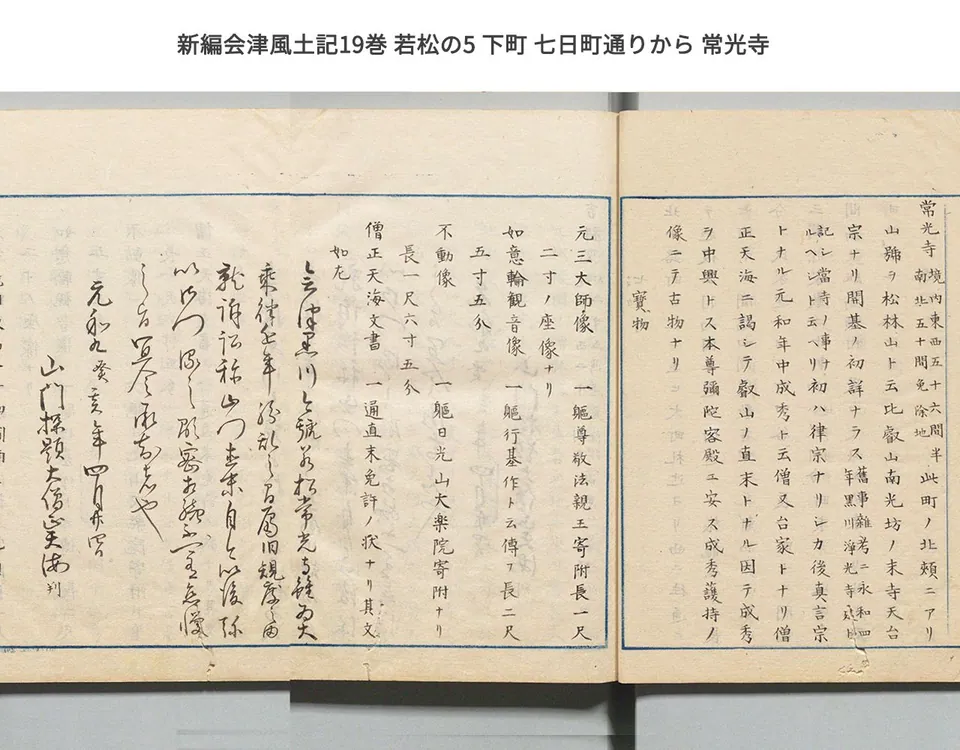 The precincts measure 56.5 ken from east to west (about 102.7 m) and 50 ken from north to south (about 91 m), and are tax-exempt land.
The temple is located on the north side of this town.
Its mountain name is Shōrin-zan, and it is a Tendai branch temple of Nankōbō on Mount Hiei.
The original founding is not clear. The "Kyūji Zakkō" records a temple built as Kurokawa Jōkō-ji in 1378, which is believed to refer to this temple. The Kyūji Zakkō refers to the Aizu Kyūji Zakkō, described later.
It was originally of the Ritsu school and later became Shingon. Around 1623, a monk named Seishū converted it to the Tendai school and became a direct branch of Mount Hiei through Great Archbishop Tenkai. Seishū is therefore regarded as the temple's restorer.
The principal image, Amida, is enshrined in the guest hall. It is an old image that Seishū had protected.
Treasures
One statue of Gantai Daishi, a seated figure about 1 shaku 2 sun (about 45.6 cm) tall, donated by Prince Sonkei ※1
One statue of Nyoirin Kannon, said to have been made by Gyōki ※2, 2 shaku 5 sun 5 bu (about 96.9 cm) long
One statue of Fudō, donated by Daigakuin of Nikkō-san ※3, 1 shaku 6 sun 5 bu (about 62.6 cm) long
One document by Great Archbishop Tenkai, a letter of license for the direct branch. Its text reads as follows.
Aizu Kurokawa, now Wakamatsu Jōkō-ji, although of the Great Vehicle Ritsu school, has recently fallen into disorder. Following the complaint, it is placed under the old regulations and made a direct branch of the Sanmon. From now on, the esoteric and exoteric practices of the Gomon lineage shall continue without neglect; let this be known.
Fourth month, 24th day, 1623
Judged by Great Archbishop Tenkai, Sanmon Tandai
※1Prince Sonkei, also known as Prince Shuchō. 1634–1680. First Prince-Abbot of the Rinnōji Miya line (Nikkō monzeki). Head of Tōei-zan (Kan'ei-ji) and Nikkō-san (Rinnō-ji), and Tendai Zasu.
※2A Japanese Buddhist monk, 668–749.
※3Daigakuin, Nikkō Tōshō-gū.
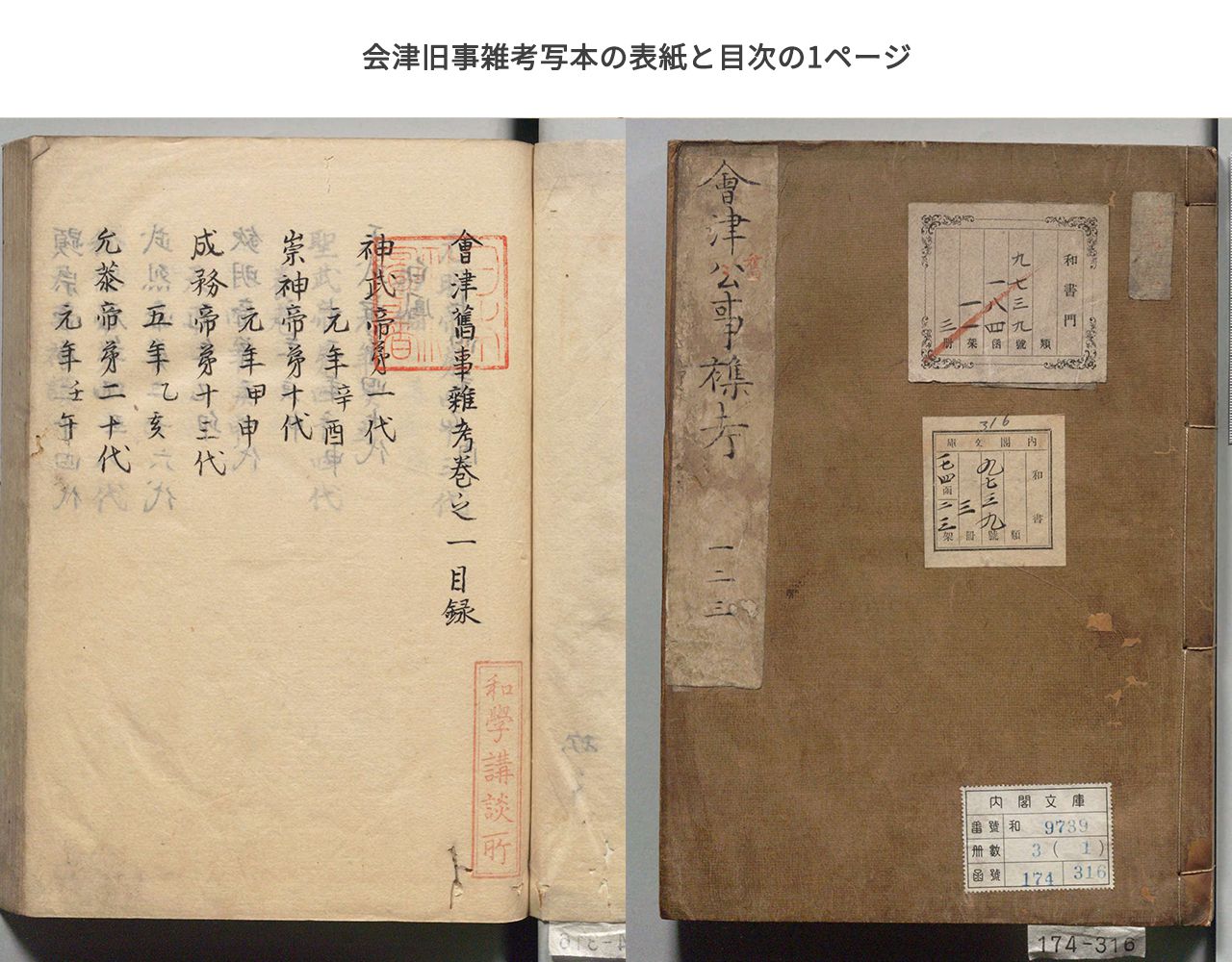
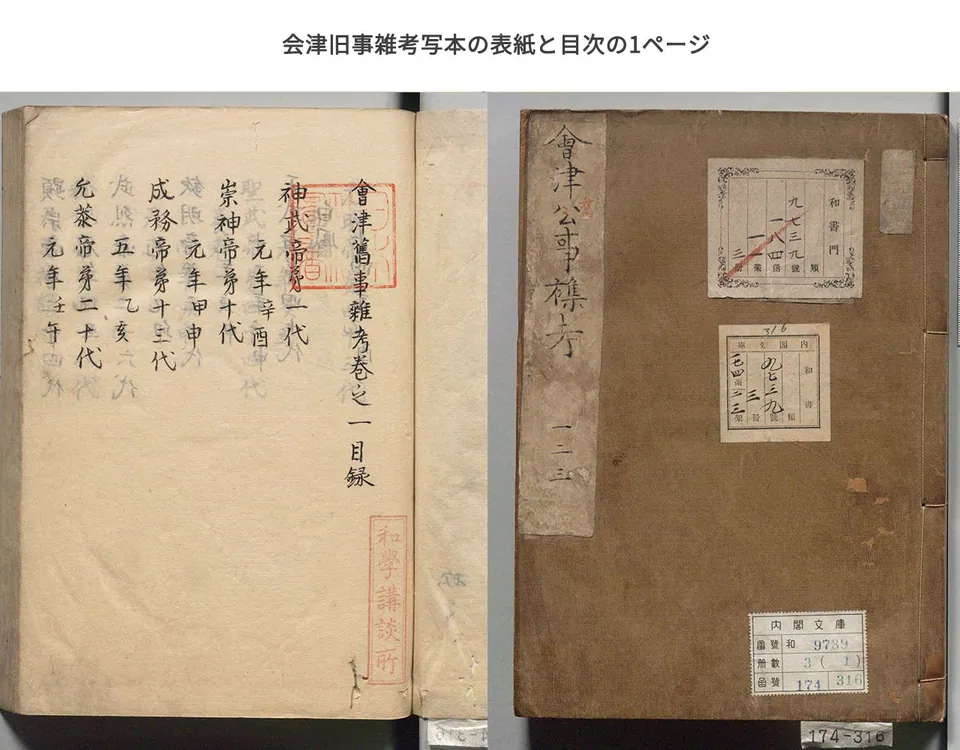 The Aizu Kyūji Zakkō is a book written by Mukai Yoshishige in 1672, recording events that occurred in Aizu. The information in the Shinpen Aizu Fudoki is based on the Aizu Kyūji Zakkō. It is available through the National Archives of Japan's digital archive.
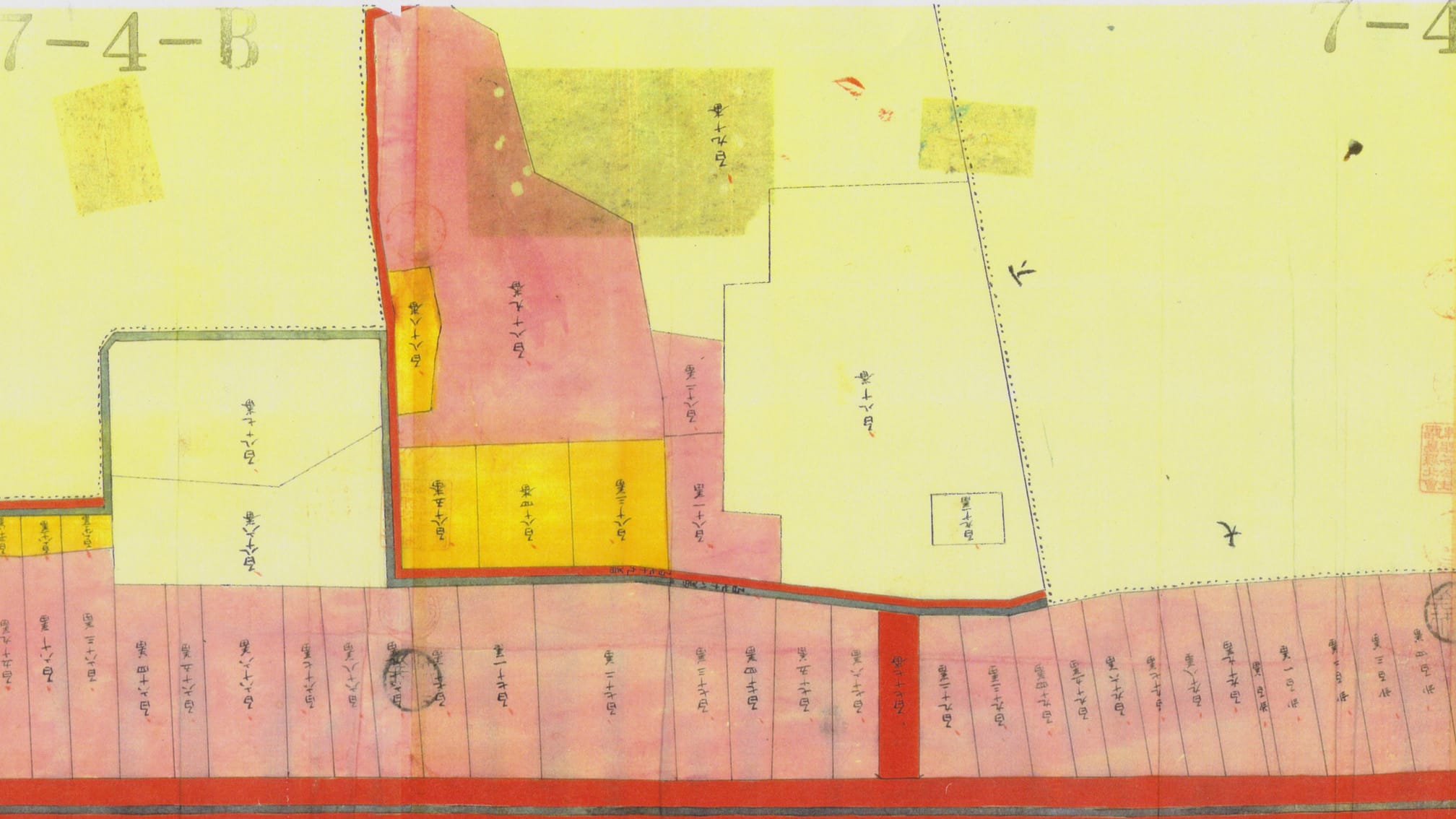
The Dignity of Jōkō-jiJōkō-ji once occupied a vast site and was called "Jōkō-ji of the Four Moats." It was surrounded on all four sides by moats, and its grounds covered one chō (about one hectare). The garden had an artificial hill, and the temple buildings (garan) are said to have been magnificent. As evidence, the land survey map of 1884 records that moats surrounded Jōkō-ji.
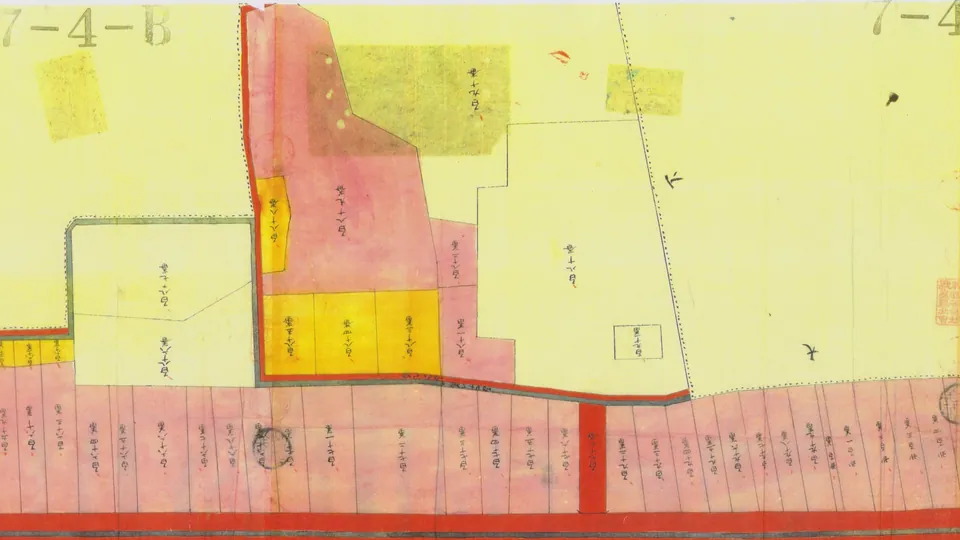 Jōkō-ji on the land registration map. Red lines show roads and gray lines show waterways. Red areas are residential land and yellow areas are cultivated land. Broken lines show the boundary with another town, whose land registration map also shows waterways.However, the grand buildings were lost to several fires.
On April 11, 1681, a fire broke out after Gon'emon, a stonecutter, had gone to work at Keiyama. It spread to 533 households in the surrounding area, and Jōkō-ji was burned in the blaze.
Later, in 1866, the main hall of Hagurosan Tōkō-ji ※4 was received and rebuilt in the butai-zukuri style (a construction style in which long pillars support the floor and the building sits on top; also called kakezukuri or gakezukuri, mainly used for temples and shrines). However, the rebuilt main hall was also lost in the great fire of May 1, 1883, which started in Wakamatsu and destroyed a total of 1,500 houses.
For this reason, the main hall that remains today was extended and rebuilt in 1979.
Jōkō-ji holds a valuable document, the "Aizu Jiin Engi" (History of Aizu Temples), which records the Buddhist history of the Aizu region. It also has a pair of folding screens by Node Shōu ※5 and the grave of Kaitō Gohei ※6, and it is a place where a long history is passed down.
※4Hagurosan Tōkō-ji. The present-day Hagurosan Shrine in Higashiyama Onsen (Terayashiki 11, Yumoto, Higashiyama-machi, Aizuwakamatsu City, Fukushima Prefecture).
Founded as Hagurosan Tōkō-ji in 729 by the eminent monk Gyōki. Later, during the anti-Buddhist movement of the Meiji period, the temple was abolished and became Hagurosan Yunoue Shrine.
※5Node Shōu, a painter born in Yonedai Sanno-chō, Wakamatsu, in 1847.
He studied Southern Song painting under Shiota Gyūsho, a samurai of the Aizu domain. When Matsudaira Katamori went to Kyoto as Kyoto Shugoshoku, Node Shōu also went to Kyoto. He later took part in the Battle of Seishidō and the castle siege during the Boshin War. After the war he worked in agriculture and for the courts, and later lived in Hongō, Setomachi, present-day Aizumisato Town, where he began teaching ceramic painting.
From around 1877 he began full-scale creative work. In 1884 he moved to Tokyo and worked under Taki Katei of the Nagasaki school. Node Shōu completed his own style before the appearance of what is called modern Japanese painting, and he is highly regarded.
※6Kaitō Gohei. Said to have been a lacquer artisan or wealthy merchant of Aizu lacquerware.
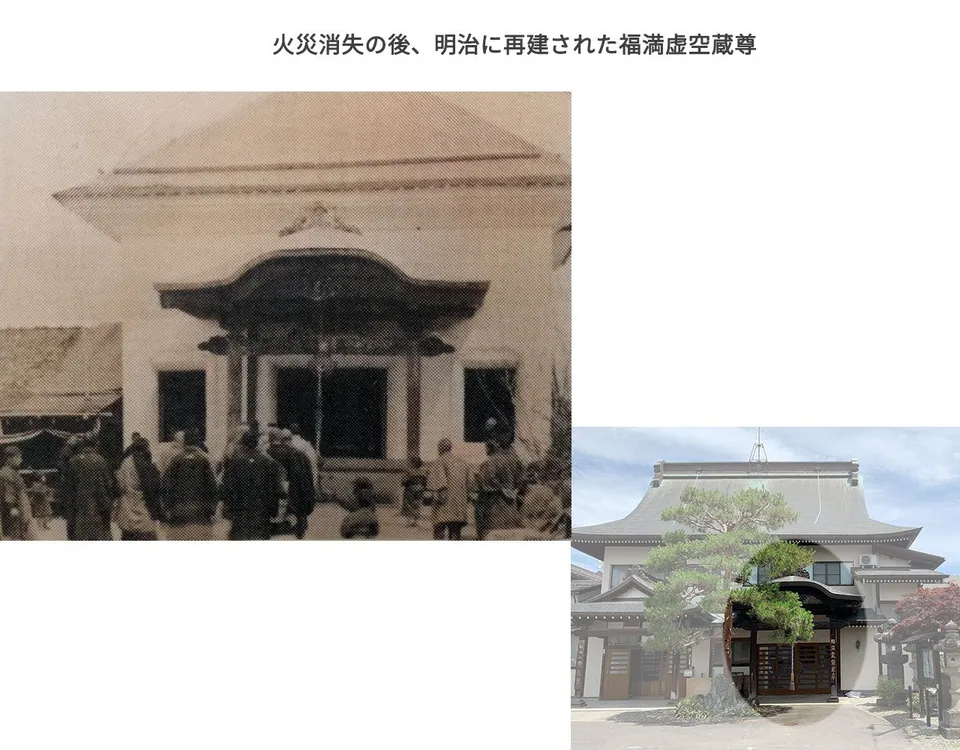 Jōkō-ji was rebuilt after each fire. The photograph shows the building rebuilt in March 1891. The present building was extended and rebuilt in 1979, but traces of the earlier roof remain above the entrance.
The Kokūzō Bosatsu of Jōkō-ji was once the guardian image of Katō Yoshiaki and was kept on his helmet. In the Matsudaira era it was enshrined as the principal image in the Gomadō of Enju-ji inside Tsuruga Castle, and successive domain lords worshipped it.
According to legend, when Matsudaira Katamori was serving as Kyoto Shugoshoku, he fell ill. Kokūzō Bosatsu appeared in his dream and gave an oracle: "Move to Jōkō-ji in Nanukamachi."
It is said that when the image was moved to Jōkō-ji on October 12, 1863, Matsudaira Katamori's illness recovered. This legend remains.
Colorized by deep learning
Lively Gatherings of Many PeopleIn December 1749, the largest peasant uprising in the history of the Aizu domain took place. Although crops had failed, the heavy annual tax was the cause. Following this uprising, the Aizu domain began to encourage various industries other than agriculture.
Along with this, kabuki, jōruri chanting, lion dances, and Aizu Manzai (a performance with humorous exchanges while dancing), which had been strictly banned in the domain under Hoshina Masayuki, were permitted again.
According to the "Higurashi Enmei Monogatari," a record of performances, in November 1787, the Edo grand sumo wrestler Onimenyama (1826–1871, 13th yokozuna) and the Onogawa group put on a performance in the precincts of Jōkō-ji, which was recorded as a great success.
In 1791, a "Gekijō Ningyōza" (puppet theater) was built on a plaza adjoining Jōkō-ji. On February 27 it was opened to the public free of charge, and from March 1 admission was charged for performances by the Takeda puppet troupe.Afterward, the celebrated actor Morita Kanya performed plays such as "Kanadehon Chūshingura," "Itozakura Teramachi Sodachi," and "Koi Nyōbō Somewake Tazuna," and the performances were a great hit.
Students of the Nisshinkan, the domain school of Aizu, also visited the puppet theater to watch.
Afterward it continued to be lively with Bon dances, sideshow stalls, sumo, and circuses. It sparked the revitalization of the castle town, and other towns also began building theaters.
In 1893, Tsukahara Motokichi (1878) built the "Wakamatsu-za" on this site.
An early Taisho-era Aizu Nippō report states that in 1914 the first motion pictures in Aizu were screened at Wakamatsu-za, and the following year it was renamed Wakamatsu-kan, a permanent movie theater.
Wakamatsu-za was also called the "Shibai-goya Wakamatsu Gekijō." As a permanent playhouse in the entertainment district of Nanukamachi, and the only permanent theater in the Aizu region, it drew many people.
According to testimony from people involved at the time, "Wakamatsu-za had a revolving stage. Besides films, it staged plays and jōruri. It closed and was demolished around 1939, after which it operated as a boarding house."
At the same time, a Bon dance yagura (tower) was also set up in the precincts of Jōkō-ji. Behind the present-day Shimizuya Aizu Kiri-geta, a yose (variety hall) called Isshin-tei was also built.
Later, in the mid-Meiji period, a pleasure quarter in Iwami-machi was established, north of Nanukamachi. Although the pleasure quarter has since disappeared, its atmosphere remains in some of the buildings.
Then in 1908, when the 65th Infantry Regiment became stationed in Wakamatsu, the area around Jōkō-ji, with its pleasure quarter and theaters, reached its peak as a bustling entertainment district.
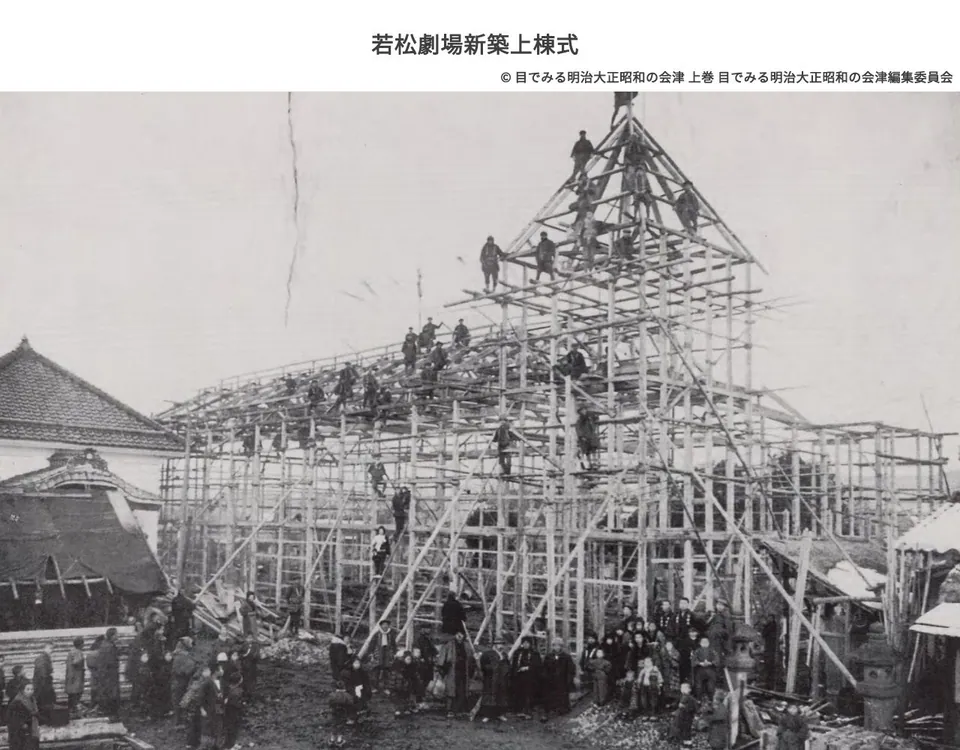 The ridge-raising ceremony of the "Shibai-goya Wakamatsu Gekijō," photographed in the early Taisho period. Its framework is distinctive, and it is easy to imagine that it was a striking building.
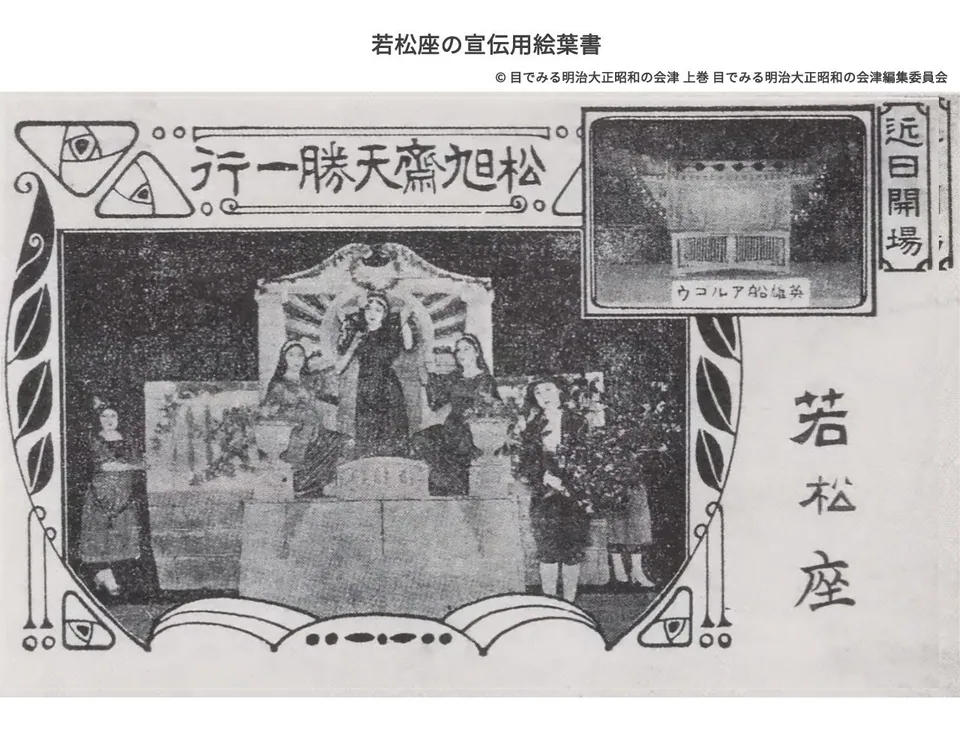 Promotional postcard of Wakamatsu-za. Motion pictures can be cited as one of the advances in entertainment in the Taisho era. In Wakamatsu, the first permanent motion picture theater (Eiraku-za) opened in 1915. Wakamatsu-za, next to Jōkō-ji, opened in the same year.
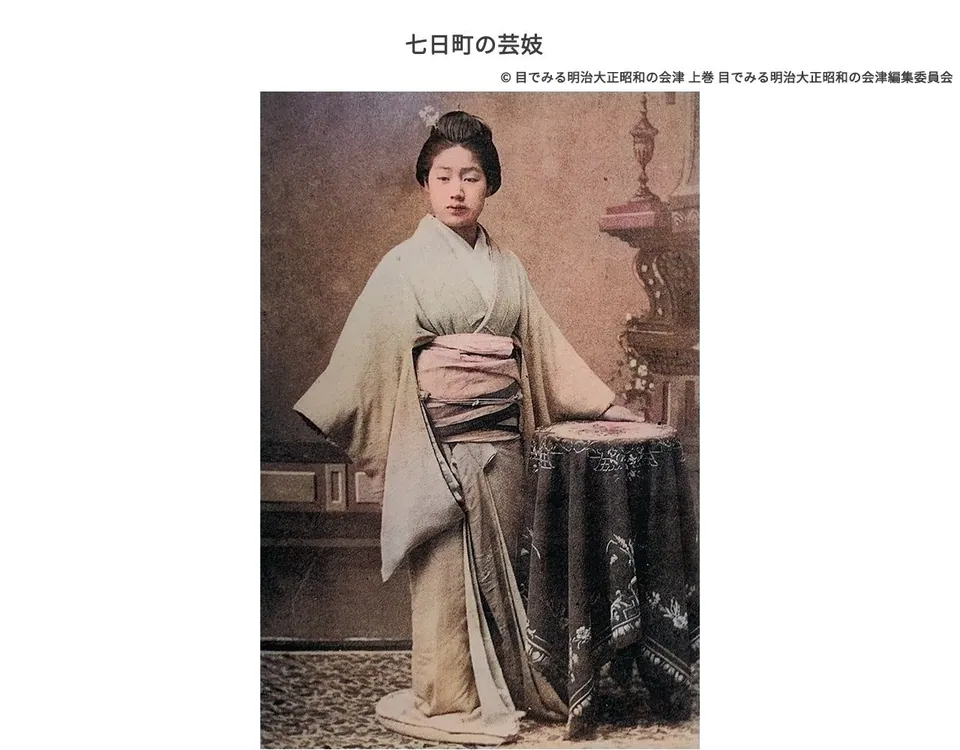 Geisha of Nanukamachi, photographed at the end of the Meiji period.
Colorized and noise-corrected by deep learning
Today, festivals of shrines and temples that were worshipped by each neighborhood, called "Ohiichi," are held and are lively.
On the same grounds is enshrined a statue of Kannon Bosatsu known as the Meguriai Kannon.
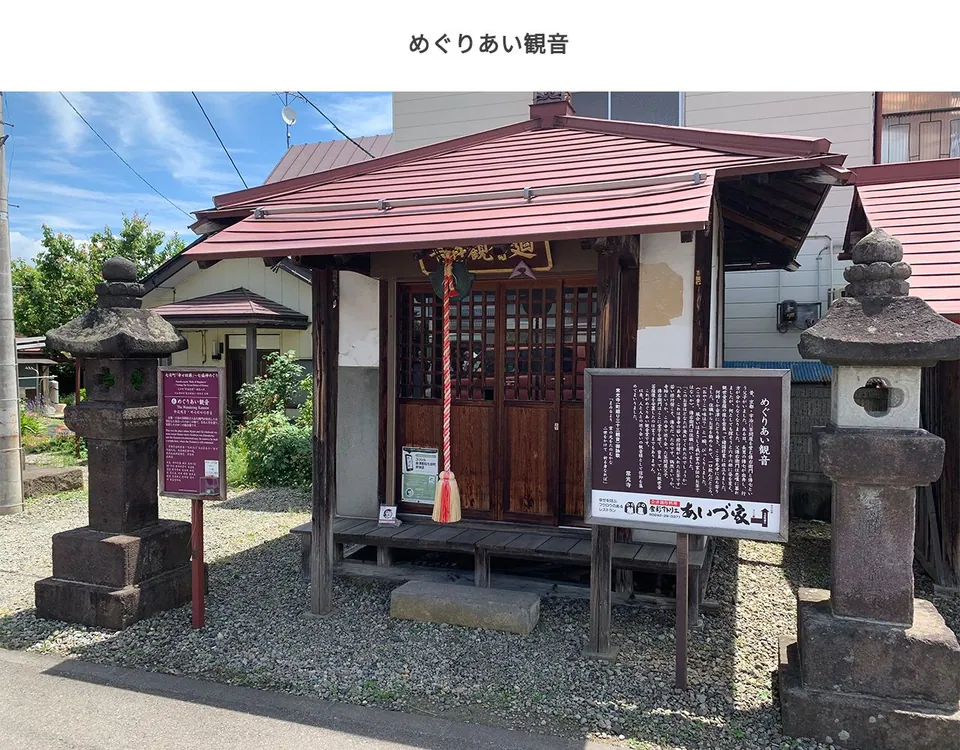 According to legend, a man named Denemon lived in Uji, Kyoto, making a living by making tea. Denemon had a son named Denshichi, who left home. In his old age, Denemon took the form of a rokubu (a wandering monk) and carried a statue of Kannon Bosatsu on his back as he searched the country.
When he came to Wakamatsu, visited Jōkō-ji, and was served tea, it tasted just like the tea he had made. The monk who had made the tea was none other than Denshichi.
Denemon enshrined the Kannon statue at Jōkō-ji, where he had reunited with his son.
"Mairu yori / tsune no hikari o tanomu kana / nise kakete / inoru mi nareba"
Modern Japanese: Rather than walking from temple to temple, let us rely on the compassion of the Buddha of Jōkō-ji, the constant light. For I am one who prays across this life and the next, across two generations.
Materials cited in this article
- Shinpen Aizu Fudoki, Vol. 19, Tanaka Harumi (1893–1901) https://www.digital.archives.go.jp/item/4287373
- Aizu Kyūji Zakkō, Mukai Yoshishige (dates unknown) https://www.digital.archives.go.jp/file/1231740
- Aizu in Pictures: Meiji, Taishō, and Shōwa, Vol. 1, edited by the Aizu in Pictures Editorial Committee (1986) info:ndljp/pid/9643896
- Origins of Town Names: A Mini History of Our Town, edited by the Former Town Names and Place-Name Origins Booklet Publication Committee (1986) info:ndljp/pid/9643741
Jōkō-ji and TenkaiJōkō-ji was founded in 706 as a temple of the Ritsu school. It later changed to the Shingon school, and then in 1623 it received a license from Great Archbishop Tenkai (a Tendai high priest active from the late Azuchi-Momoyama period to the early Edo period, born in Takada, Aizu, present-day Aizumisato Town, Fukushima Prefecture), and converted to the Tendai school.
At the time of the conversion, a monk named Zuiryūin Seishū doubted the teachings of Shingon and decided to receive Tendai teachings at Mount Hiei. Because he also received the instruction of Tenkai, who was at Nankōbō on Mount Hiei at the same time, Jōkō-ji became a branch temple of Nankōbō on Mount Hiei.
Information about Jōkō-ji is also recorded in the "Shinpen Aizu Fudoki" (New Edition of the Aizu Gazetteer), compiled between 1803 and 1809.
 The precincts measure 56.5 ken from east to west (about 102.7 m) and 50 ken from north to south (about 91 m), and are tax-exempt land.
The temple is located on the north side of this town.
Its mountain name is Shōrin-zan, and it is a Tendai branch temple of Nankōbō on Mount Hiei.
The original founding is not clear. The "Kyūji Zakkō" records a temple built as Kurokawa Jōkō-ji in 1378, which is believed to refer to this temple. The Kyūji Zakkō refers to the Aizu Kyūji Zakkō, described later.
It was originally of the Ritsu school and later became Shingon. Around 1623, a monk named Seishū converted it to the Tendai school and became a direct branch of Mount Hiei through Great Archbishop Tenkai. Seishū is therefore regarded as the temple's restorer.
The principal image, Amida, is enshrined in the guest hall. It is an old image that Seishū had protected.
Treasures
One statue of Gantai Daishi, a seated figure about 1 shaku 2 sun (about 45.6 cm) tall, donated by Prince Sonkei ※1
One statue of Nyoirin Kannon, said to have been made by Gyōki ※2, 2 shaku 5 sun 5 bu (about 96.9 cm) long
One statue of Fudō, donated by Daigakuin of Nikkō-san ※3, 1 shaku 6 sun 5 bu (about 62.6 cm) long
One document by Great Archbishop Tenkai, a letter of license for the direct branch. Its text reads as follows.
Aizu Kurokawa, now Wakamatsu Jōkō-ji, although of the Great Vehicle Ritsu school, has recently fallen into disorder. Following the complaint, it is placed under the old regulations and made a direct branch of the Sanmon. From now on, the esoteric and exoteric practices of the Gomon lineage shall continue without neglect; let this be known.
Fourth month, 24th day, 1623
Judged by Great Archbishop Tenkai, Sanmon Tandai
※1Prince Sonkei, also known as Prince Shuchō. 1634–1680. First Prince-Abbot of the Rinnōji Miya line (Nikkō monzeki). Head of Tōei-zan (Kan'ei-ji) and Nikkō-san (Rinnō-ji), and Tendai Zasu.
※2A Japanese Buddhist monk, 668–749.
※3Daigakuin, Nikkō Tōshō-gū.
 The Aizu Kyūji Zakkō is a book written by Mukai Yoshishige in 1672, recording events that occurred in Aizu. The information in the Shinpen Aizu Fudoki is based on the Aizu Kyūji Zakkō. It is available through the National Archives of Japan's digital archive.
The Dignity of Jōkō-jiJōkō-ji once occupied a vast site and was called "Jōkō-ji of the Four Moats." It was surrounded on all four sides by moats, and its grounds covered one chō (about one hectare). The garden had an artificial hill, and the temple buildings (garan) are said to have been magnificent. As evidence, the land survey map of 1884 records that moats surrounded Jōkō-ji.
 Jōkō-ji on the land registration map. Red lines show roads and gray lines show waterways. Red areas are residential land and yellow areas are cultivated land. Broken lines show the boundary with another town, whose land registration map also shows waterways.
On April 11, 1681, a fire broke out after Gon'emon, a stonecutter, had gone to work at Keiyama. It spread to 533 households in the surrounding area, and Jōkō-ji was burned in the blaze.
Later, in 1866, the main hall of Hagurosan Tōkō-ji ※4 was received and rebuilt in the butai-zukuri style (a construction style in which long pillars support the floor and the building sits on top; also called kakezukuri or gakezukuri, mainly used for temples and shrines). However, the rebuilt main hall was also lost in the great fire of May 1, 1883, which started in Wakamatsu and destroyed a total of 1,500 houses.
For this reason, the main hall that remains today was extended and rebuilt in 1979.
Jōkō-ji holds a valuable document, the "Aizu Jiin Engi" (History of Aizu Temples), which records the Buddhist history of the Aizu region. It also has a pair of folding screens by Node Shōu ※5 and the grave of Kaitō Gohei ※6, and it is a place where a long history is passed down.
※4Hagurosan Tōkō-ji. The present-day Hagurosan Shrine in Higashiyama Onsen (Terayashiki 11, Yumoto, Higashiyama-machi, Aizuwakamatsu City, Fukushima Prefecture).
Founded as Hagurosan Tōkō-ji in 729 by the eminent monk Gyōki. Later, during the anti-Buddhist movement of the Meiji period, the temple was abolished and became Hagurosan Yunoue Shrine.
※5Node Shōu, a painter born in Yonedai Sanno-chō, Wakamatsu, in 1847.
He studied Southern Song painting under Shiota Gyūsho, a samurai of the Aizu domain. When Matsudaira Katamori went to Kyoto as Kyoto Shugoshoku, Node Shōu also went to Kyoto. He later took part in the Battle of Seishidō and the castle siege during the Boshin War. After the war he worked in agriculture and for the courts, and later lived in Hongō, Setomachi, present-day Aizumisato Town, where he began teaching ceramic painting.
From around 1877 he began full-scale creative work. In 1884 he moved to Tokyo and worked under Taki Katei of the Nagasaki school. Node Shōu completed his own style before the appearance of what is called modern Japanese painting, and he is highly regarded.
※6Kaitō Gohei. Said to have been a lacquer artisan or wealthy merchant of Aizu lacquerware.
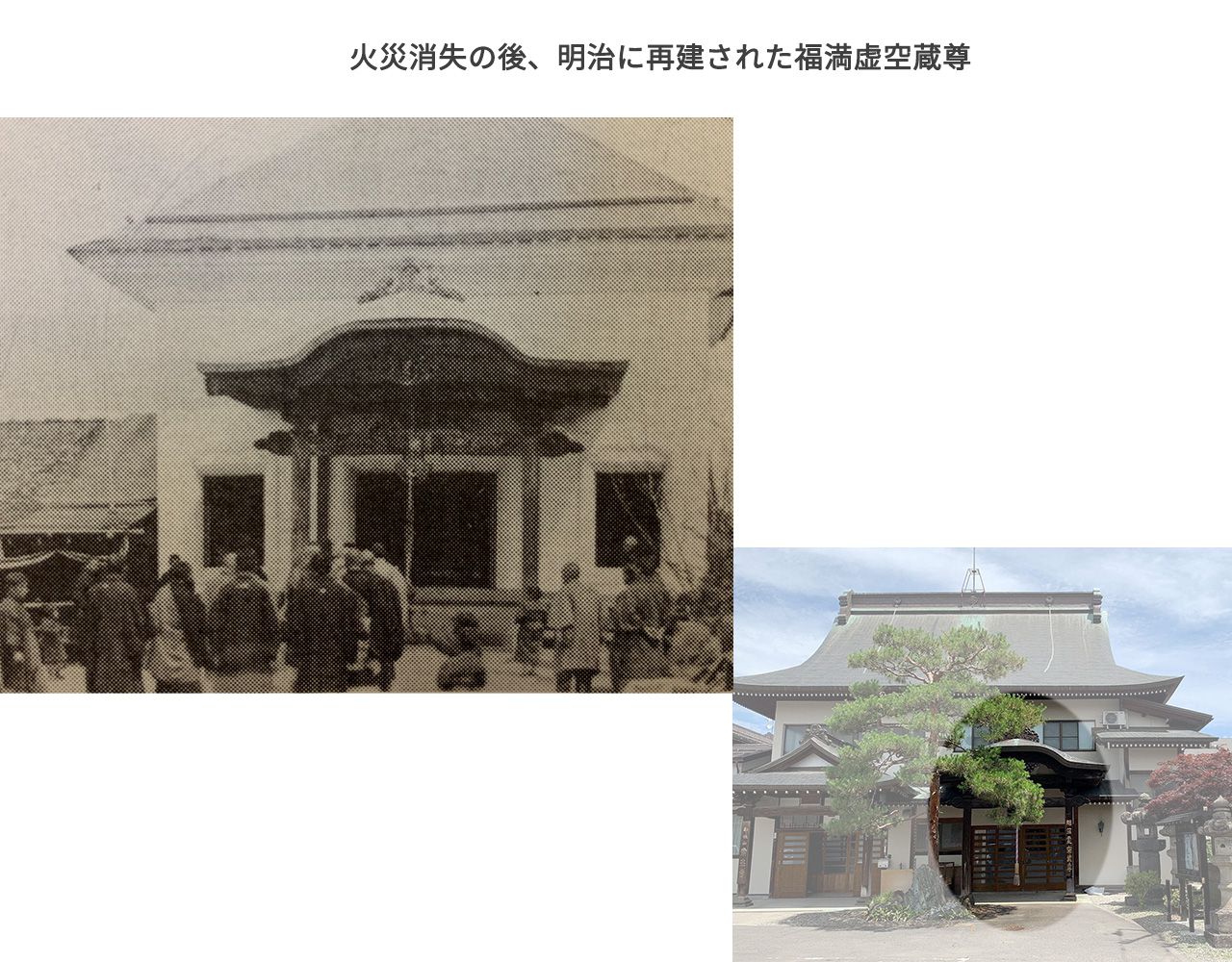 Jōkō-ji was rebuilt after each fire. The photograph shows the building rebuilt in March 1891. The present building was extended and rebuilt in 1979, but traces of the earlier roof remain above the entrance.
The Kokūzō Bosatsu of Jōkō-ji was once the guardian image of Katō Yoshiaki and was kept on his helmet. In the Matsudaira era it was enshrined as the principal image in the Gomadō of Enju-ji inside Tsuruga Castle, and successive domain lords worshipped it.
According to legend, when Matsudaira Katamori was serving as Kyoto Shugoshoku, he fell ill. Kokūzō Bosatsu appeared in his dream and gave an oracle: "Move to Jōkō-ji in Nanukamachi."
It is said that when the image was moved to Jōkō-ji on October 12, 1863, Matsudaira Katamori's illness recovered. This legend remains.
Colorized by deep learning
Lively Gatherings of Many PeopleIn December 1749, the largest peasant uprising in the history of the Aizu domain took place. Although crops had failed, the heavy annual tax was the cause. Following this uprising, the Aizu domain began to encourage various industries other than agriculture.
Along with this, kabuki, jōruri chanting, lion dances, and Aizu Manzai (a performance with humorous exchanges while dancing), which had been strictly banned in the domain under Hoshina Masayuki, were permitted again.
According to the "Higurashi Enmei Monogatari," a record of performances, in November 1787, the Edo grand sumo wrestler Onimenyama (1826–1871, 13th yokozuna) and the Onogawa group put on a performance in the precincts of Jōkō-ji, which was recorded as a great success.
In 1791, a "Gekijō Ningyōza" (puppet theater) was built on a plaza adjoining Jōkō-ji. On February 27 it was opened to the public free of charge, and from March 1 admission was charged for performances by the Takeda puppet troupe.Afterward, the celebrated actor Morita Kanya performed plays such as "Kanadehon Chūshingura," "Itozakura Teramachi Sodachi," and "Koi Nyōbō Somewake Tazuna," and the performances were a great hit.
Students of the Nisshinkan, the domain school of Aizu, also visited the puppet theater to watch.
Afterward it continued to be lively with Bon dances, sideshow stalls, sumo, and circuses. It sparked the revitalization of the castle town, and other towns also began building theaters.
In 1893, Tsukahara Motokichi (1878) built the "Wakamatsu-za" on this site.
An early Taisho-era Aizu Nippō report states that in 1914 the first motion pictures in Aizu were screened at Wakamatsu-za, and the following year it was renamed Wakamatsu-kan, a permanent movie theater.
Wakamatsu-za was also called the "Shibai-goya Wakamatsu Gekijō." As a permanent playhouse in the entertainment district of Nanukamachi, and the only permanent theater in the Aizu region, it drew many people.
According to testimony from people involved at the time, "Wakamatsu-za had a revolving stage. Besides films, it staged plays and jōruri. It closed and was demolished around 1939, after which it operated as a boarding house."
At the same time, a Bon dance yagura (tower) was also set up in the precincts of Jōkō-ji. Behind the present-day Shimizuya Aizu Kiri-geta, a yose (variety hall) called Isshin-tei was also built.
Later, in the mid-Meiji period, a pleasure quarter in Iwami-machi was established, north of Nanukamachi. Although the pleasure quarter has since disappeared, its atmosphere remains in some of the buildings.
Then in 1908, when the 65th Infantry Regiment became stationed in Wakamatsu, the area around Jōkō-ji, with its pleasure quarter and theaters, reached its peak as a bustling entertainment district.
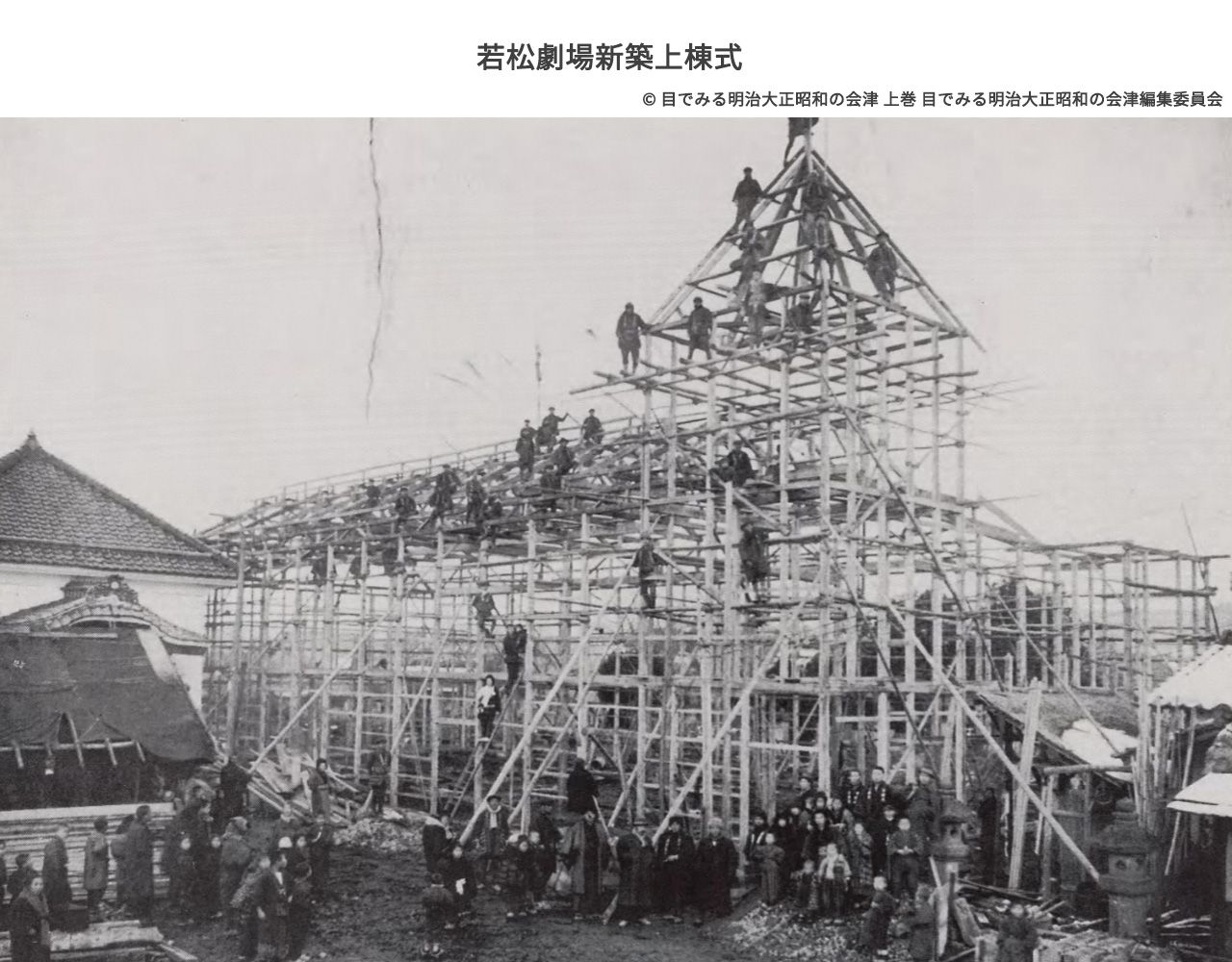 The ridge-raising ceremony of the "Shibai-goya Wakamatsu Gekijō," photographed in the early Taisho period. Its framework is distinctive, and it is easy to imagine that it was a striking building.
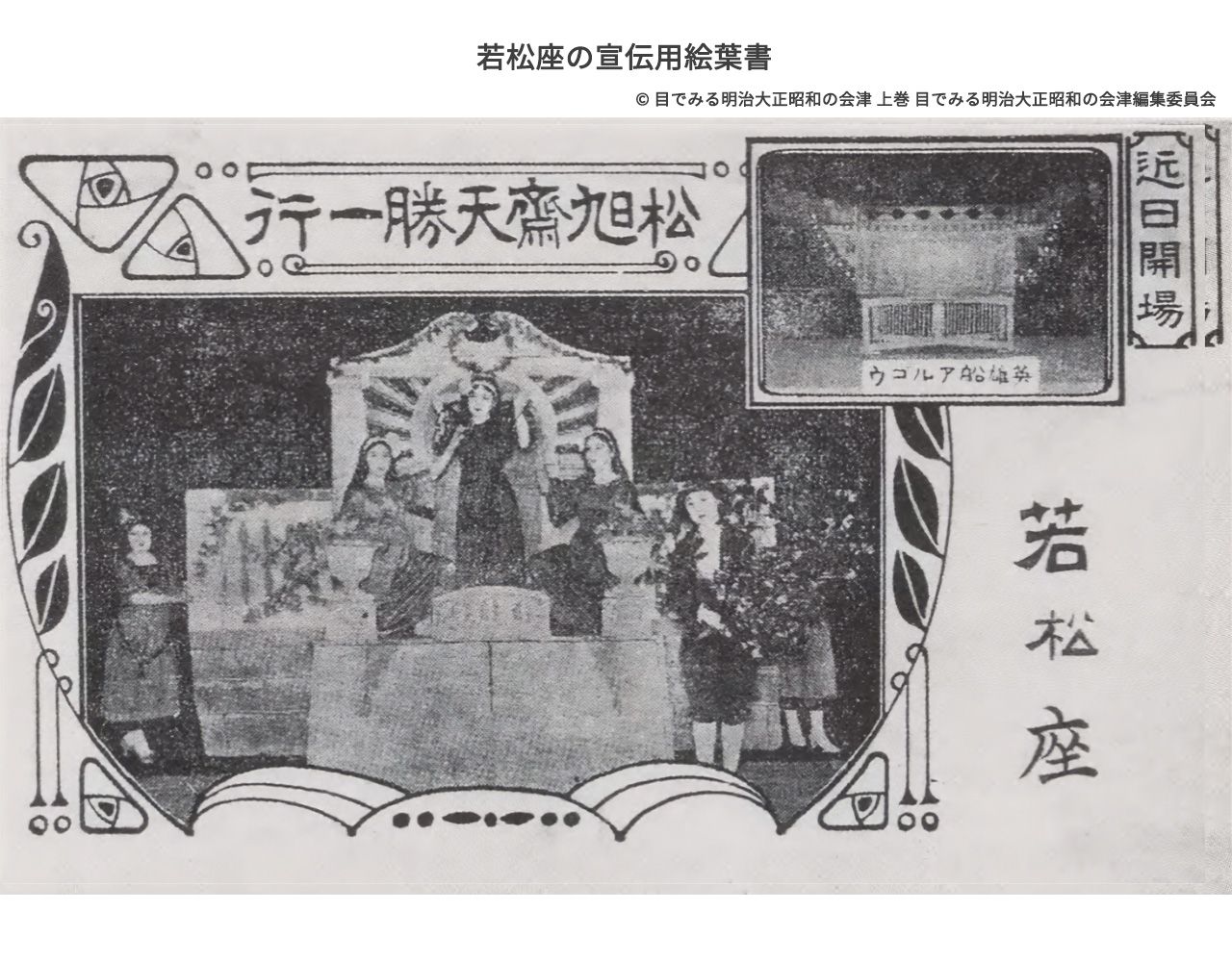 Promotional postcard of Wakamatsu-za. Motion pictures can be cited as one of the advances in entertainment in the Taisho era. In Wakamatsu, the first permanent motion picture theater (Eiraku-za) opened in 1915. Wakamatsu-za, next to Jōkō-ji, opened in the same year.
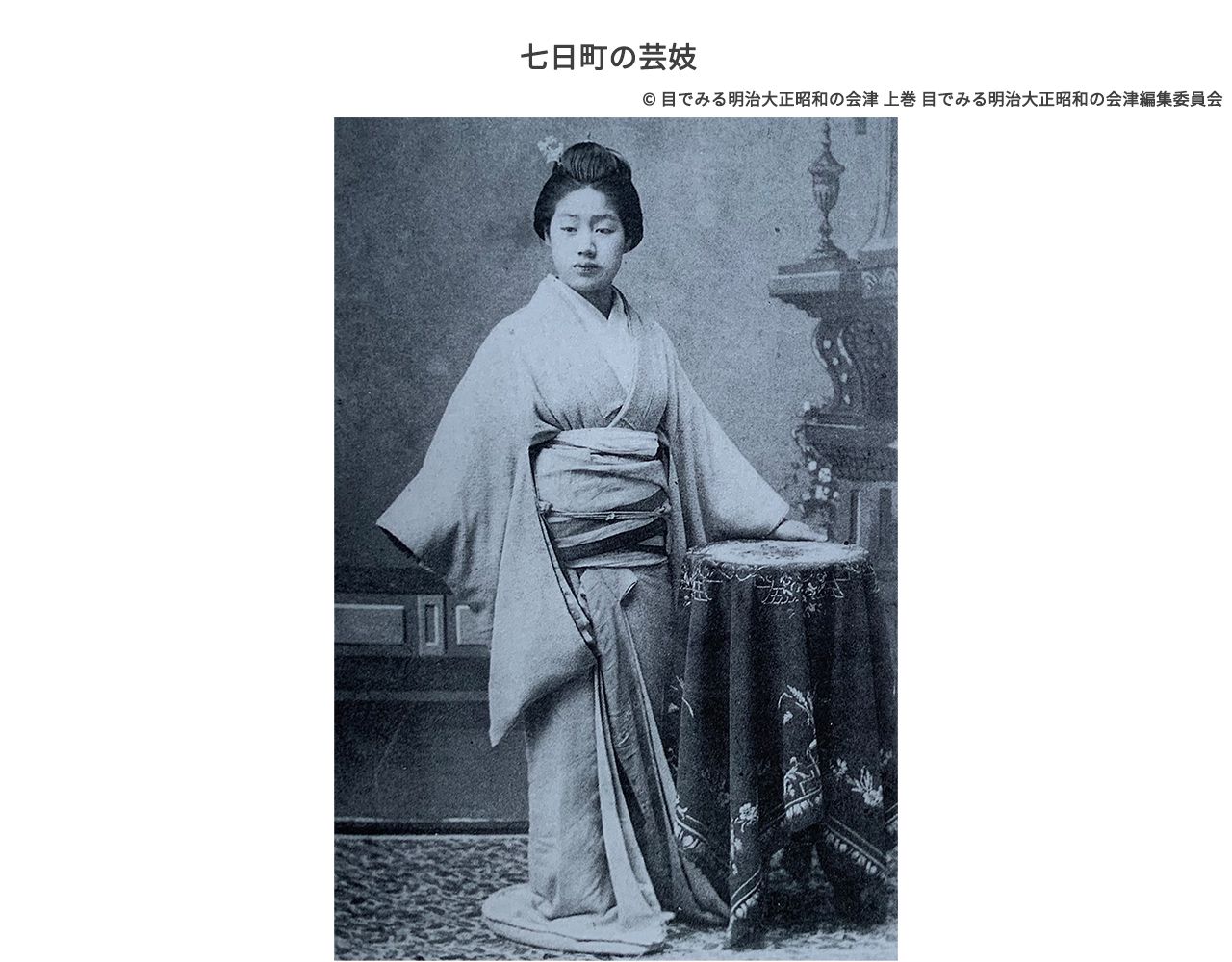 Geisha of Nanukamachi, photographed at the end of the Meiji period.
Colorized and noise-corrected by deep learning
Today, festivals of shrines and temples that were worshipped by each neighborhood, called "Ohiichi," are held and are lively.
On the same grounds is enshrined a statue of Kannon Bosatsu known as the Meguriai Kannon.
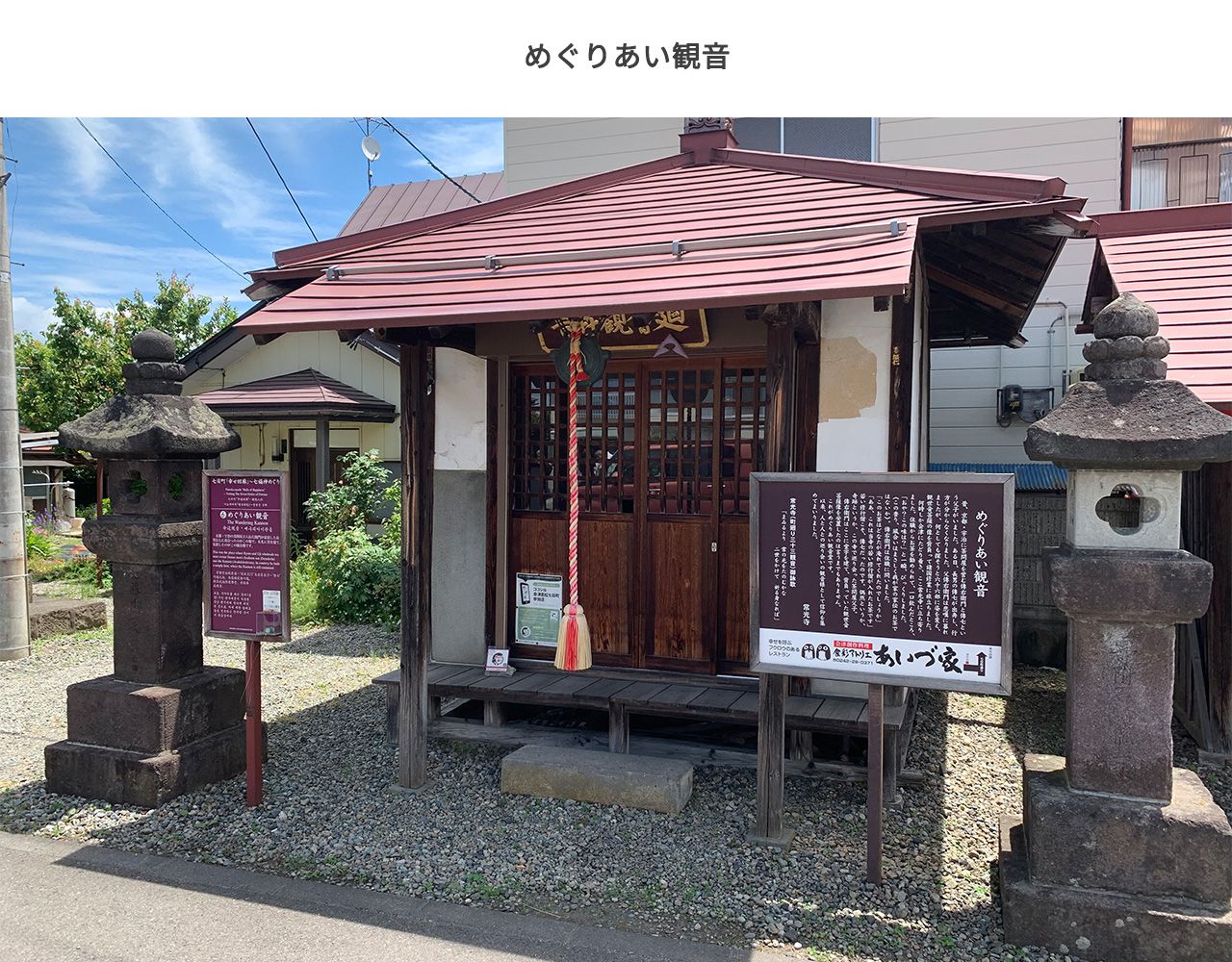 According to legend, a man named Denemon lived in Uji, Kyoto, making a living by making tea. Denemon had a son named Denshichi, who left home. In his old age, Denemon took the form of a rokubu (a wandering monk) and carried a statue of Kannon Bosatsu on his back as he searched the country.
When he came to Wakamatsu, visited Jōkō-ji, and was served tea, it tasted just like the tea he had made. The monk who had made the tea was none other than Denshichi.
Denemon enshrined the Kannon statue at Jōkō-ji, where he had reunited with his son.
"Mairu yori / tsune no hikari o tanomu kana / nise kakete / inoru mi nareba"
Modern Japanese: Rather than walking from temple to temple, let us rely on the compassion of the Buddha of Jōkō-ji, the constant light. For I am one who prays across this life and the next, across two generations.
Materials cited in this article
- Shinpen Aizu Fudoki, Vol. 19, Tanaka Harumi (1893–1901) https://www.digital.archives.go.jp/item/4287373
- Aizu Kyūji Zakkō, Mukai Yoshishige (dates unknown) https://www.digital.archives.go.jp/file/1231740
- Aizu in Pictures: Meiji, Taishō, and Shōwa, Vol. 1, edited by the Aizu in Pictures Editorial Committee (1986) info:ndljp/pid/9643896
- Origins of Town Names: A Mini History of Our Town, edited by the Former Town Names and Place-Name Origins Booklet Publication Committee (1986) info:ndljp/pid/9643741