Iwami-machi Yukaku Site (Wakamatsu Yukaku)







Highlights
People and buildings have been replaced, and the townscape has been transformed into an entirely new one.
To consolidate these quarters in one place for the sake of public morals, the Kawaramachi Yugawabata area (near today's Josai Elementary School), once known as a cherry blossom spot, was chosen. However, the mayor at the time, Akiyama Seihachi, opposed establishing a pleasure quarter within the city.
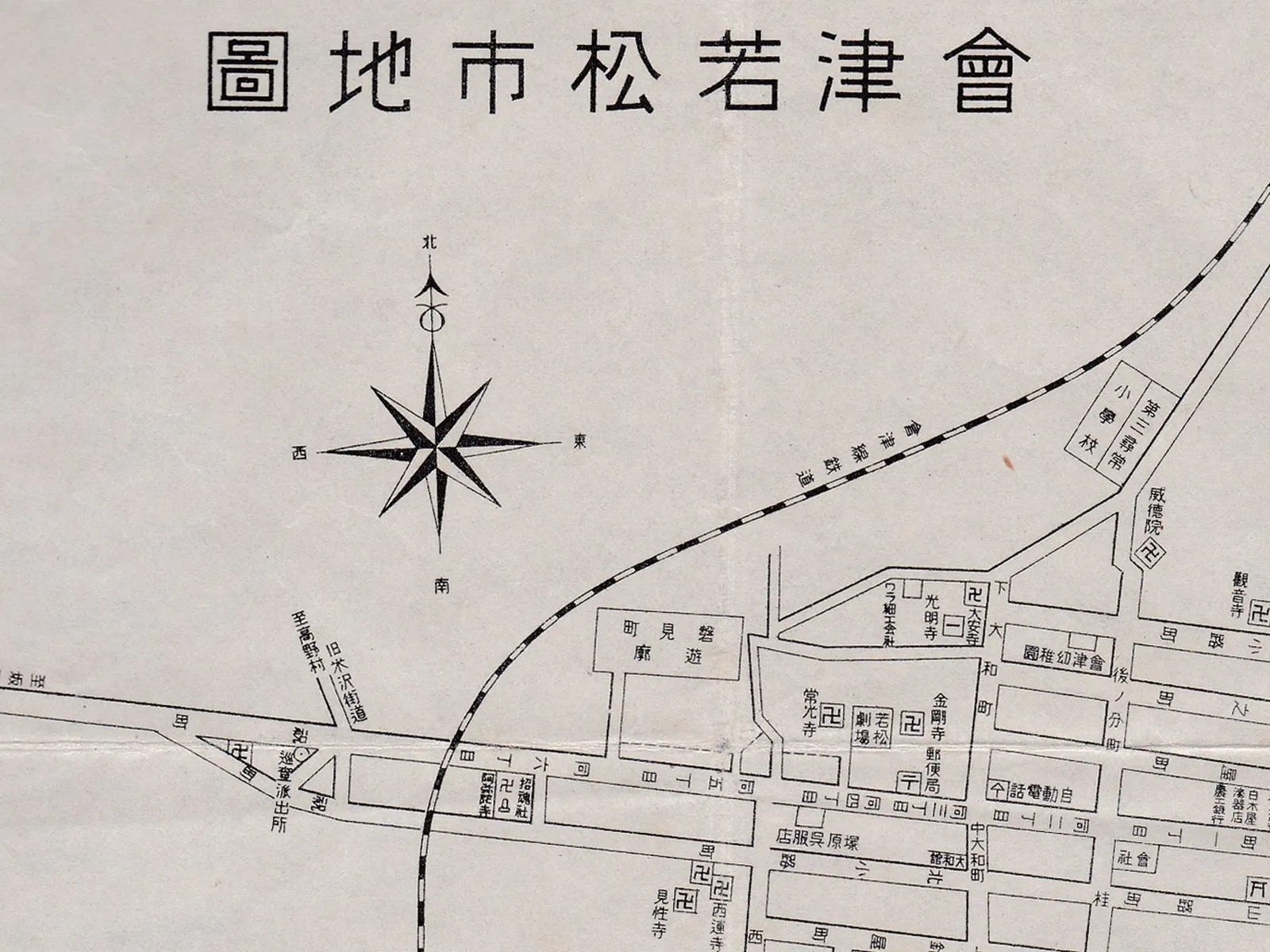
Around the same time, in February 1896, Wakamatsu City petitioned for the establishment of a Japanese army barracks to promote the city's development, and offered land for the barracks. Anticipating that troops would be stationed permanently in Wakamatsu, operators chose a site northwest of Nanukamachi-dori (Iwami-machi) in 1901, and rebuilt the scattered quarters together on that site.
The original quarter had about ten houses. Later, in 1908, when the 65th Infantry Regiment arrived in Wakamatsu from Sendai, about forty women were said to be working there.
At Iwami-machi, police patrolled the area, and there is a record that stepping out of the quarter without permission was treated as a violation of the regulations on prostitutes and resulted in a fine of 2 to 3 yen.
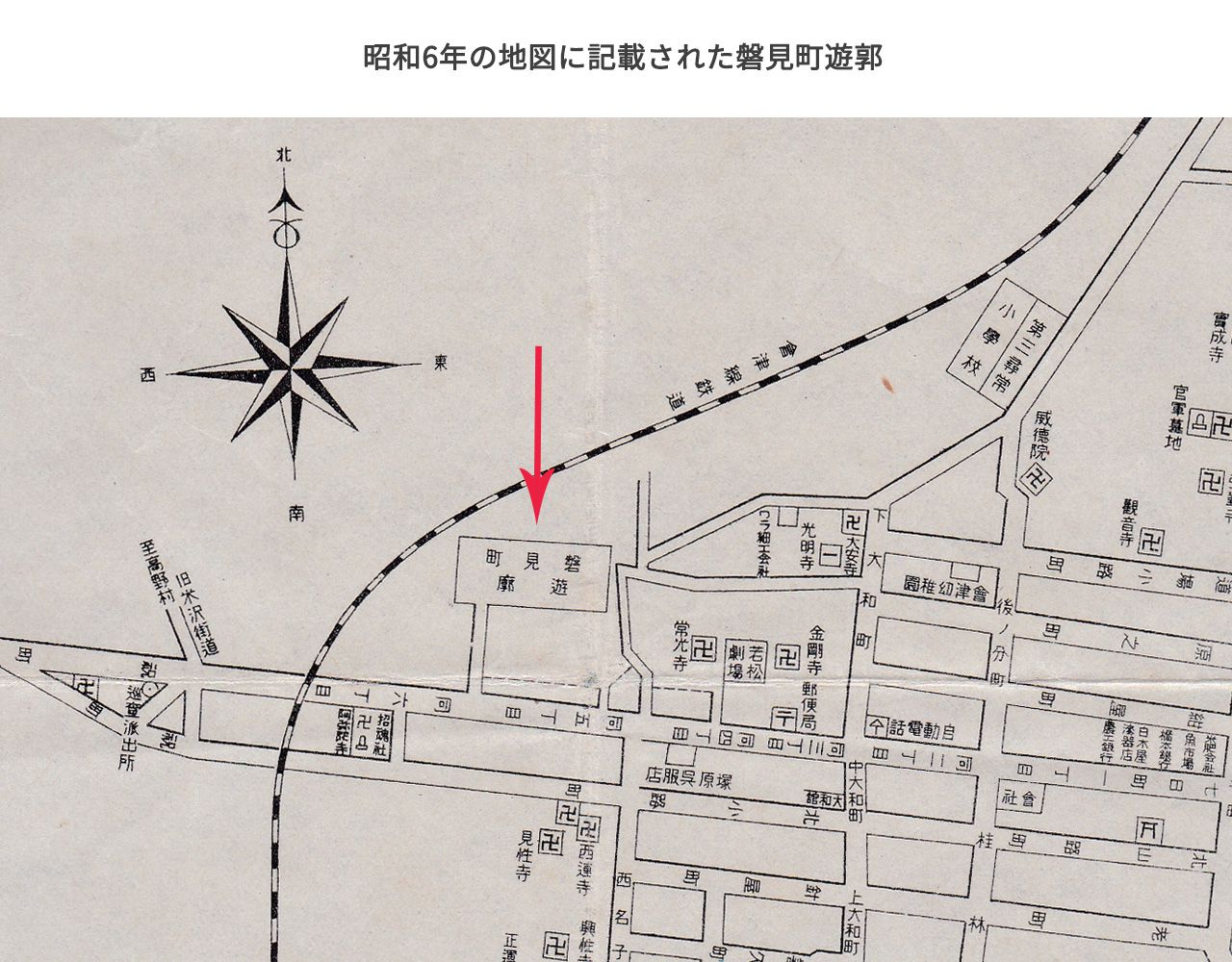 The Iwami-machi pleasure quarter as shown on a map of Aizuwakamatsu City published in 1931.
The road leading to the pleasure quarter remains today as the road that passes in front of Aizu Brand Kan.
The bend in the road on the west side of Joko-ji Temple still remains today as the road that passes in front of Okonomiyaki Sogetsu.
The present-day appearance of the former Iwami-machi can be viewed in the gallery below. Select a thumbnail to switch between the image and its description.
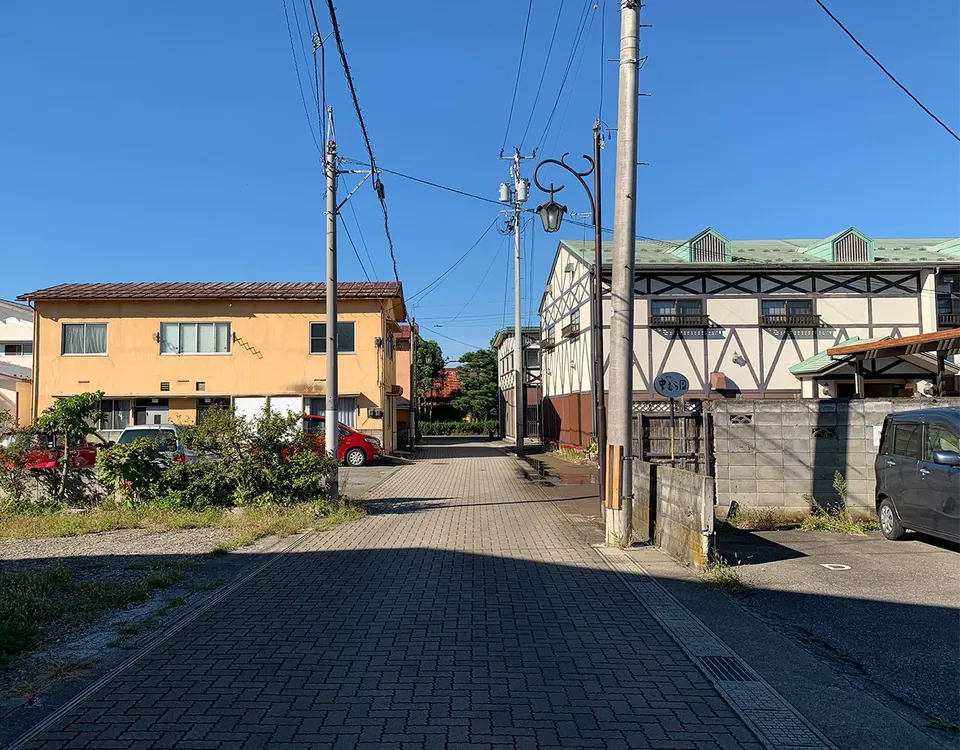 The present-day street leading into the former pleasure quarter. No trace of the old days remains.
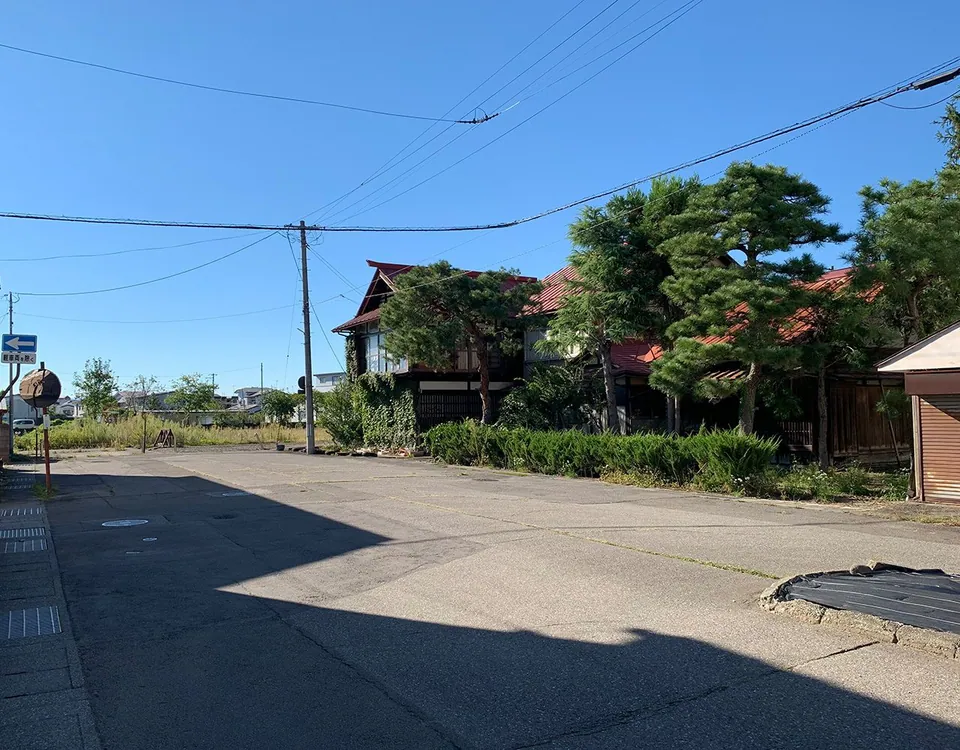 The building that was Araki Gofukuten, at the end of the street
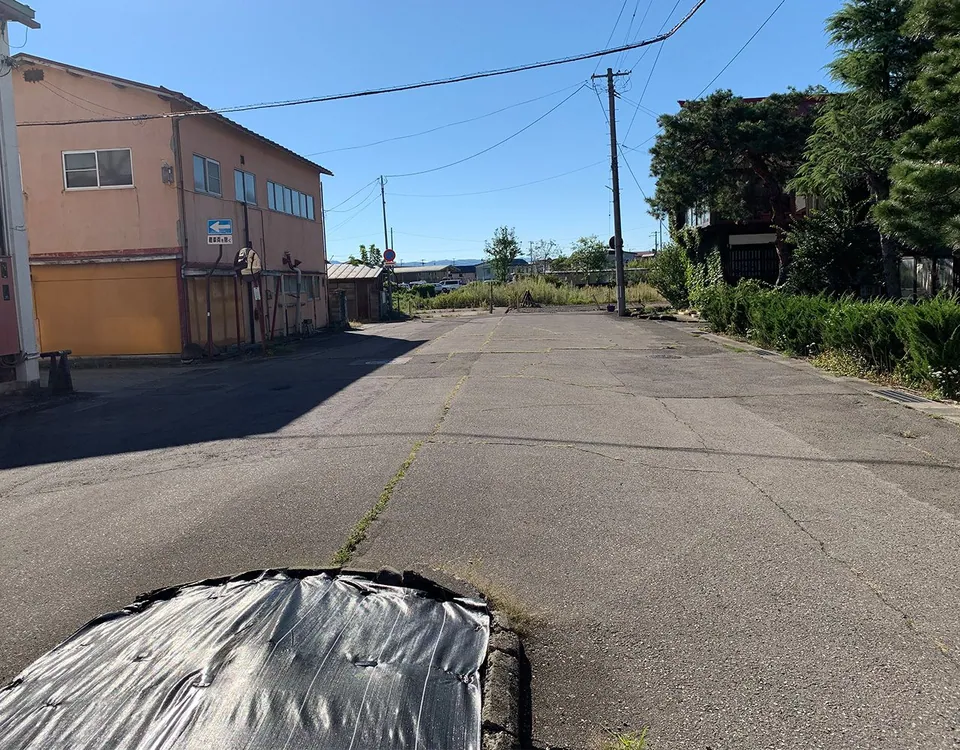 Looking right from the street that was inside the pleasure quarter, toward Araki Gofukuten
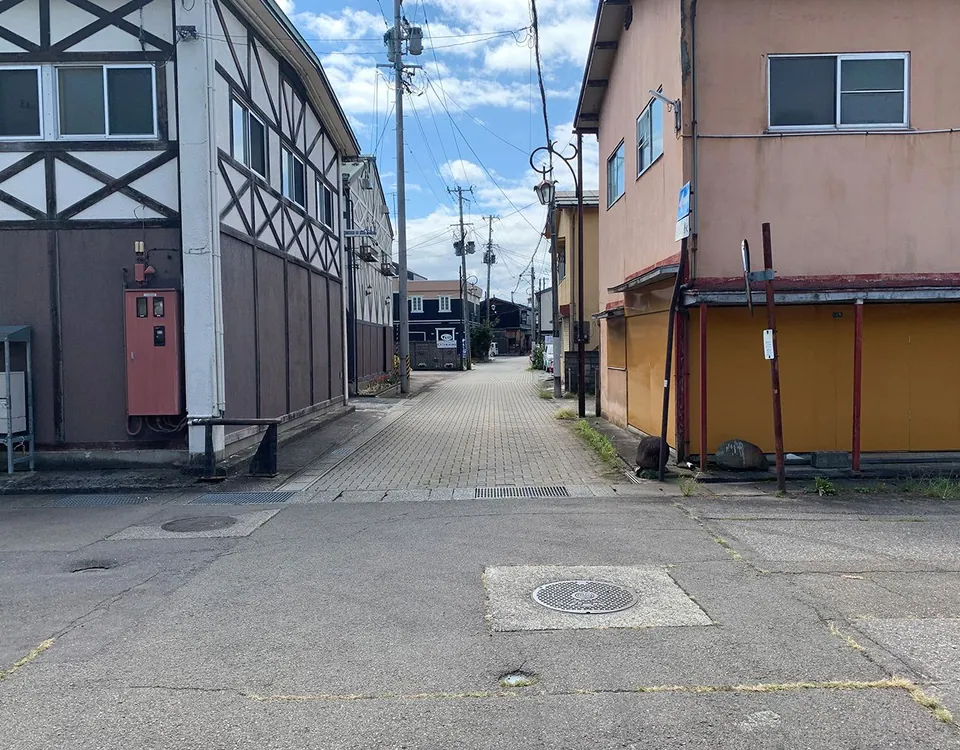 The road that once led to the pleasure quarter, with Araki Gofukuten behind
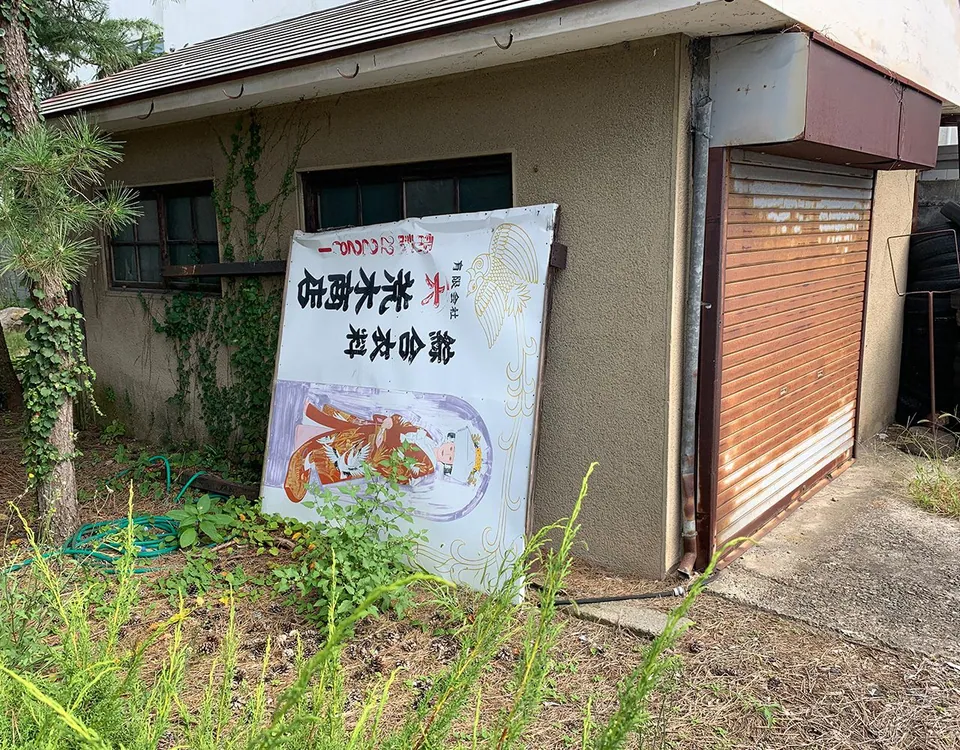 Sign of Araki Gofukuten
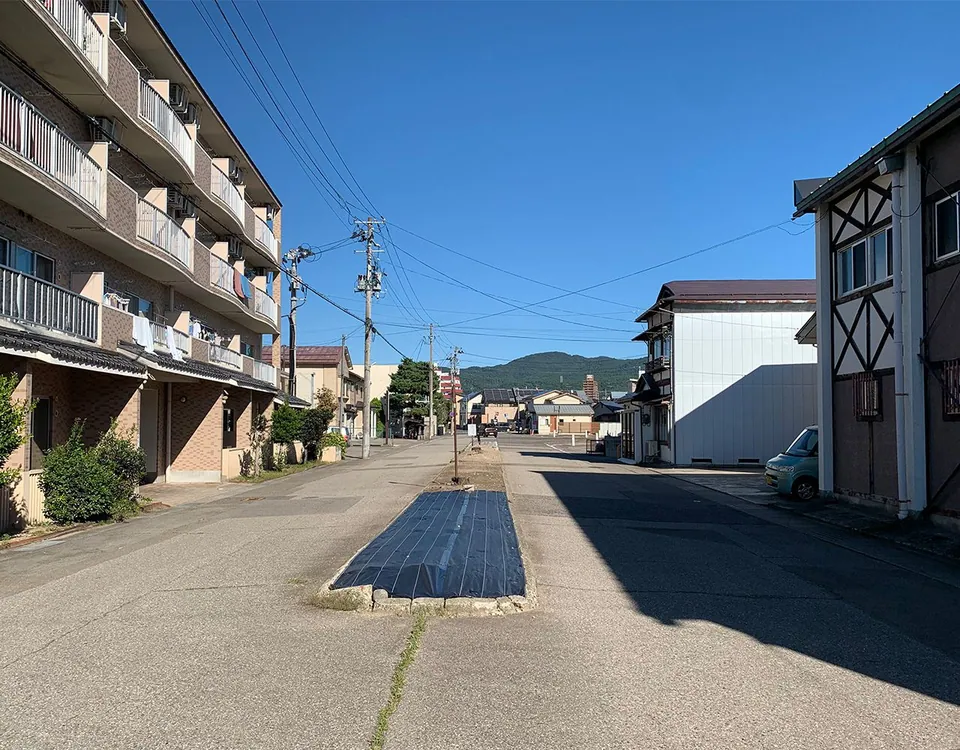 Looking at the street that was inside the pleasure quarter, with Araki Gofukuten on the left
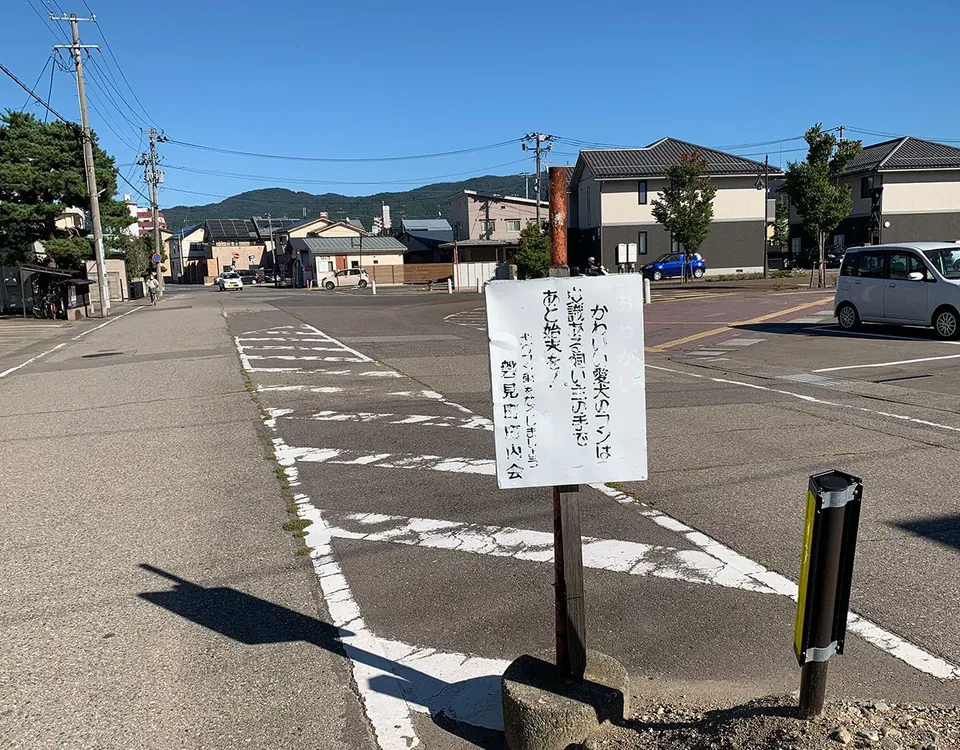 The name "Iwami-machi" remains in the neighborhood association.
The Heyday of the Iwami-machi YukakuWhile troops were stationed in Wakamatsu, Nanukamachi-dori was a center of entertainment, with theater performances held in the precincts of Joko-ji Temple, and people gathered at the pleasure quarter as well.
In fact, it is said that the Iwami-machi pleasure quarter and the army had a relationship of mutual support.
For example, when Emperor Taisho ascended the throne in 1915, the Ministry of Agriculture and Commerce (a central government office in the Meiji and Taisho periods) instructed municipalities across the country to plant commemorative trees.
Ten establishments operating in Iwami-machi (Komatsurō, Yahatarō, Yamadarō, Yoshidarō, Kikuseirō, Senrō, Tokiwa, Shin-Komatsurō, Matsushimarō, and Shōfūtei) planted pine trees in commemoration and erected a commemorative stone. Its seal inscription reads: "Sixty-Fifth Regiment Commander, Army Infantry Colonel, Junior Fifth Rank, Order of Merit Third Class, Fourth Grade Meritorious Service, Yamauchi Masao."
At its peak, the Iwami-machi pleasure quarter had a river running through it and willow trees planted. Cherry trees lined both sides of the road running east to west, and palatial-looking buildings stood along the road. During the cherry blossom season, the electric lights glowed beautifully.
There is also testimony that ordinary people visited to enjoy the cherry blossoms at night during the blossom season.
In August 1918, the so-called "rice riots" broke out across the country as the price of rice soared. Fukushima Prefecture was no exception, and riots also occurred in Wakamatsu City.
These riots extended beyond rice shops directly tied to rice, to sake breweries, miso makers, moneylenders, and zashiki (banquet-house) operators. Yamadaya, a zashiki in Iwami-machi, was also attacked.
The "Aizu Hanjōki" (Prosperity of Aizu), published in 1922, includes the Nanukamachi pleasure quarter.
Record of Reputations in the Geisha World
Wakamatsu's geisha world has developed considerably for the area, divided into the lower and upper parts of Nanukamachi and Sakaemachi.
Nanukamachi is the lower town, with about forty geisha; Sakaemachi is the upper town, with eighty geisha. Together, more than 120 geisha, all carrying on their work with great skill, make it possible to largely infer how prosperous the district is.
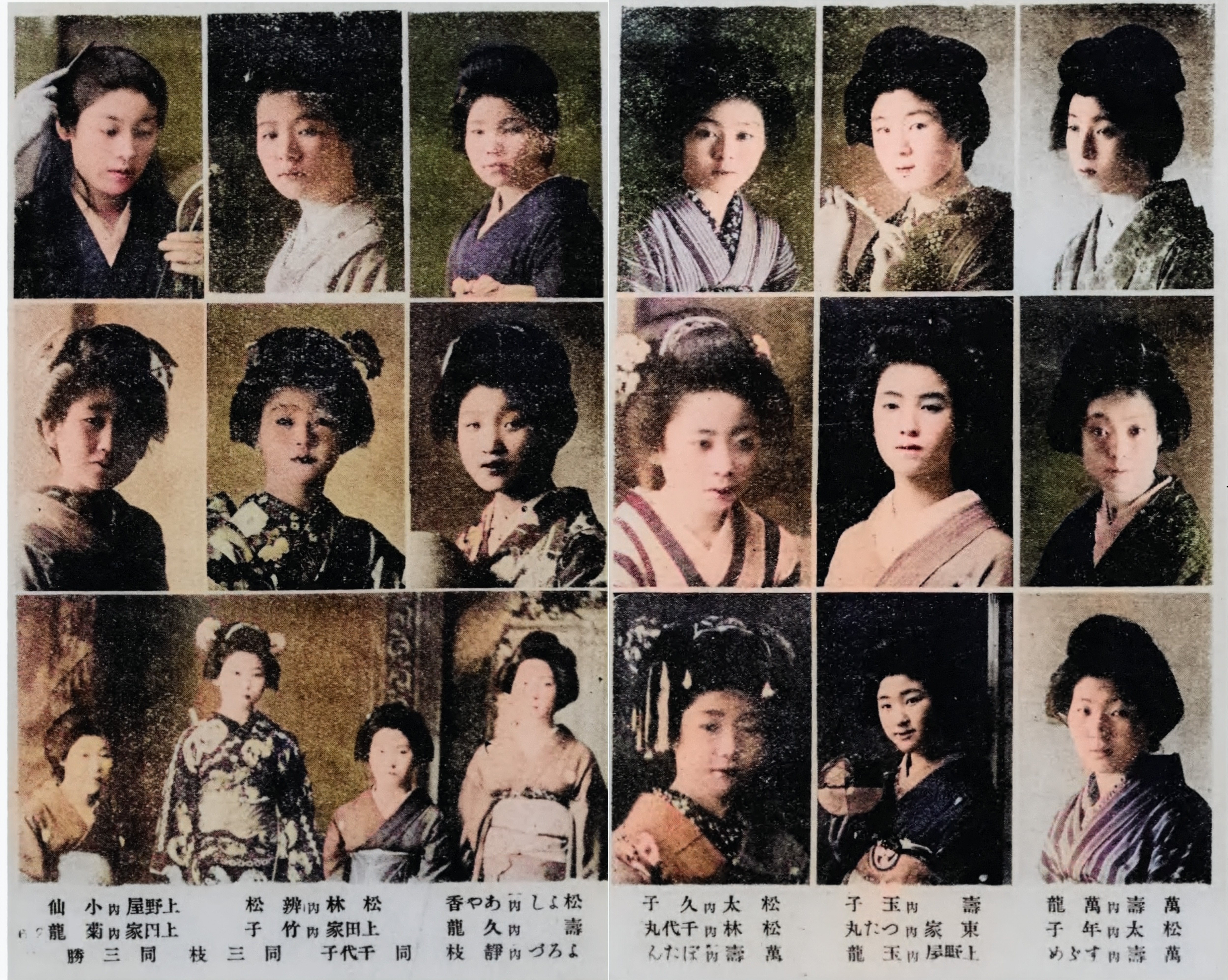 Nanukamachi Kaigo no Hana, a black-and-white photograph colored by hand (click the image to enlarge)
In the way guests enjoyed themselves there was nothing particularly different from elsewhere, but unlike the so-called "hana" gratuity customary in Fukushima, here it was left to the guest's discretion.
There were no machiai (assignation houses) at all. Neither Wakamatsu nor Higashiyama had a single one.
Higashiyama combined the two businesses, so it saw no need for machiai at all, but
Wakamatsu had none whatsoever, and since until recently entering inns had been permitted freely, which was considered undesirable for public morals,
the authorities, being rather crude, cracked down on it. Yet when pressed, the trade found ways around the restriction, and the business is said to continue to flourish.
Introduced as Kaigo no Hana (a beauty; literally, a flower that can speak), the names of Nanukamachi shops and geisha
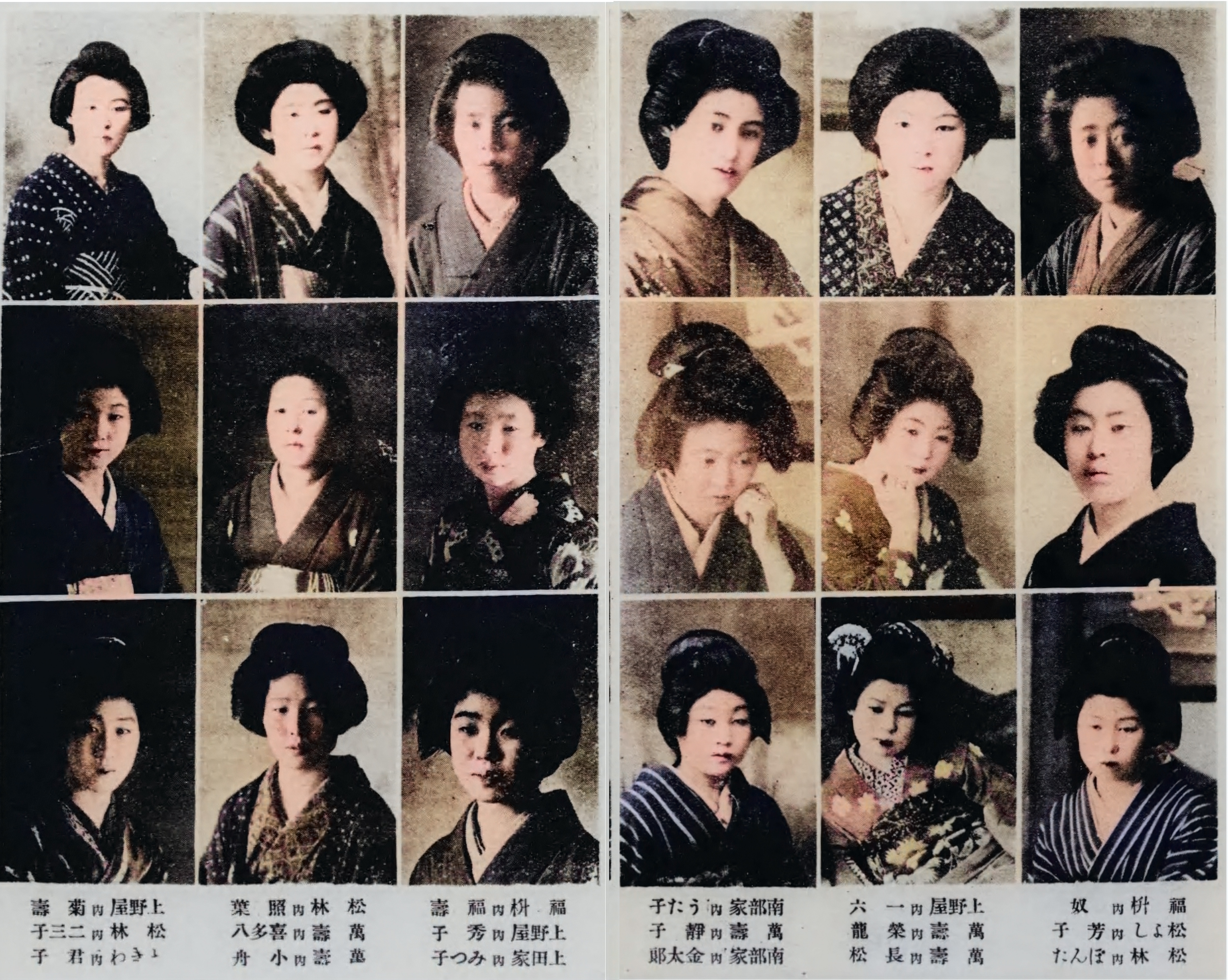 Nanukamachi Kaigo no Hana, a black-and-white photograph colored by hand (click the image to enlarge)
Ju (Tamako), Higashiya (Tsutamaru), Uenoya (Gyokuryū)
Matsuta (Hisako), Matsubayashi (Chiyomaru), Mansu (Botan)
Matsuyoshi (Ayaka), Ju (Kyūryū), Yorozu (Shizue)
Matsubayashi (Benmatsu), Uedaya (Takeko), Uedaya (Chiyoko), Uedaya (Saeko)
Uenoya (Kosen), Uedaya (Kikuryū), Uedaya (Mikatsu)
Fukumasu (Yakko), Matsuyoshi (Yoshiko), Matsubayashi (Botan)
Uenoya (Ichiroku), Mansu (Eiryū), Mansu (Chōmatsu)
Nanbuya (Utako), Mansu (Shizuko), Nanbuya (Kintarō)
Fukumasu (Fukuju), Uenoya (Hideko), Uedaya (Mitsuko)
Matsubayashi (Teruha), Mansu (Kitahachi), Mansu (Kofune)
Uenoya (Kikuju), Matsubayashi (Fumiko), Tokiwa (Kimiko)
[Aizu Hanjōki]The "Zenkoku Yūkaku Annai" (Guide to Pleasure Quarters Nationwide), published in 1930, lists the Iwami-machi pleasure quarter as one of the pleasure quarters in Fukushima Prefecture.
The Wakamatsu pleasure quarter is located in Iwami-machi, Wakamatsu City, Fukushima Prefecture. Get off at Wakamatsu Station on the Ban'etsu West Line, and it is about ten chō (roughly 1 km) to the southwest. A taxi costs 50 sen per trip.
Before the Restoration, it was the castle town of the Hoshina clan. In the Boshin War, the domain faced all the enemies of the realm alone within the isolated castle of Tsuruga, and all its people met tragic ends. Though the battle was lost, the spirit of the Aizu samurai who fought to the very end is admirable. The heroic last stand of the Byakkotai (White Tiger Corps) at Iimoriyama must be the one flower that adorns the history of the Meiji Restoration. The town produces Aizu lacquerware, Aizu pottery, candles, ginseng, textiles, and more.
The system changed from scattered prostitution to concentrated prostitution around 1897. There are now ten licensed houses, with about fifty prostitutes. All work in residence; no one is sent out.
Entertainment followed a rotation system, and no fixed companion was assigned. Fees ranged from 1 yen 90 sen to 4 yen 50 sen, with a set of dishes included, and one could stay from evening through the night. Nearby were the ruins of Tsuruga Castle, Iimoriyama, Higashiyama Onsen, and more. (The 4 yen 50 sen and 3 yen 50 sen fees include sake and dishes; the 90 sen fee includes tea and sweets.) The brothels include Yamadarō, Matsukazeirō, Kikuseirō, Kadoyahata, Tokiwarō, Shin-Komatsurō, Yoshidarō, Senrō, and Kowarō.
[Zenkoku Yūkaku Annai]
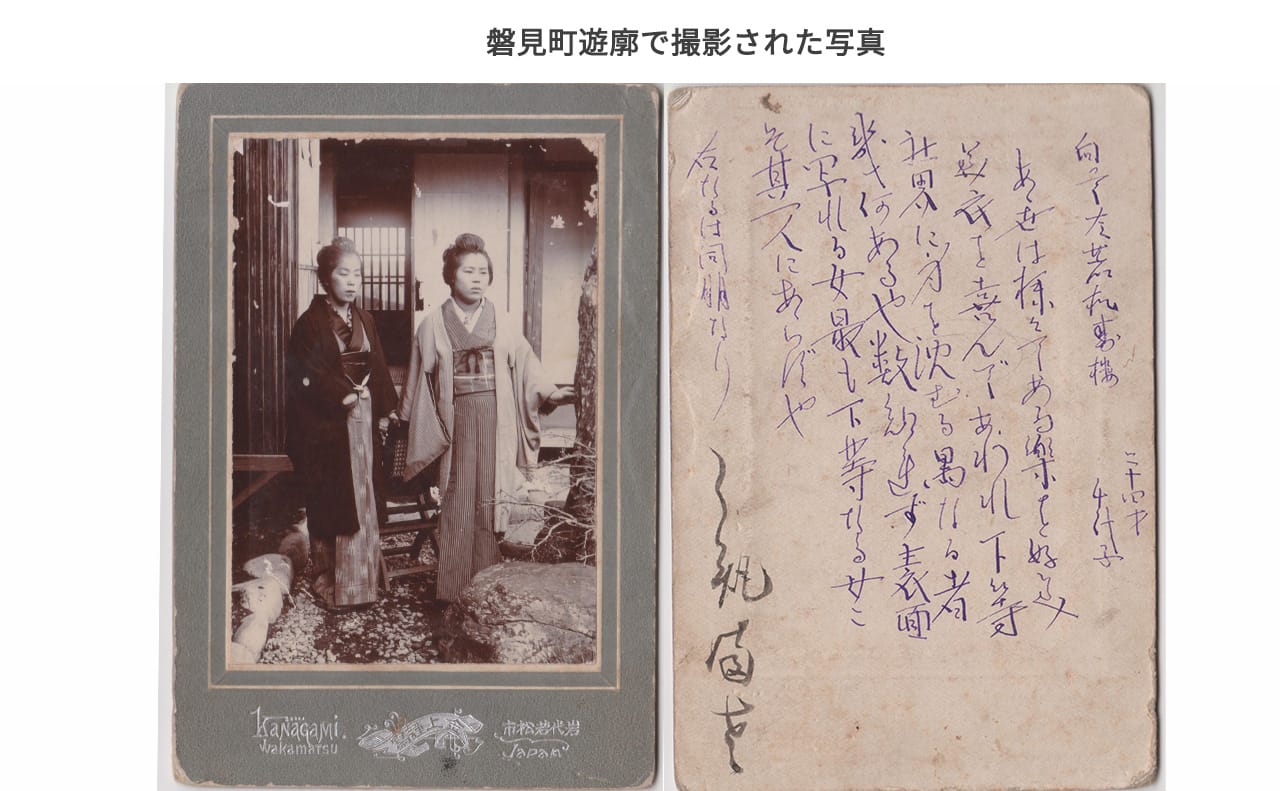 The date the photograph was taken is unknown. An inscription on the back of the photo gives no further details.
Left: Chiyoko, 24, of Wakamatsu Juro
Ah, the world holds all kinds of people, who love pleasure and delight in fine clothes, and the foolish who sink into a vulgar society are countless.
Among the women seen on the surface, is not the most vulgar one among them?
On the right is a fellow companion. Shigemasa
(Modern Japanese translation)
Left: Chiyoko, 24, of Wakamatsu Juro
Ah, the world holds all kinds of people. Those who love pleasure, delight in fine clothes, and sink into a vulgar society are countless.
Among the women seen on the surface, is not the most vulgar woman one of them?
On the right is a fellow companion. Shigemasa
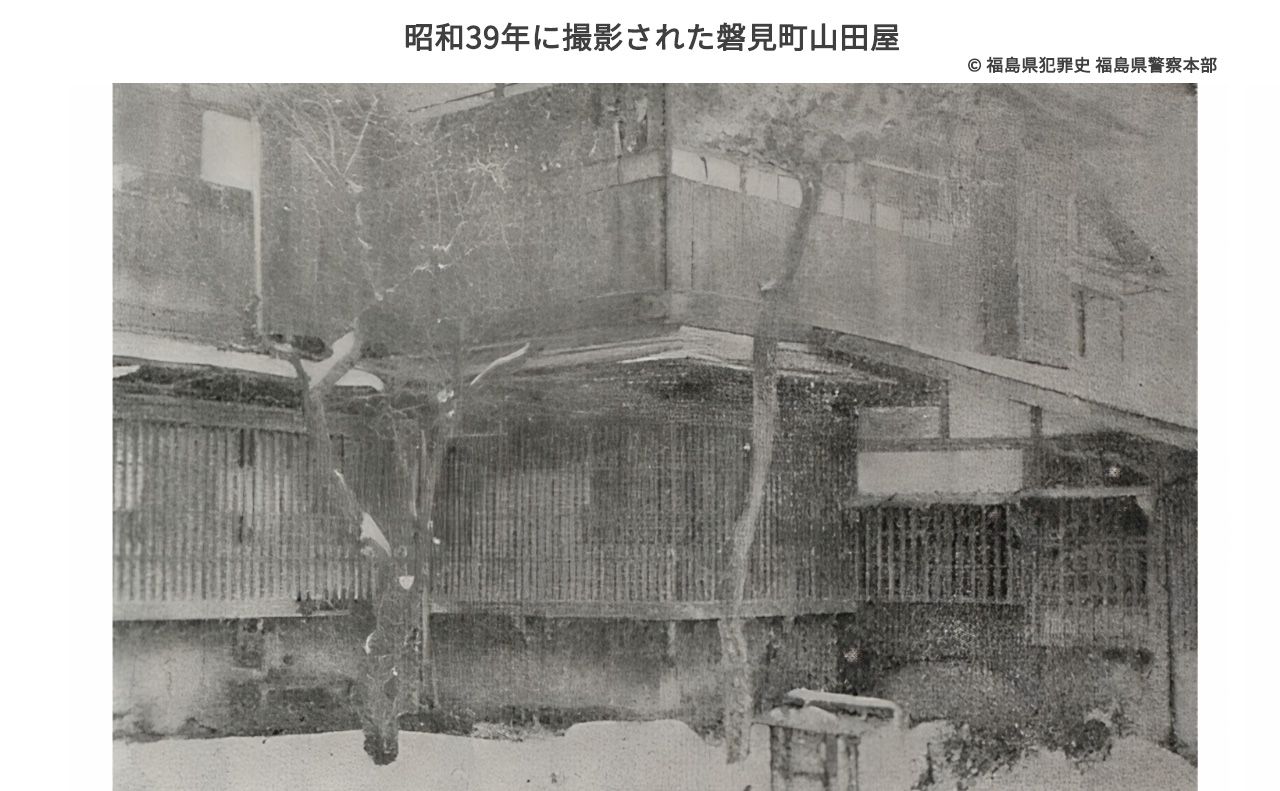 The Yamadaya building, photographed in December 1964. Its lattice and other features recall the former bustle.
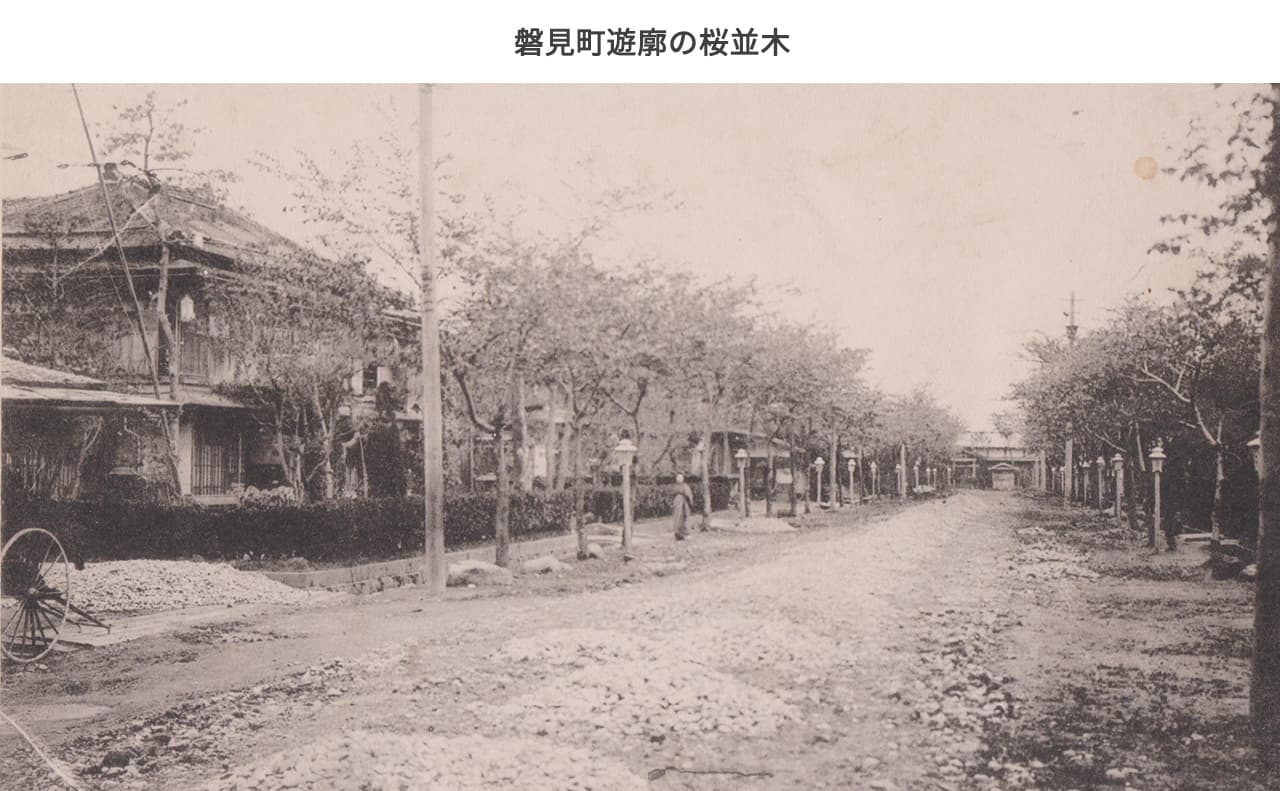 The bustle of the Iwami-machi pleasure quarter. Wakamatsu pleasure quarter.
Nanukamachi.com Digital Archive: Cherry blossoms of the Wakamatsu pleasure quarter (Aizu Famous Places: Wakamatsu Yukaku) The Prestinte Quarter Watamatsu at Aizu
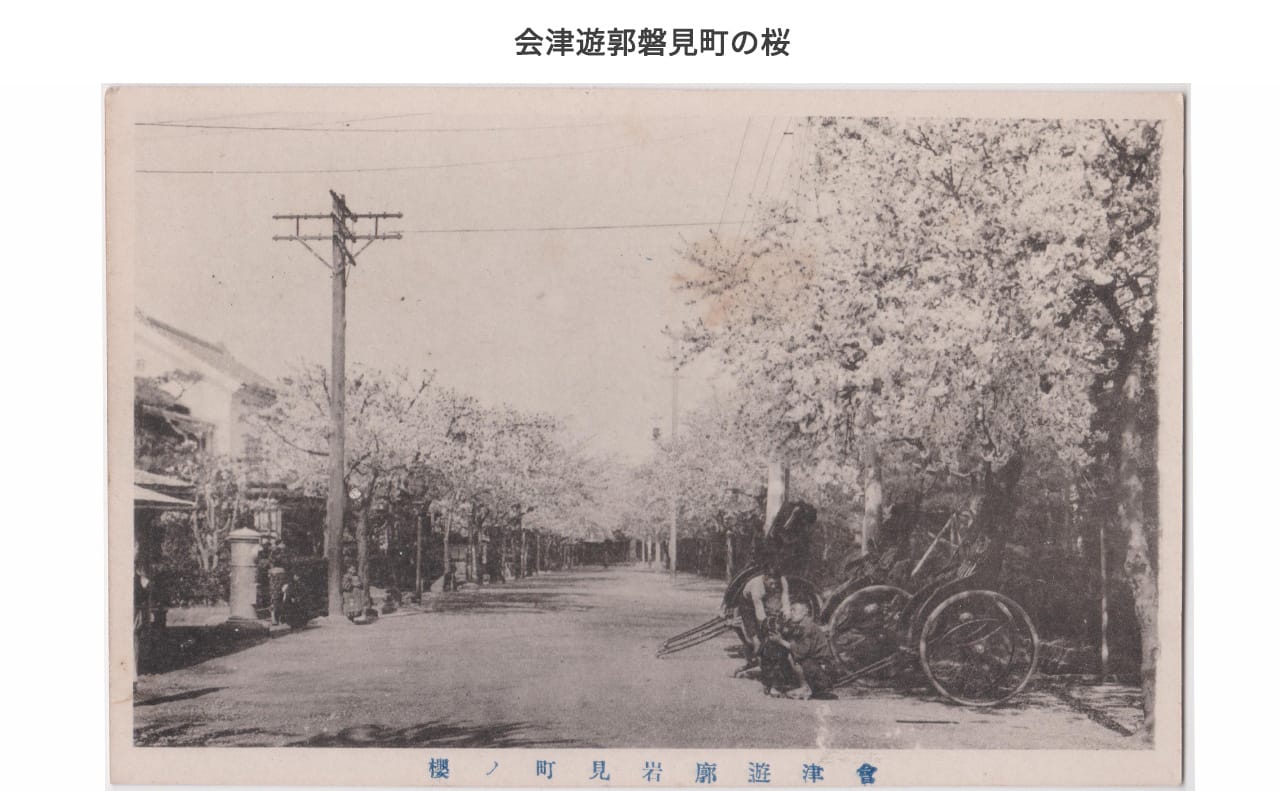 Cherry blossoms in Iwami-machi, Wakamatsu pleasure quarter, from a postcard of the period. On the lower right, a child can be seen talking with two men in front of a rickshaw. Children are also standing at the base of the utility pole on the left.
Nanukamachi.com Digital Archive: Aizu Famous Places: Tsuruga Castle Historic Site, VIEW OF TSURUGAJO
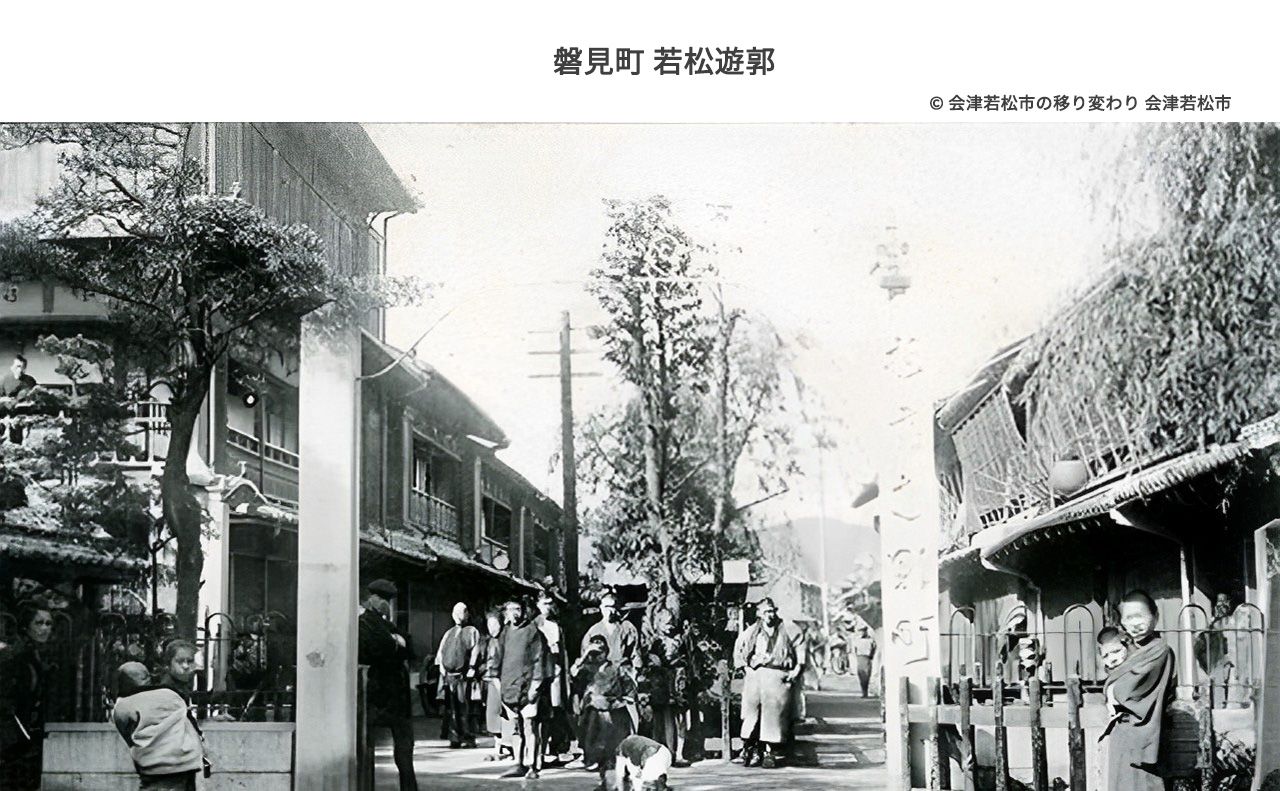 The bustle of the Iwami-machi pleasure quarter. Wakamatsu pleasure quarter.
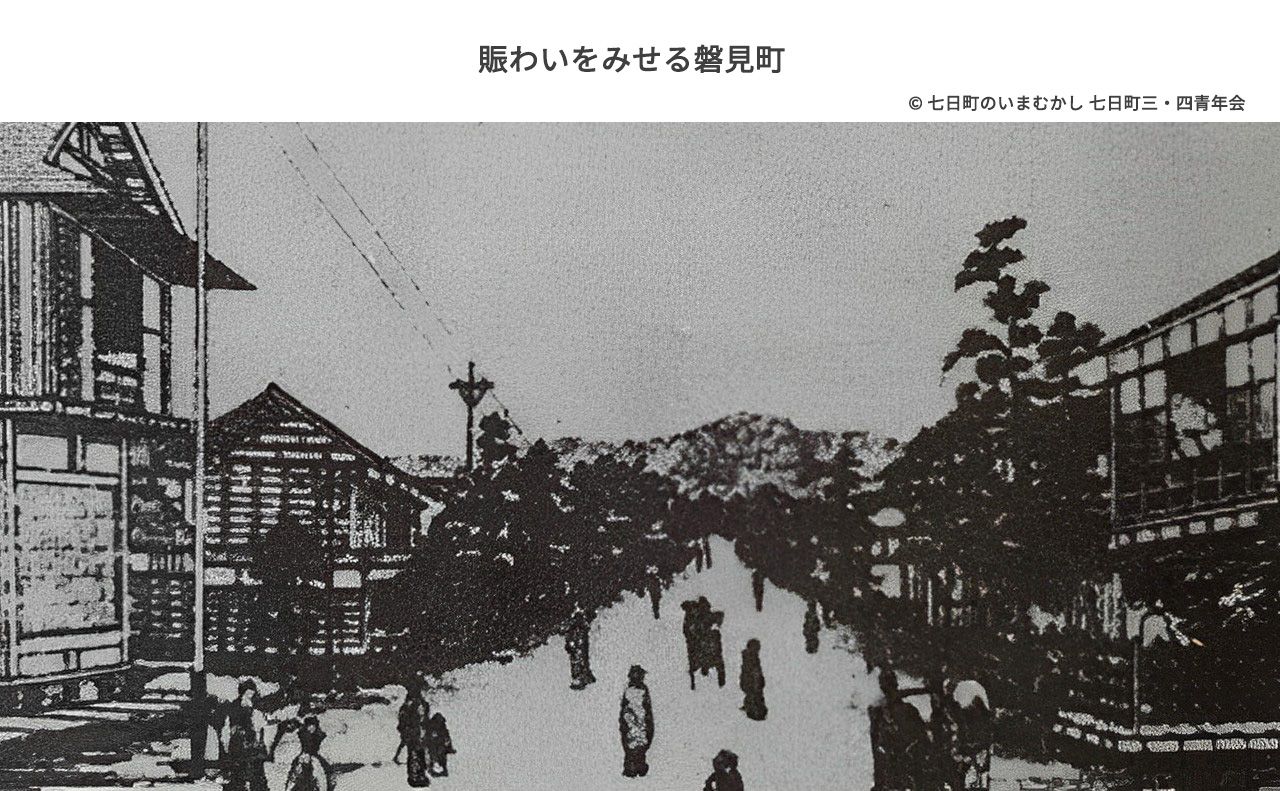 The bustling Iwami-machi pleasure quarter.
The Decline of the Iwami-machi YukakuThe operating rights of the Iwami-machi pleasure quarter belonged to the ten establishments that planted commemorative trees and erected the stone monument.
However, as time passed, the operators changed, and closures and changes of business became common. Furthermore, as the army went off to the Pacific War, the bustle of the pleasure quarter disappeared.
Just before the end of the Second World War, a red-light district from another area was demolished, and because lumber was rationed and new construction became difficult, that district relocated to Iwami-machi.
By dividing the large brothels of the earlier quarter and adding separate entrances, about twenty houses operated as brothels.
According to people who remember that time, the atmosphere changed from the former dignified pleasure quarter from that point on.
On May 24, 1956, the Prostitution Prevention Act was promulgated. At the time of promulgation, 28 establishments were operating in Iwami-machi, but they gradually changed businesses or closed.
By the time the law took effect on April 1, 1957, there were about 28 establishments.
On March 28, 1958, a farewell banquet for the people concerned was held at Higashiyama Onsen. Mayor Yokoyama Takeichi poured a congratulatory sake for each of the women, and it is said the banquet was lively. More than 80 women, business operators, and officials from the prefecture and the city attended. Their feelings may have differed, but those present, witnessing a turning point in the nation, were moved in their own ways.
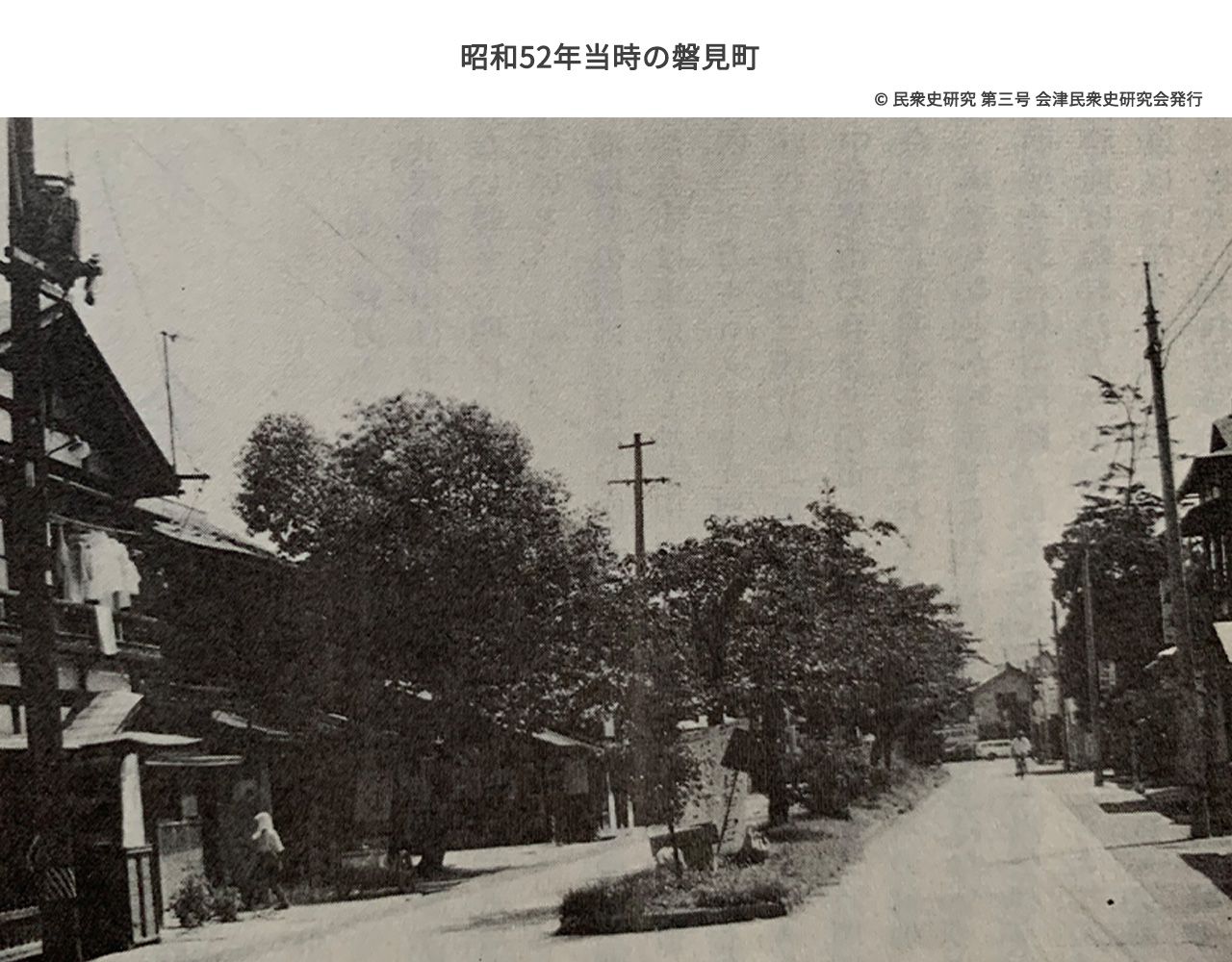 The townscape of Iwami-machi in 1977.
The Iwami-machi Yukaku and Kasama Inari ShrineNearby is Kasama Inari Shrine. Originally, it was the yashiki-sha (a shrine built within the grounds of a house) of Araki Gofukuten, which stood in a row with the pleasure quarter.
Enshrined as the god of prosperous business, it drew many worshippers, including the women working in the pleasure quarter.
Three stone monuments stand at Kasama Inari Shrine.
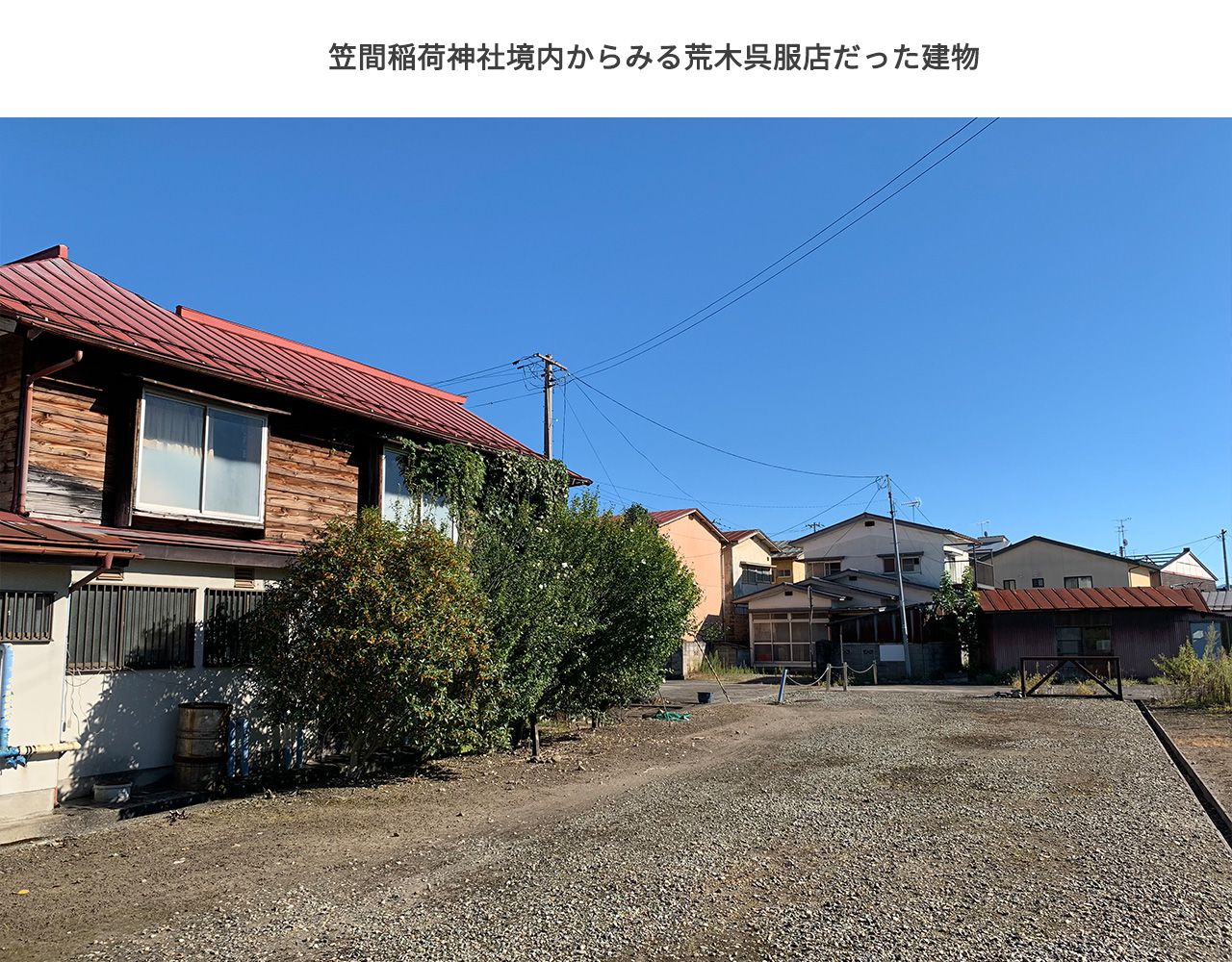 The view of the back of Araki Gofukuten from the precincts of Kasama Inari Shrine.
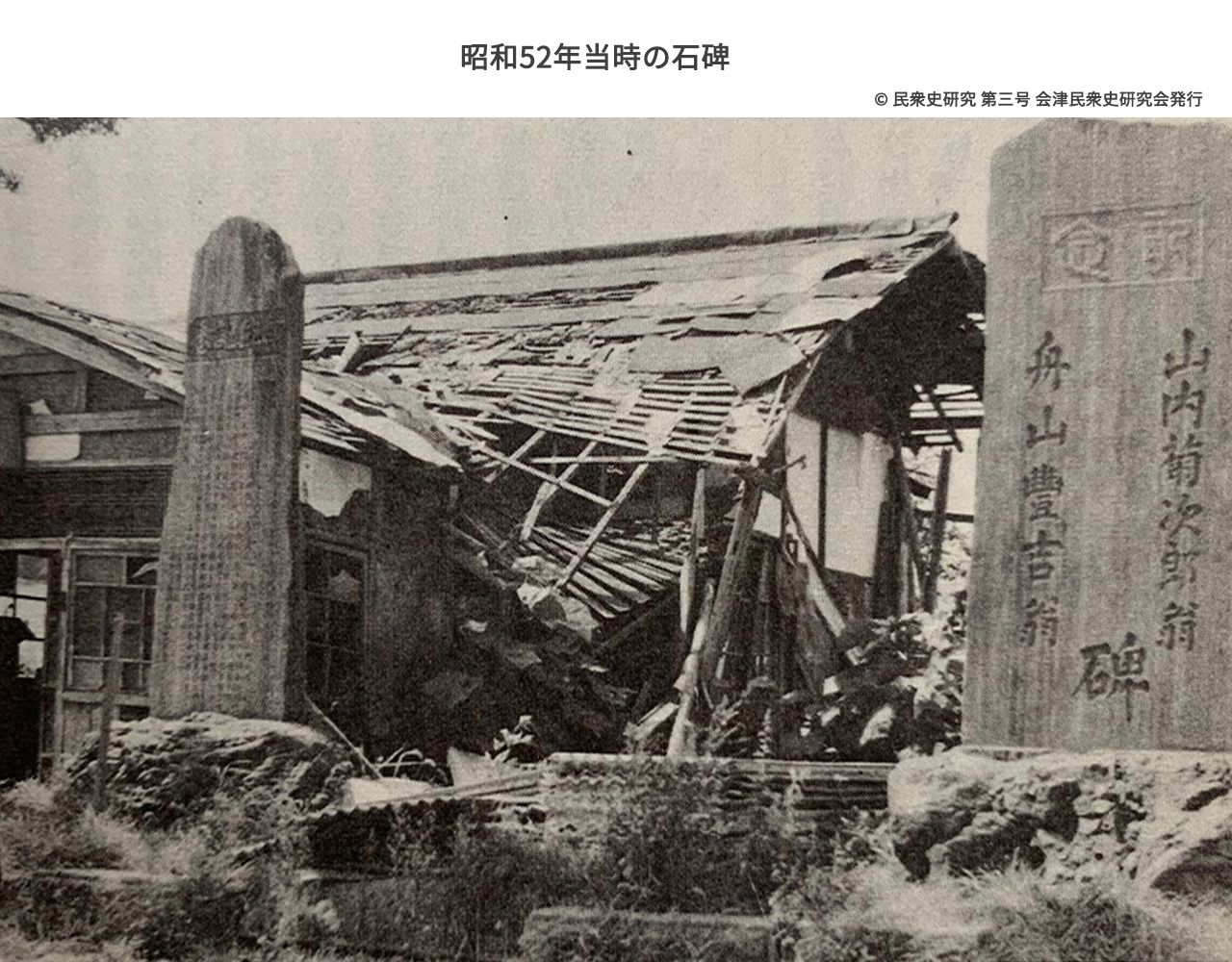 A stone monument near Kasama Inari Shrine, as it appeared in 1977. Behind the monument, the decayed buildings of the pleasure quarter can be seen.
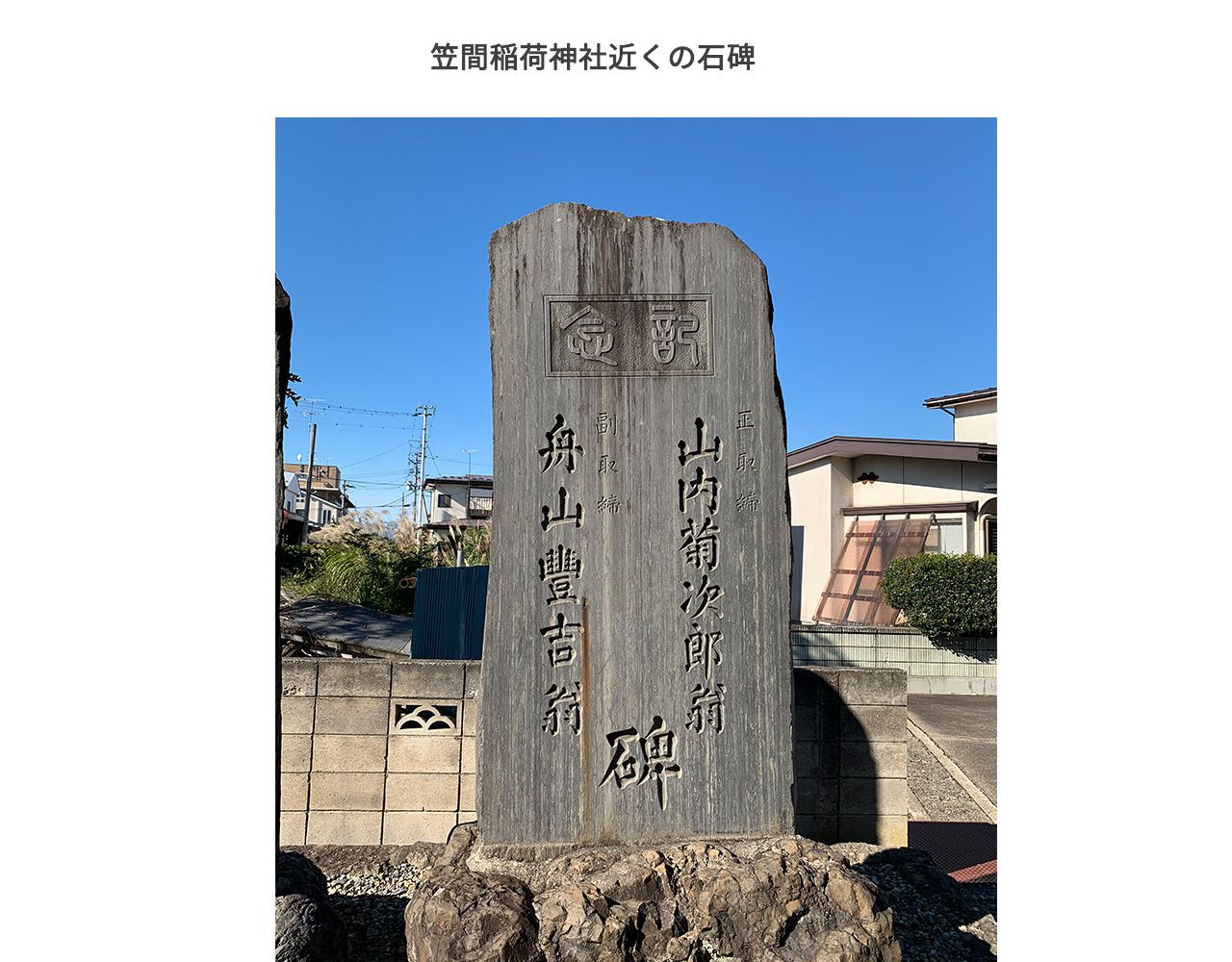 A stone monument standing at the present-day Kasama Inari Shrine.
It is inscribed "Chief Supervisor Mr. Yamauchi Kikujirō, Deputy Supervisor Mr. Funayama Toyokichi."
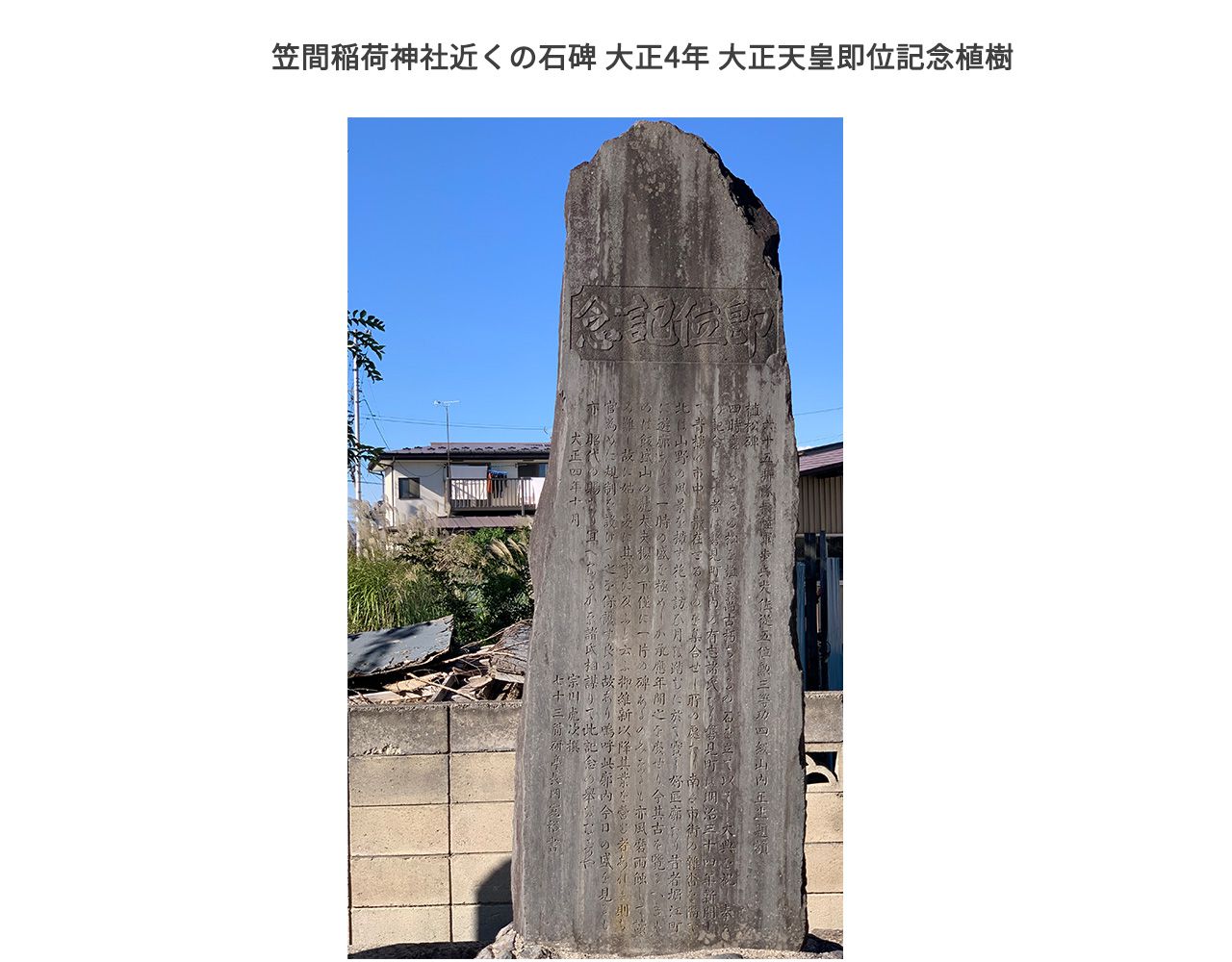 A stone monument standing at the present-day Kasama Inari Shrine. It was erected during the 1915 commemorative tree planting for the accession of Emperor Taisho.
Sixty-Fifth Regiment Commander, Army Infantry Colonel, Junior Fifth Rank, Order of Merit Third Class, Fourth Grade Meritorious Service, Yamauchi Masao
Uematsu Monument
We planted pine trees that never change through the four seasons and erected stones that will never decay, to celebrate the great ceremony.
The public-spirited gentlemen within the Iwami-machi pleasure quarter made this commemoration. Iwami-machi was newly developed in 1901, gathering in this place the pleasure houses that had been scattered through the city.
Separated from the bustle of the southern town, with mountains and fields to the north, it is truly a fine district where one visits the flowers and seeks the moon.
In the past, a pleasure quarter existed in Horie-machi and flourished for a time, but it was abolished during the Jōō era. What can be seen today is only a single monument beneath the Tayū-zakura at the foot of Iimoriyama, worn by wind and eaten by rain, and hard to read; so I touch on it here.
Since the Restoration, those in this business have existed, and the government had good reason to set rules to protect them. Alas, seeing the prosperity of this quarter today, it is also a gift of the new age. It is fitting that the gentlemen have consulted together to hold this commemoration.
Written by Munakawa Kojī
Calligraphy by Nagaoka Hirohiro, 73rd old man, Kenteicho
(Modern Japanese translation)
By planting pine trees that never change through the four seasons and erecting stones that never decay, the public-spirited gentlemen within the quarter celebrated the great ceremony.
Iwami-machi was developed in 1901, and it is the place where the pleasure houses that had been scattered through the city were gathered.
Separated from the bustle of the southern town and facing the mountains and fields to the north, it is truly a splendid district where one visits the flowers and seeks the moon.
In the past there was a pleasure quarter in Horie-machi that flourished for a time, but it was abolished between 1652 and 1655. What remains today is only a single monument beneath the Tayū-zakura (Tayū cherry tree) at the foot of Iimoriyama, which is faded by wind and rain and hard to read, so I mention it here.
After the Meiji Restoration, people in this business existed, and the government had sound reasons to set rules to protect them. Alas, seeing the prosperity of this quarter today, it is also a gift of the new era. It is fitting that the gentlemen consulted together to hold this commemoration.
Written by Munakawa Kojī
Calligraphy by Nagaoka Hirohiro, 73rd old man, Kenteicho
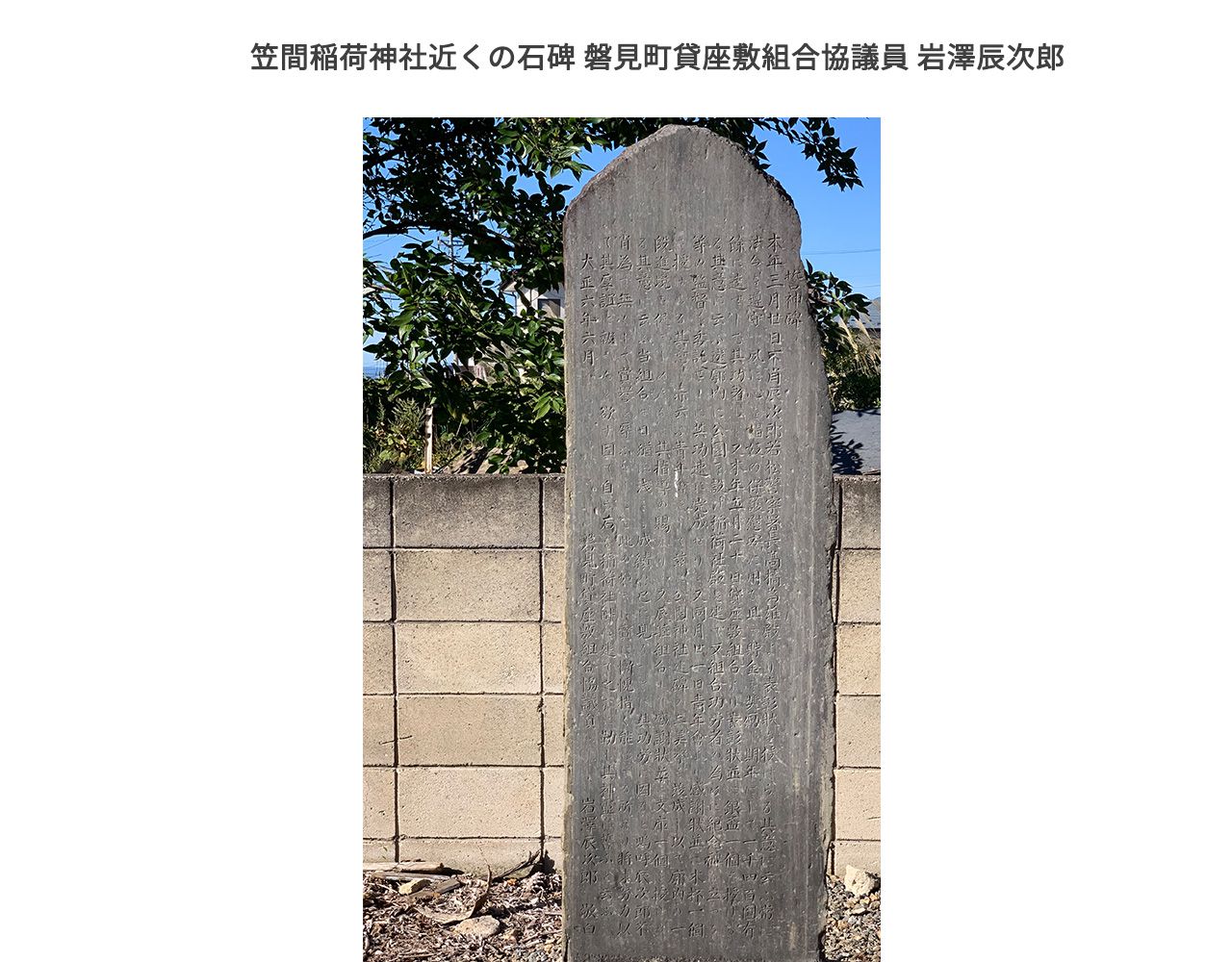 A stone monument standing at the present-day Kasama Inari Shrine, belonging to Iwazawa Tatsujirō, a member of the council of the Iwami-machi pleasure quarter lending association.
Vow Monument
On March 20 of this year, I, the unworthy Tatsujirō, was presented with a certificate of commendation by Mr. Takahashi Tameo, Chief of the Wakamatsu Police Station. Its meaning: always observing laws and regulations, and devoting my heart early to the protection and comfort of prostitutes, while encouraging savings, the total reached more than 1,400 en. The achievement is remarkable.
On May 20 of this year, I was also presented with a certificate of commendation and a silver cup by the lending association. Its meaning: a park was established within the quarter, a Inari shrine was built, and a commemorative monument was erected for the association's meritorious members, and their supervision was entrusted to me, which was completed swiftly.
On the 21st of the same month, I received a letter of gratitude and a wooden cup from the Youth Association. Its meaning: the Youth Association completed the three great works of park, shrine, and monument, which advanced the quarter one more step, and that was the result of your guidance.
Furthermore, I received a letter of gratitude and a bookshelf from the Tatsumutsu Association. Its meaning: though our association is still young, the results are already visible, and this is due to your meritorious service.
Honored in this way, the credit is said to belong to Tatsujirō, which is a shame I cannot bear.
Hoping to repay that kindness in the future, I have had a stone erected by the Inari shrine myself, inscribed to swear before the divine spirits.
Iwazawa Tatsujirō, respectfully submitted, council member of the Iwami-machi Pleasure Quarter Lending Association
(Modern Japanese translation)
In March of this year, I, the unworthy Tatsujirō, was presented with a certificate of commendation by Chief Takahashi Tameo of the police station.
The reason: "Always observing laws and regulations, you devoted your heart early to the protection and comfort of prostitutes, and encouraged savings, which reached over 1,400 yen. Your achievement is remarkable."
On May 20 of this year, I was also presented with a certificate of commendation and a silver cup by the lending association.
Its content: "A park was established within the quarter, an Inari shrine was built, and a commemorative monument was erected for the association's meritorious members. Although we entrusted the supervision to you, it was completed swiftly."
On the 21st of the same month, I received a letter of gratitude and a wooden cup from the Youth Association.
Its content: "The Youth Association completed the park, shrine, and monument, which advanced the quarter one more step; this is the result of your guidance."
Furthermore, I received a letter of gratitude and a bookshelf from the Tatsumutsu Association.
Its content: "Our association is still young, yet its results are already visible, which is due to your meritorious service."
The honors are said to belong to Tatsujirō himself, and I cannot bear the shame of receiving such praise without having done anything.
In the future I wish to repay that kindness, so I have erected this stone by the Inari shrine myself, inscribed it, and vowed before the divine spirits.
Iwazawa Tatsujirō, respectfully submitted, council member of the Iwami-machi Pleasure Quarter Lending Association
In this way, the Iwami-machi pleasure quarter once flourished. From the name Iwami-machi, which remains on the map, you can sense the differences in the historical background, culture, and values of that time.
List of materials cited in this article
- Aizu Hanjōki, Satō Kumesaburō / Tajiri Asanosuke, Kōsaka Shinbundō (1922) info:ndljp/pid/964388
- Zenkoku Yūkaku Annai, Nihon Yūransha (1930) info:ndljp/pid/1453000
- Considering the Modern History of Aizu, Nakamura Toshi (1993)
- Minshūshi Kenkyū, Vol. 3, Aizu Minshūshi Kenkyūkai (1979)
- Nanukamachi Then and Now, Nanukamachi 3- and 4-chome Youth Associations (1983)
- Fukushima Prefecture Criminal History, Vol. 2, Fukushima Prefectural Police Headquarters info:ndljp/pid/3036065