Amida-ji Temple









Highlights
The head temple of Amida-ji Temple is Chion-in in Kyoto (400 Hayashincho, Higashiyama-ku, Kyoto City, Kyoto Prefecture), but it is also regarded as a branch temple of Daitakuzan Entsu-ji (a head temple of the Nagoshiha sect of Jodo Buddhism; 1770 Osawa, Mashiko-machi, Haga-gun, Tochigi Prefecture).
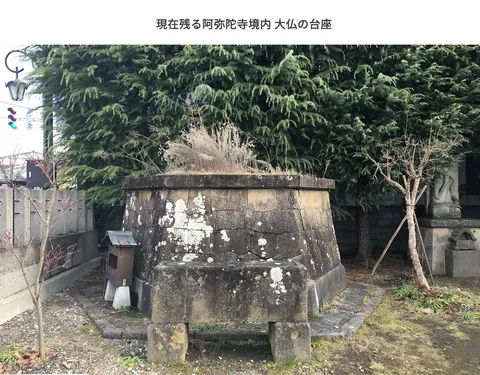
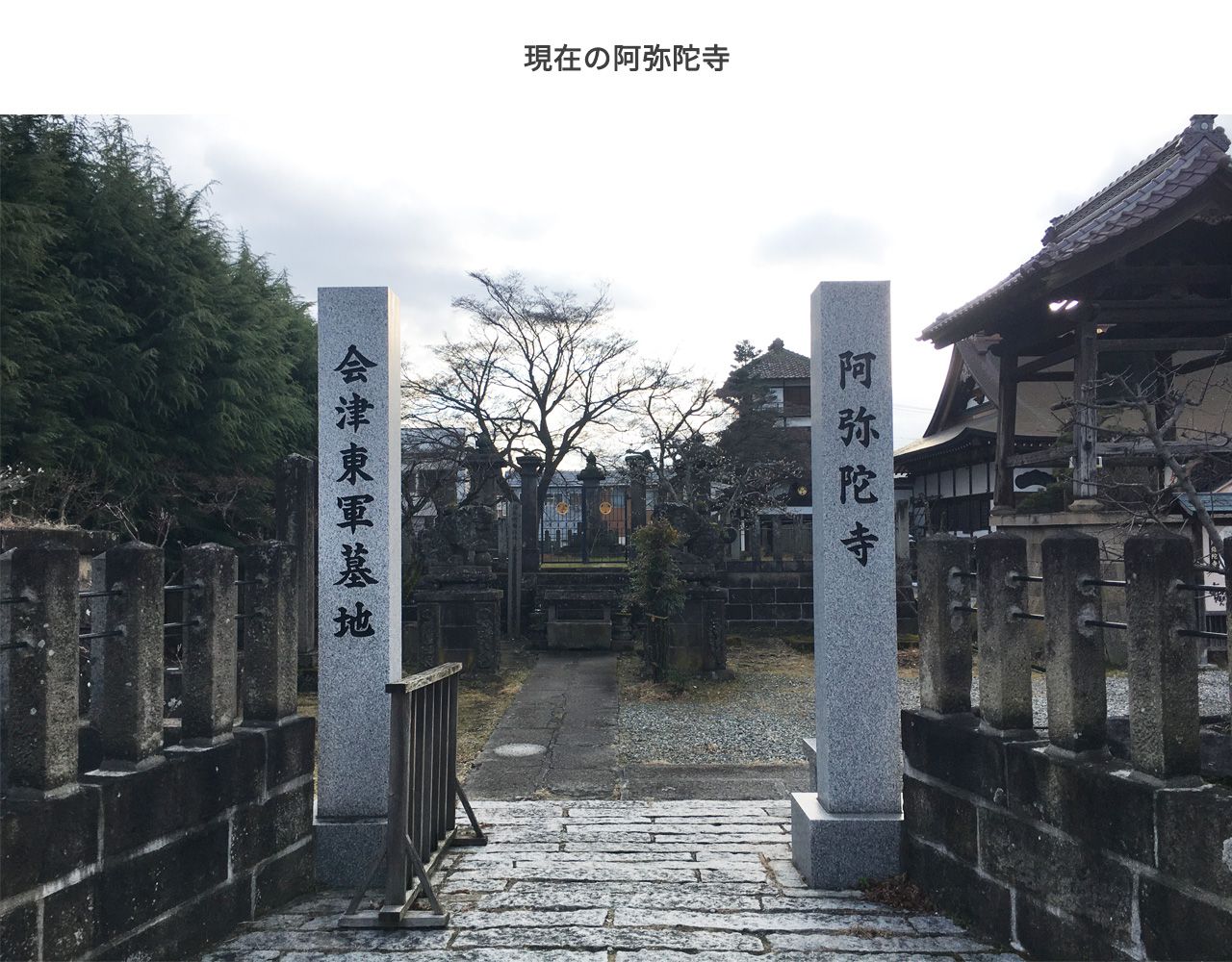 Amida-ji Temple today. This photograph was taken from the same angle as the photo above (Taisho 3, 1914).
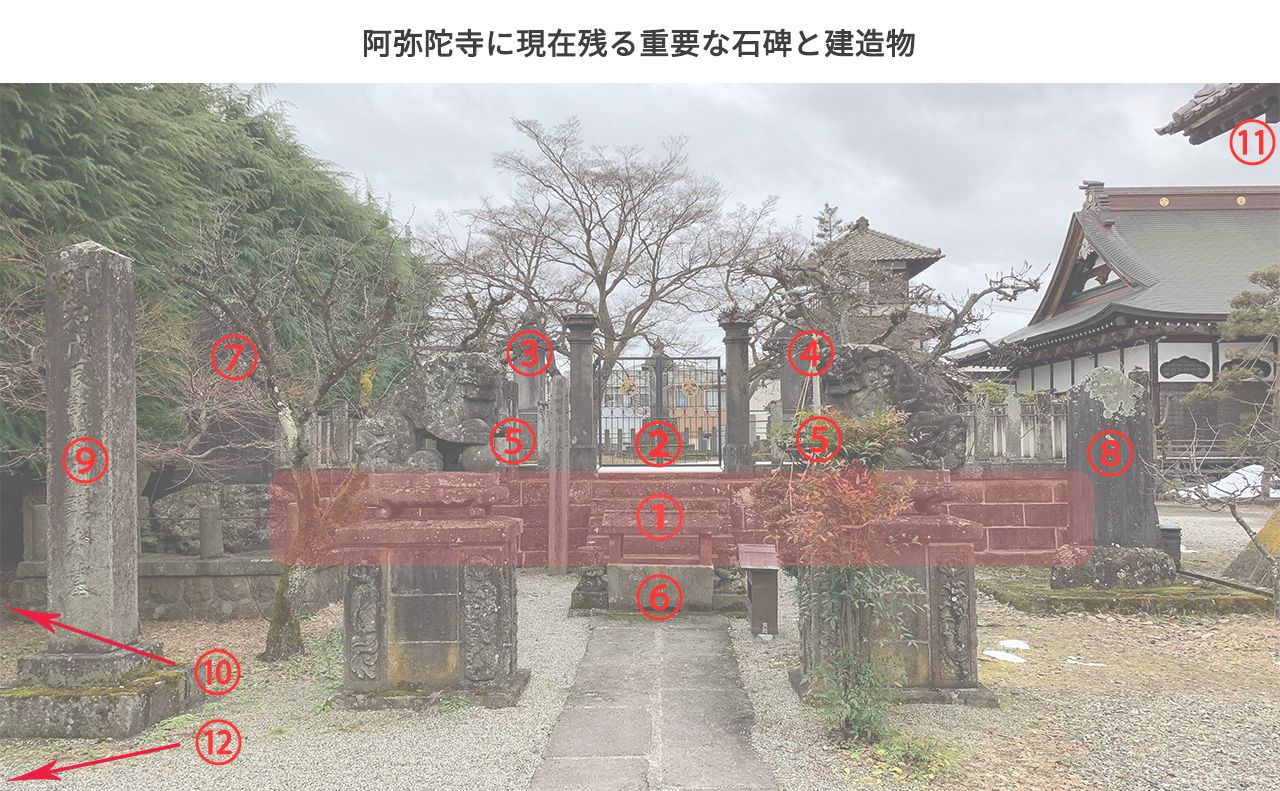
Important stone monuments and structures that remain todayValuable stone monuments still remain at Amida-ji Temple. These monuments carry the wishes of those who came before, who sought to preserve their memory for future generations.
 Major important stone monuments and structures remaining today
1. Funbo (burial mound)
2. Kayano Nagamitsu yohai-hi (stele of the Aizu Domain commissioner Kayano Nagamitsu)
3. Hokoku Jinchu-hi (Devotion to Country and Loyalty stele)
4. Senshi-baka (fallen soldiers' grave)
5. Lantern dedicated in Meiwa 5 (1768)
6. Stone hand-washing basin
7. Fukuroku kinen-hi (Restoration of Stipends memorial stele)
8. Boshin War 50th Anniversary memorial stele
9. Stone pillars of the Meiji Boshin War martyrs' grave
10. Kannon statue pedestal remains and stone contemplative Buddha
11. Bonsho bell and bell tower (bell spared from requisition during the Pacific War)
12. Great Buddha foundation
 1. Burial mound
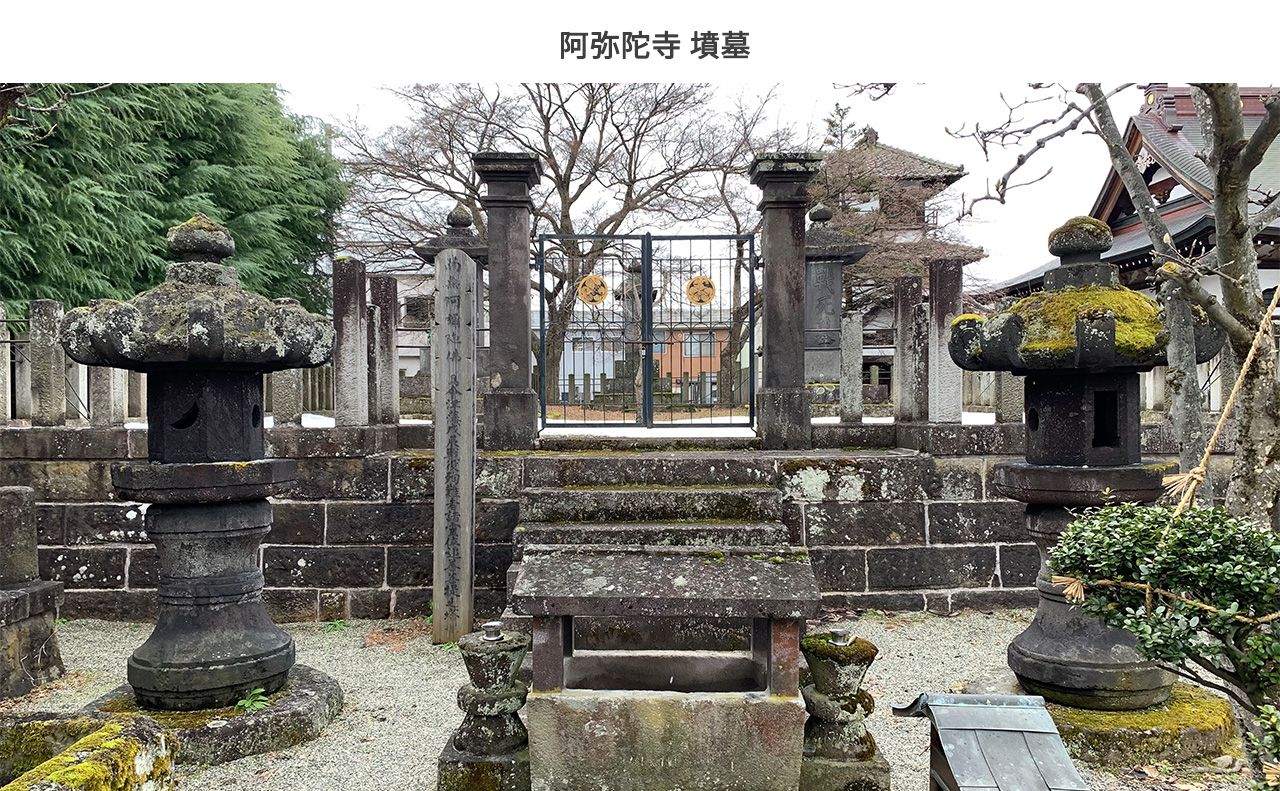
Completed in Showa 21 (1946).The present burial mound is a square platform measuring 7 jo east-west (approx. 12.7 m) by 8.5 jo north-south (approx. 15.5 m), standing 4 shaku 5 sun high (approx. 1.3 m). At the rear, a section of the same height measuring 3.5 jo east-west (approx. 6.4 m) by 2 jo north-south (approx. 3.6 m) projects to the south.
The perimeter is built up with stone, and the upper edge forms a stone tamagaki (boundary fence). On the south side (facing Nanukamachi-dori), there are seven stone steps and two iron doors that open outward. Golden chrysanthemum crests are embossed on the doors.
Several monuments stand on this slightly elevated area.
First, the "Kayano Nagamitsu Yohai-hi" stands at the front. Kayano Nagamitsu served as a chief retainer of the Aizu Domain. In front of it are two large steles. The left stele is inscribed "Hokoku Jinchu-hi" (Devotion to Country and Loyalty), and the right stele is inscribed "Senshi-baka" (Fallen Soldiers' Grave).
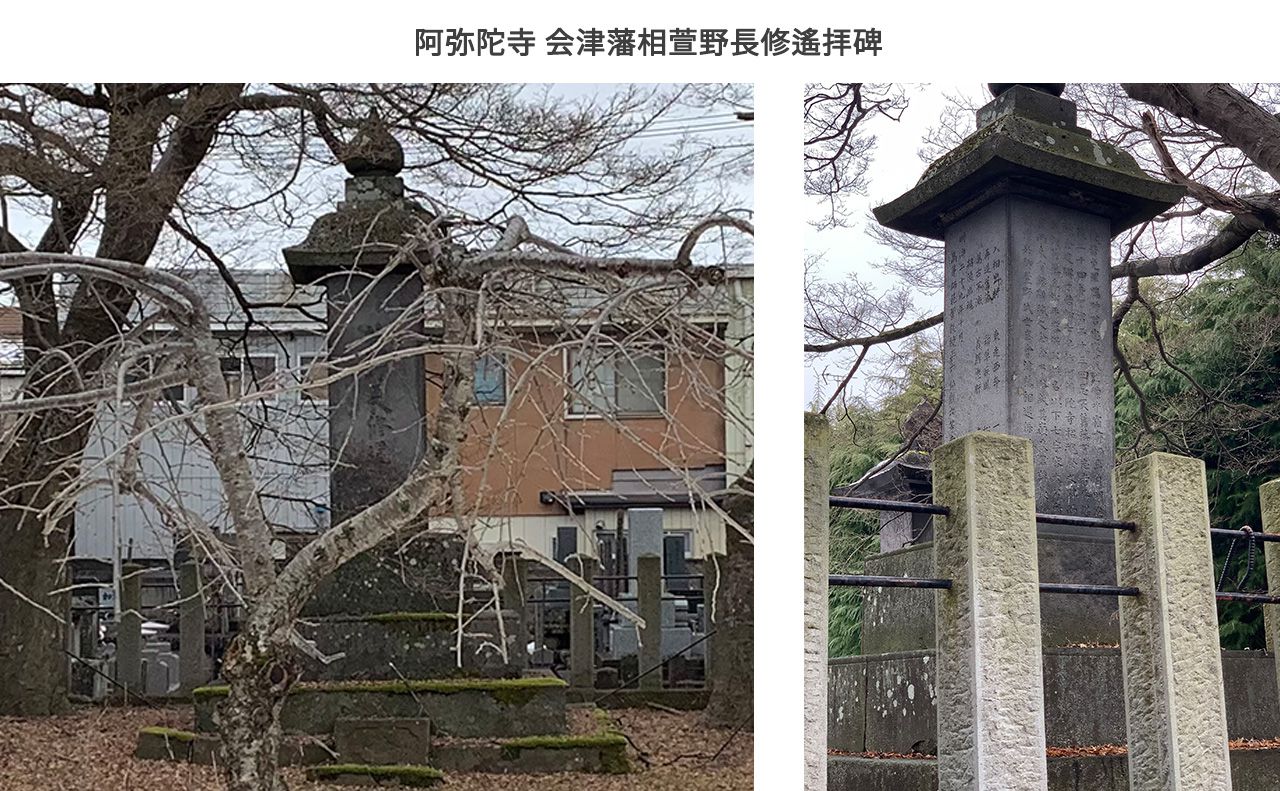 2. Kayano Nagamitsu yohai-hi stele of the Aizu Domain
This stele stands on a three-tiered base. It was erected in October of Meiji 27 (1894), the 23rd memorial year of Kayano Nagamitsu's death, by a group of former Aizu Domain members who contributed funds.
The horizontal characters reading "Aizu Domain Commissioner" on the front, written from right to left, were brushed by Katamori Matsudaira (the 9th lord of the Aizu Domain). The vertical characters below, reading "Kayano Nagamitsu Yohai-hi," were brushed by Katahira Matsudaira (the 11th head of the Aizu Matsudaira family and lord/governor of the Tono Domain). The inscription "Monument inscription for Kayano, former Aizu Domain commissioner" was composed by Namba Tsunanori.
Inscription for Kayano, former Aizu Domain commissioner (literary rendition)
In the disturbance of Meiji Boshin, heaven and earth were sealed, sun and moon darkened, and people lost their way. At that time, he took charge of domain affairs, commanded the three armies, and devoted himself utterly to his duties as a retainer. When peace was restored, the court sought those who had resisted the imperial army. His colleagues Tanaka Genkai and Kambo Takaatsu faced this judgment together. But Genkai and Takaatsu had already fallen in battle. He then took sole responsibility, was confined at the Arima residence, and the following year, on May 14, was granted death. Through this, the lord's house was rebuilt, and his fellow retainers were all absolved. Alas, his loyalty and valor were solemn as winter frost and bright as the sun. Twenty-four years later, on his 23rd memorial, former loyalists gathered funds to erect a stele at Amida-ji Temple in Wakamatsu Nanukamachi. The seal on the stele was inscribed by former lord Katamori Matsudaira, and the seven characters of his name were written by Katamori. As there was no inscription, they asked me to compose one. I have briefly recorded his story. His given name was Nagamitsu, called Gonbe. The Kayano family served as Aizu commissioners for generations. Thus I conclude the inscription: In office, a statesman; in the field, a general. He ran east and west and gave his life for his country. He restored the old domain. Like grass bending before a gale, like pine and cypress enduring the cold, his name shall never perish for ten thousand ages. With a righteous heart and loyal spirit, we raise this stone to call his spirit.
October, Meiji 29
Professor, Higher Normal School, Senior Sixth Rank, Sixth Class Merit — Namba Tsunanori, composer
Inscription for Kayano, former Aizu Domain commissioner (modern translation)
During the Meiji Boshin War, the world was in chaos, and people had lost their direction. At that time, Kayano took charge of domain governance and commanded the armies, fulfilling his duty as a retainer with all his strength. When the war ended, the court began searching for rebels. He was to bear responsibility alongside his colleagues Tanaka Genkai and Kambo Takaatsu. However, Genkai and Takaatsu had already died in battle. Kayano therefore accepted sole blame, was confined at the Arima residence, and on May 14 of the following year, was ordered to take his own life. As a result, the lord's house was restored, and the other retainers were pardoned.Ah, his loyalty and devotion were as austere as severe frost, as clear as the sun. Twenty-four years later, on his 23rd memorial, former domain loyalists raised funds and planned to erect a stele at Amida-ji Temple in Wakamatsu Nanukamachi. The dedicatory calligraphy on the stele face was by former lord Katamori Matsudaira, and the seven characters below the name were written by Katamori. As no inscription text existed, I was asked to compose one. I therefore set down the outline of his life.His name was Nagamitsu, known as Gonbe. The Kayano family served as senior ministers of the Aizu Domain for generations. The inscription reads: "Within, a statesman; abroad, a general. He ran east and west, giving his life to the nation. He rebuilt the old domain. His will, like grass before a gale, like pine and cypress in the cold, endures forever. With a heart of righteousness and loyalty, we invite his spirit to this stone."
October, Meiji 29
Professor, Higher Normal School, Senior Sixth Rank, Sixth Class Merit — Namba Tsunanori, composer
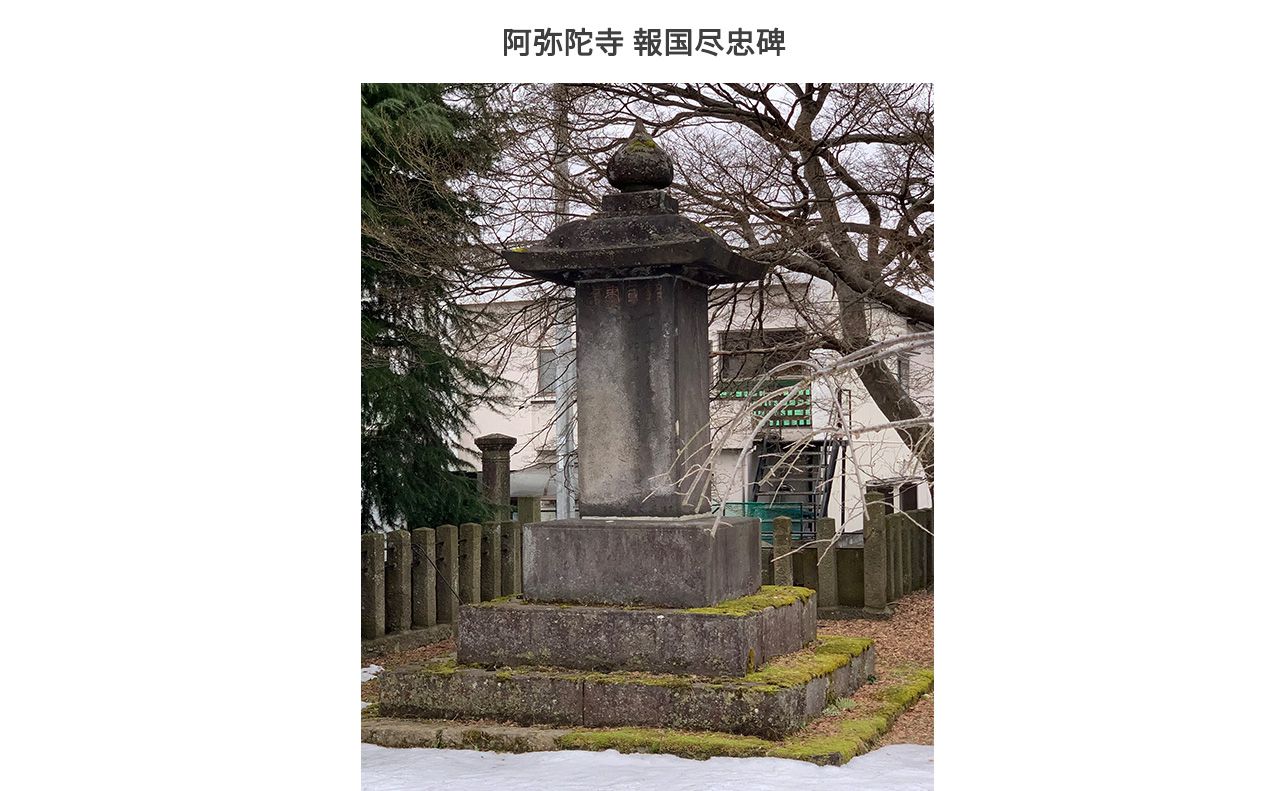 3. Hokoku Jinchu-hi (Devotion to Country and Loyalty stele)
Two steles stand in front of the Kayano Nagamitsu yohai-hi.
The one on the left is inscribed "Hokoku Jinchu-hi" and bears the names of 70 men, led by Sagawa Kanbe, who lost their lives in the Satsuma Rebellion of Meiji 10 (1877).
The front of the stele reads "Hokoku Jinchu" (Devotion to Country and Loyalty) in horizontal script, with the following text inscribed below.
Hokoku Jinchu-hi (literary rendition)
In the Satsuma Campaign, more than sixty men fought fiercely and gave their lives, led by Sagawa Kanbe. All had previously endured the national crisis of Boshin. They knew not surrender; how could they bear such cruelty? Their comrades discussed and erected a stone to express their mourning. Junior Fifth Rank Katamori Matsudaira inscribed the seal in seal script. The inscription reads:
Who among men can avoid death? To preserve one's honor is loyalty. The steles face each other; their fragrance shall never end.
October, Meiji 11 — Ogasawara Katsutoshi, composer
Hokoku Jinchu-hi (modern translation)
In the Battle of Satsuma, more than sixty men led by Sagawa Kanbe lost their lives after fierce fighting. They had all previously faced the national crisis of the Boshin War. They did not know surrender; how could they not lament such cruelty? Their comrades agreed to erect a stone stele to express their mourning. Junior Fifth Rank Katamori Matsudaira wrote the seal inscription.
The inscription reads: "Every person is destined to die. Yet to fulfill one's honor is loyalty. These steles face each other, and their reputation shall endure forever."
October, Meiji 11
Ogasawara Katsutoshi, composer
The names of the fallen are inscribed on the reverse side. The stele text states "more than sixty," but 71 names are recorded; these were added later over time.
Sagawa Kanbe Niwa Shigemitsu Kasahara Tadatomo Nagai Fuyonosuke Omara Kazue
Uchimura Naoyoshi Shinosawa Toraassuke Hashizume Yukiaka Akagi Sakutaro Higuchi Iwago
Kasuga Shigetake Arakawa Takeshi Inamura Shige Takaki Kozo Yoshikawa Shichiro
Ogawa Hayajiro Noguchi Yuji Kogane Maru Takaki Shinroku Miyashita Sankosaburo
Akutsu Takemori Nezu Kinji Sakai Poljiro Yamamura Sagoro Ikari Hachijiro
Ozaki Tojir Yoshioka Chuta Ishiyama Tsuneyoshi Yamamuro Goro Miyake Torajiro
Yukishita Kumanosuke Kodaira Yosaku Kubota Shota Shibukawa Katsusaburo Horiuchi Tomekuro
Higuchi Kogo Kurokawa Yujito Sato Sakujir Nihei Kotaro Matsuzaka Heijiro
Zenpa Meirin Akaya Masatada Kuriki Takisaburo Sugihara Gonosuke Igarashi Sadamatsu
Shimohira Tsugutaka Unno Hachigoro Yamaguchi Kameshiro Wada Soshu Inoue Shokichi
Takaki Chiyo Tomita Kazuo Ogawa Katsujiro Tsunoki Hironobu Yamaura Toyotaro
Tahara Shigetaka Nakazawa Chozo Ozawa Yasuta Nagoe Harunao Kato Chuhei
Amakawa Naoyo Soma Kengo Komatsu Teishiro Kanda Toyoharu Ishii Tomekichi
Hino Heizaburo Hashimoto Unota Sahara Ichiro Uzuki Heisaku Wakui Toyonosuke
Saito Gengo
The stele base is inscribed with "Stone workers: Kaise Shintaro, Kawashima Ichigoro." The inscription "The two steles face each other" refers to the matching stele on the right, which bears the three characters "Senshi-baka" (Fallen Soldiers' Grave) on its front.
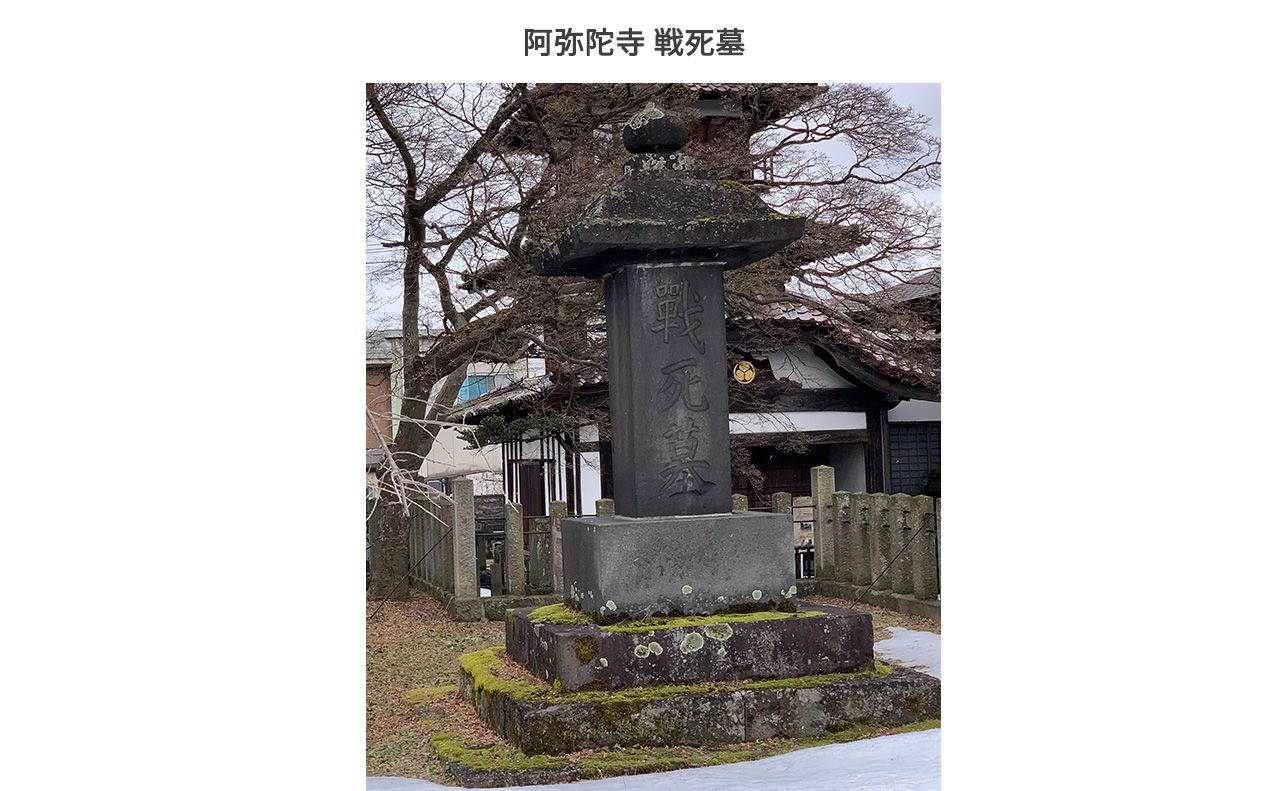 4. Fallen soldiers' grave
In front of the Kayano Nagamitsu yohai-hi stele, to the right of the Hokoku Jinchu-hi on the left, stands the stele inscribed "Senshi-baka" (Fallen Soldiers' Grave).
On the reverse side, the six characters "Erected by Hatt Muneyoshi" are recorded.
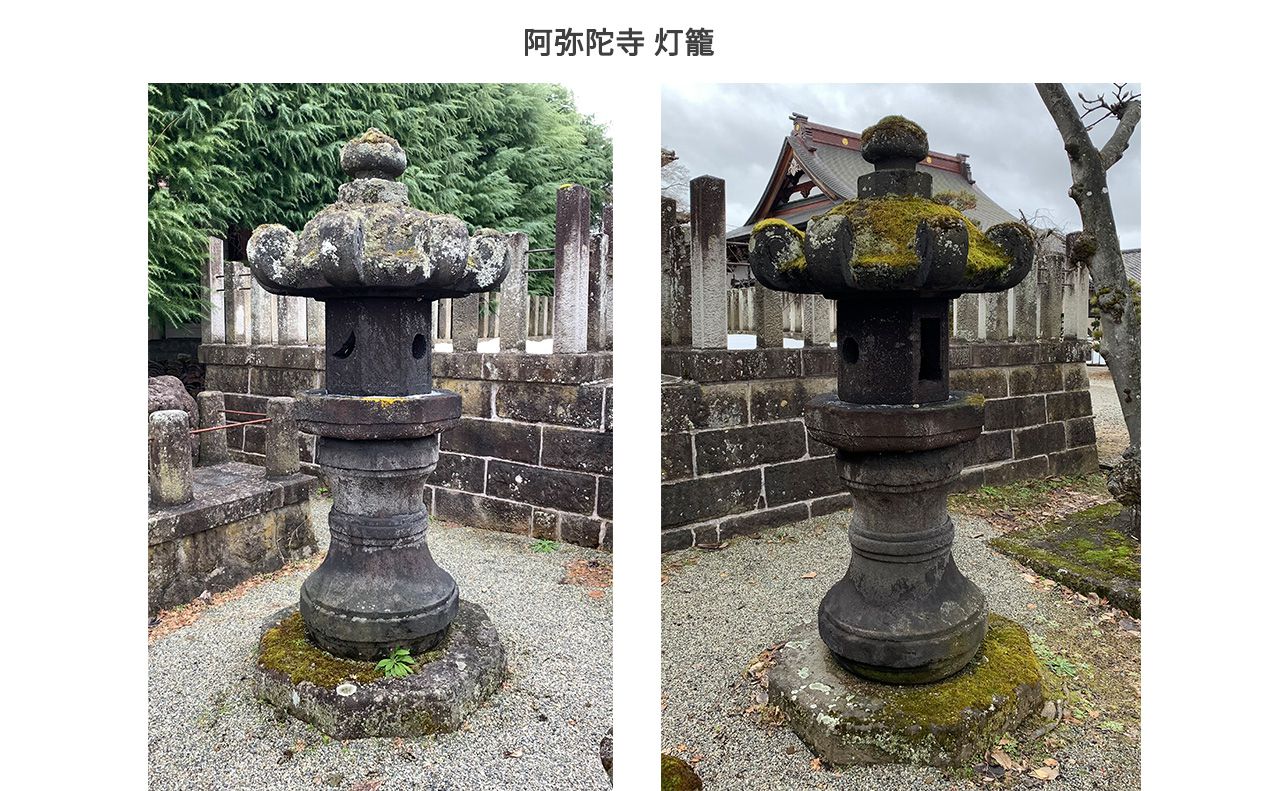 5. Lantern dedicated in Meiwa 5 (1768)
A pair of lanterns, each 1.5 jo tall (1.7 m), stands before the burial mound. The lanterns bear the inscription "Meiji 5 (1768), Tsuchinoe Ne, March, auspicious day."
The right lantern was moved from Tsuruga Castle in Meiji 1 (1868). The left lantern is said to have been relocated from the residence of Yamanouchi Kikujiro in Iwami-cho, where Prince Arisugawa Taruhito stayed during his inspection of Wakamatsu on October 5-6, Meiji 14 (1881), in connection with the 50th anniversary of the Boshin War.
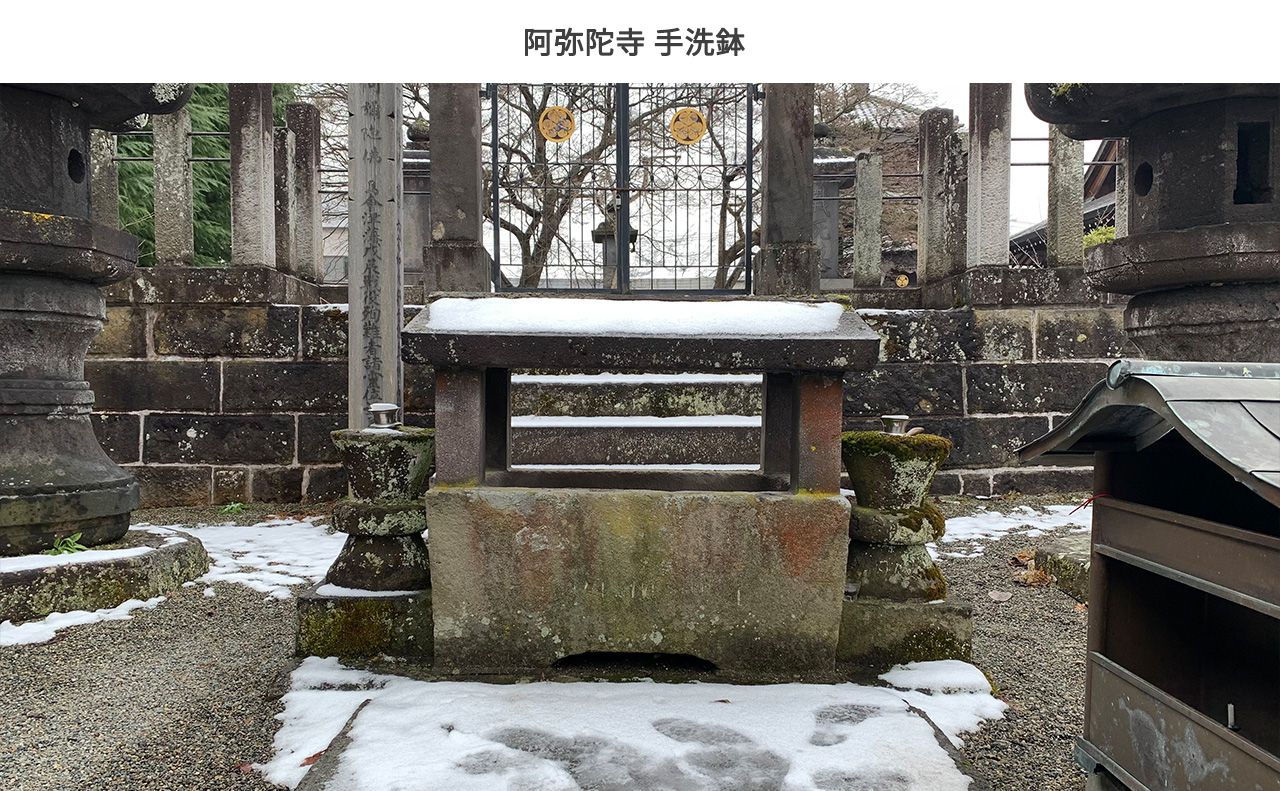 6. Stone hand-washing basin
Between the lanterns, there is a stone incense burner flanked by flower stands, and a large stone hand-washing basin is placed here.The basin bears the inscription: "Taisho 15, January — dedicated by Nanukamachi Otsu Tatsumi Youth Association."
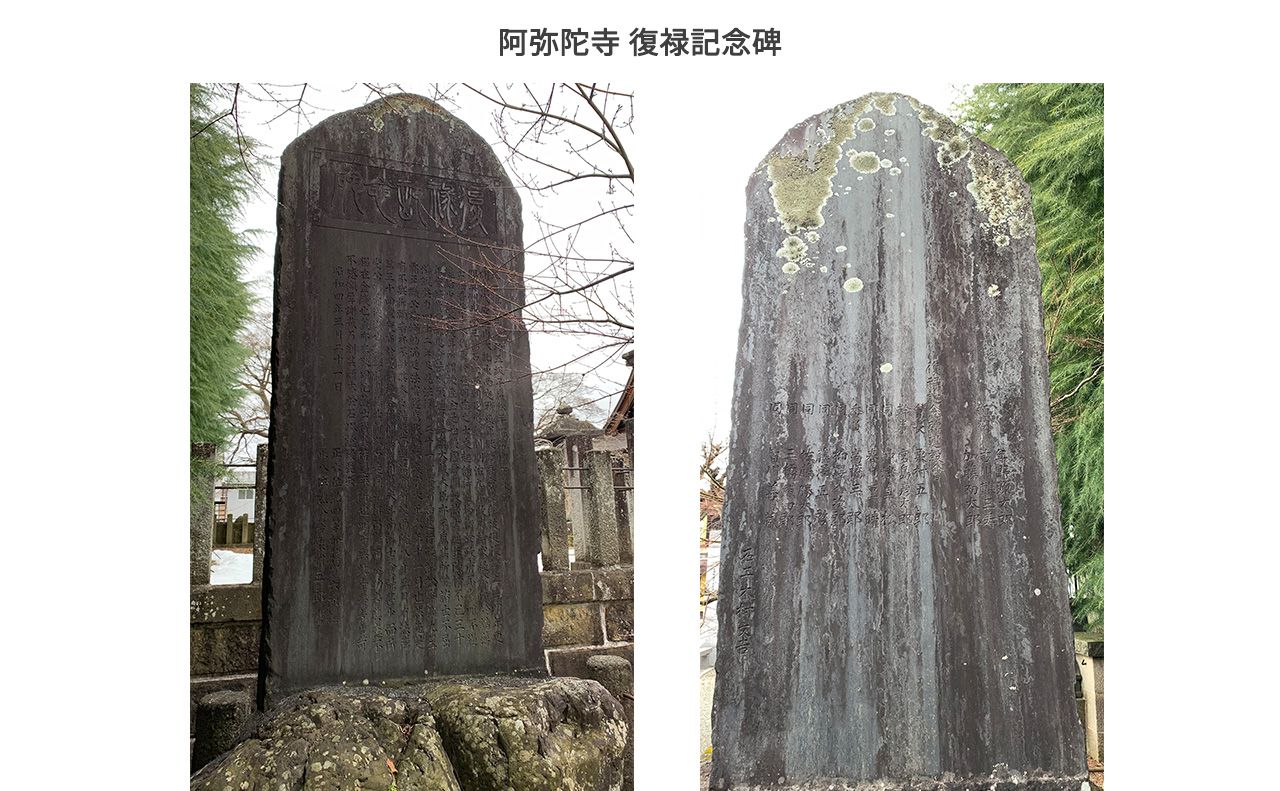 7. Restoration of Stipends memorial stele
The Sendai stone stele on the left records the hardships endured until the former Aizu domain samurai won government bonds from the new government.
In November of Meiji 2 (1869), Katamori Matsudaira was relocated to the Tono Domain with 30,000 koku, and all Aizu domain retainers were placed under his authority.
However, the domain had been reduced from 280,000 koku to just 30,000 koku, making it impossible to provide adequate stipends to the retainers.
The former Aizu Domain petitioned the new government for a loan of 670,028 ryo, but the new government granted only 170,000 ryo and 1,200 koku of rice.
The former Aizu Domain was forced to relocate within its limited means, and approximately 7,300 people moved to Tono. Other retainers chose their own trades and found ways to support themselves.
In Meiji 30 (1897), the Hereditary Stipends and Reward Stipends Disposition Act was enacted, providing government bonds equivalent to stipends to samurai nationwide.
However, Minister of Finance Masayoshi Matsukata argued that former Tono Domain retainers had no proof of having received stipends under the old domain system, and former Tono (former Aizu) retainers were denied the bonds.
The retainers appealed, and in Meiji 42 (1909), they filed a lawsuit against the Minister of Finance under the Administrative Litigation Law. After nine years of deliberation, they finally won in November of Taisho 6 (1917), obtaining bonds equivalent to the value of 7 koku 2 to of rice per year for 13 years at prevailing prices. The following people received bonds:
Hachinohe-cho, Sannohe-gun, Aomori Prefecture — Nakamura Taketaka and 2,540 others
Omachi-cho, Onuma-gun, Fukushima Prefecture — Takahashi Daikichi and 95 others
Kami-Arai Shinden, Kita-Aizu-gun — Nakamura Genjuro and 61 others
Taima-cho, Wakamatsu City — Suda Kakichi and 63 others
However, more than 900 people whose original registration records bore the notation "muen" (no connection) were unable to receive bonds.
They then sued the Minister of Finance again, arguing that they too had in fact relocated to Tono and deserved the same rights. As a result of negotiations, they won this right on March 15, Taisho 8 (1919).
Nevertheless, those who had turned to farming or commerce after life hardships in Tono, those who had moved further to other regions, those who had been transferred to Tokyo or Wakamatsu as domain officials, and those sent to other prefectures on domain business or to study in Tokyo could not benefit from these rights.
These hardships as a defeated domain are recorded on the Restoration of Stipends memorial stele. The inscribed text reads as follows.
Restoration of Stipends memorial stele (literary rendition)
Senior Fourth Rank, Third Class Merit, Fifth Class Service, Viscount Yasuo Matsudaira — seal inscription
"In Meiji Boshin, the realm was greatly disturbed, and east and west fought. The eastern army was defeated, and our Aizu Domain lost its territory. The following year, we were granted Tono in Mutsu with 30,000 koku.
The court then abolished the domain system. In Meiji 9, the government granted hereditary stipend bonds to samurai of all domains, but ours alone was excluded. Comrades rose one after another to petition the government for equal treatment, but were not heard, receiving only a small sum of money.
This was the so-called vocational assistance fund. Later, the Diet opened, and samurai petitioned year after year. In year 30, the Hereditary Stipends Disposition Act was passed. People signed a petition to the Minister of Finance, but again it was not accepted.
The samurai did not yield and redoubled their advocacy. In year 42, Law No. 21 was promulgated. Administrative litigation was filed, and after nine years of argument, justice moved the court, and the judges ruled in our favor.
This was in November of Taisho 6. Yet many who had not joined the suit were not few in number. They united and petitioned both houses of the Diet.
In March of year 8, Law No. 34 was promulgated. Thus each party gained recognition of its rights. The stipends of Tono samurai were meager, and the bonds received were correspondingly small.
Yet the reason the earlier generation struggled and overcame a hundred difficulties was not merely for money.
Rather, they wished to obtain treatment equal to samurai of other domains. Alas, those who share in this honor — could they not be deeply moved and give thanks? I therefore carve the details in stone, to inform posterity."
March 21, Showa 4
Senior Sixth Rank, Fourth Class Merit — Kato Kanroku, composer
Junior Eighth Rank, Eighth Class Merit — Kurimura Goro, calligrapher
Restoration of Stipends memorial stele (modern translation)
Senior Fourth Rank, Third Class Merit, Fifth Class Service, Viscount Yasuo Matsudaira — seal inscription
During the Meiji Boshin disturbance, the nation was thrown into chaos, and east and west fought. The eastern army was defeated, and our Aizu Domain lost its territory. The following year, we were granted the Tono Domain in Mutsu with 30,000 koku.
The court then abolished the domain system. In Meiji 9, the government granted hereditary stipend bonds to samurai of all domains, but ours alone was excluded. Comrades rose to petition the government for equal treatment but were not heard, receiving only a small sum.
This was the so-called vocational assistance fund. Later, the Diet opened, and samurai petitioned year after year without success. In year 30, the Hereditary Stipends Disposition Act was enacted. People signed a petition to the Minister of Finance, but it was again ignored.
The samurai did not yield and intensified their advocacy. In year 42, Law No. 21 was promulgated. Administrative litigation was filed, and after nine years of argument, justice moved the court, and the judges ruled in our favor.
This was in November of Taisho 6. Yet there were also many who had not joined the suit. They united and petitioned both houses.
In March of year 8, Law No. 34 was promulgated, and each party gained recognition of its rights. However, the stipends of Tono samurai were meager, and the bonds received were correspondingly small.
Yet the reason many struggled and overcame difficulties was not simply about money.
It was to gain the same treatment as samurai of other domains. Alas, could those who share in this honor not be deeply moved? I therefore carve the details in stone to inform posterity.
March 21, Showa 4
Senior Sixth Rank, Fourth Class Merit — Kato Kanroku, composer
Junior Eighth Rank, Eighth Class Merit — Kurimura Goro, calligrapher
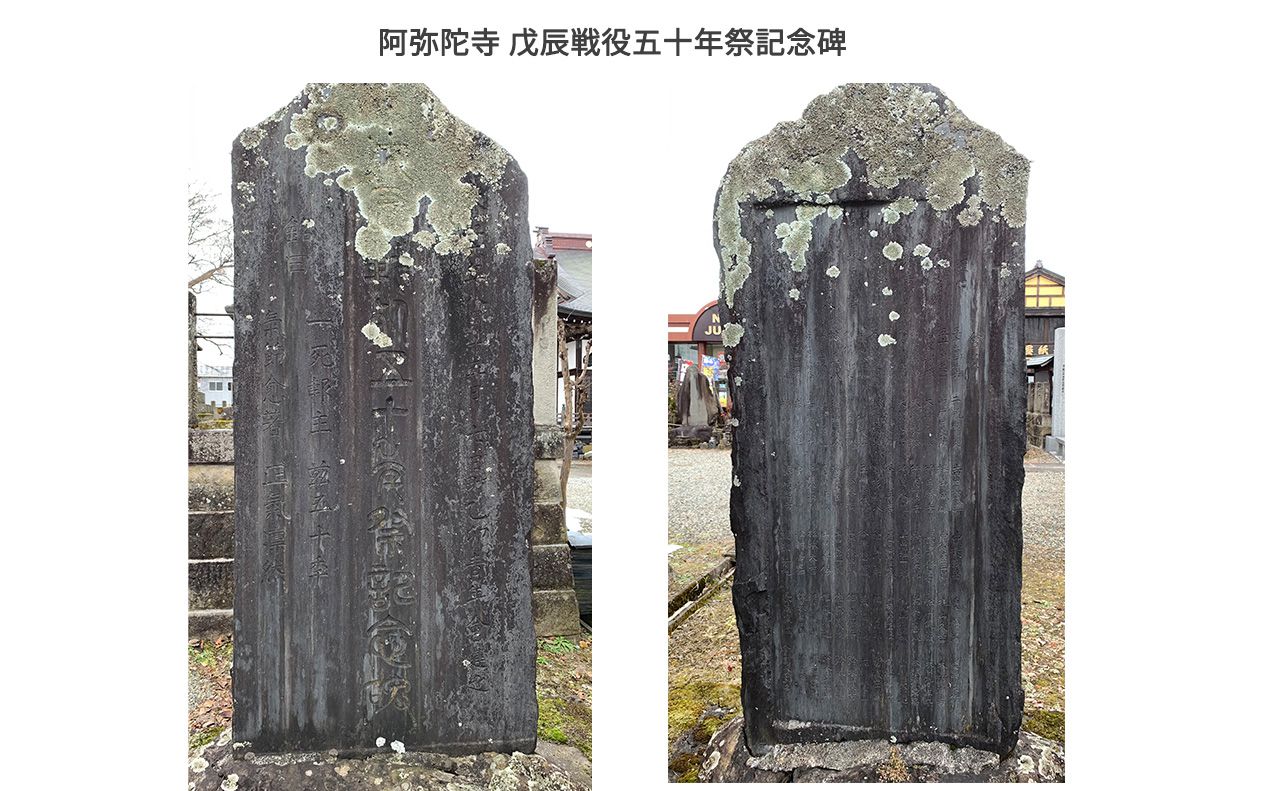 8. Boshin War 50th Anniversary memorial stele
This Sendai stone stele stands to the right of the lanterns. At the center, "Boshin War 50th Anniversary memorial stele" is inscribed, and to the right, "Erected on August 15, Taisho 6, by Nanukamachi Otsu Tatsumi Youth Association."
The reverse side bears the following names.
Advisors
Ito Yonejir, Tojo Kichijiro, Oi Keinosuke, Tsukahara Kakichi, Node Heihachi, Yamaguchi Shinkichi
Members
Igarashi Chiyokichi, Igarashi Heiichi, Iwasawa Munezo, Inamura Tomiji, Inazuki Seitaro, Ishikawa Zenkichi, Ishiyama Tadanosuke, Iseki Tatsunosuke, Inomata Etsumi, Hayashi Naohachi, Hayashi Shigejiro, Haga Eigo, Harada Sojiro, Okabe Yoshimasa, Nihei Takami, Niida Chosuke, Osawa Yoshimatsu, Oba Ryomatsu, Ozeki Zenkichi, Watanabe Tokusuke, Kawamori Kuninosuke, Watanabe Ushijiro, Kawamata Yoshie, Kanda Eiji, Kaneko Kamekichi, Yoshida Kiyoshi, Yoshikawa Komaso, Yokoyama Kiyoshi, Yoshida Kiyohisa, Yokoyama Naruo, Takeda Katsukichi, Takeuchi Tokichi, Takeuchi Tokomitsu, Tanikawa Svekichi, Takasugi Kakuha, Tamaki Kiyomatsu, Tanaka Taihei, Tsukahara Tamegoro, Kadota Heiji, Nakamura Kinjiro, Nakamura Miyabi, Fujisaki Chukichi, Nagamine Katsuyoshi, Ukawa Yotaro, Ueda Uichiro, Kuzuoka Toyozo, Kume Kiyomi, Yatsu Sozo, Yamaadera Tetsushiro, Yamaguchi Zenichiro, Yamaguchi Zengo, Matsumoto Taikichi, Matsumura Yoshiaki, Watanabe Yoshimaru, Mafune Kiyoshi, Maruyama Hisakichi, Funayama Kenzo, Nukaya Zenpachi, Koyama Tokuzo, Oarai Masaji, Aikawa Tomekuro, Arami Akira, Sato Genpei, Sato Yoshitsugu, Sato Seizo, Sato Eisaburo, Sasayama Zenjiro, Naganao Torazo, Sakuta Misao, Kimura Seikichi, Kinose Hanpei, Kinebuchi Kohei, Minagawa Chozo, Miyazawa Soji, Niinose Shozo, Shibukawa Kenji, Suzuki Hamakichi, Suzuki Genki, Suzuki Kojiro, Sosa Shichiemmon, Sugai Hikozaburo — 83 members
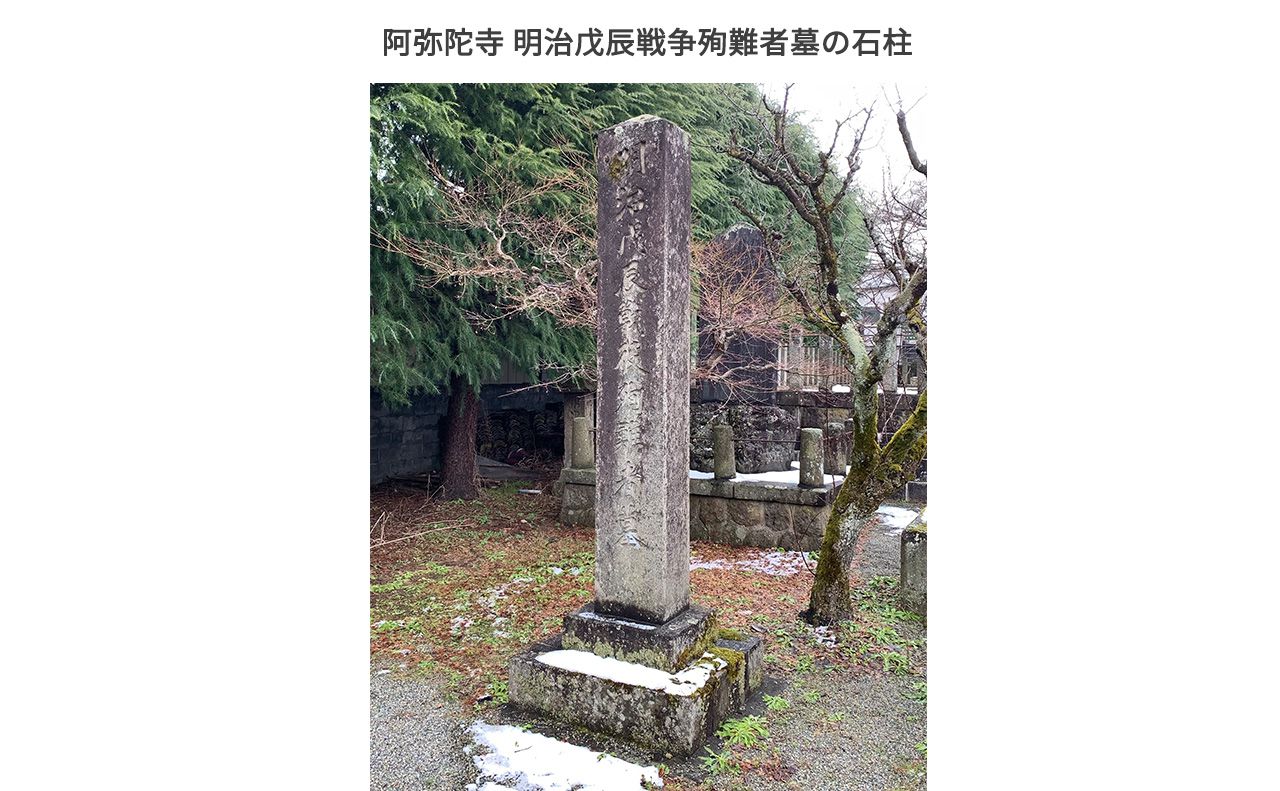 9. Stone pillars of the Meiji Boshin War martyrs' grave
These stone pillars stand before the Restoration of Stipends memorial stele. They were erected and dedicated by Kashiwa Mura Tsuyoshi, a businessman from Aizu, on September 22, Showa 32 (1957), during the 90th anniversary observance of the Boshin War.
The front is inscribed with "Grave of martyrs of the Meiji Boshin Campaign," and the reverse bears the following text.
In commemoration of the 90th anniversary of the Meiji Boshin Campaign
Donated and erected by Kashiwa Mura Tsuyoshi
September 22, Showa 32
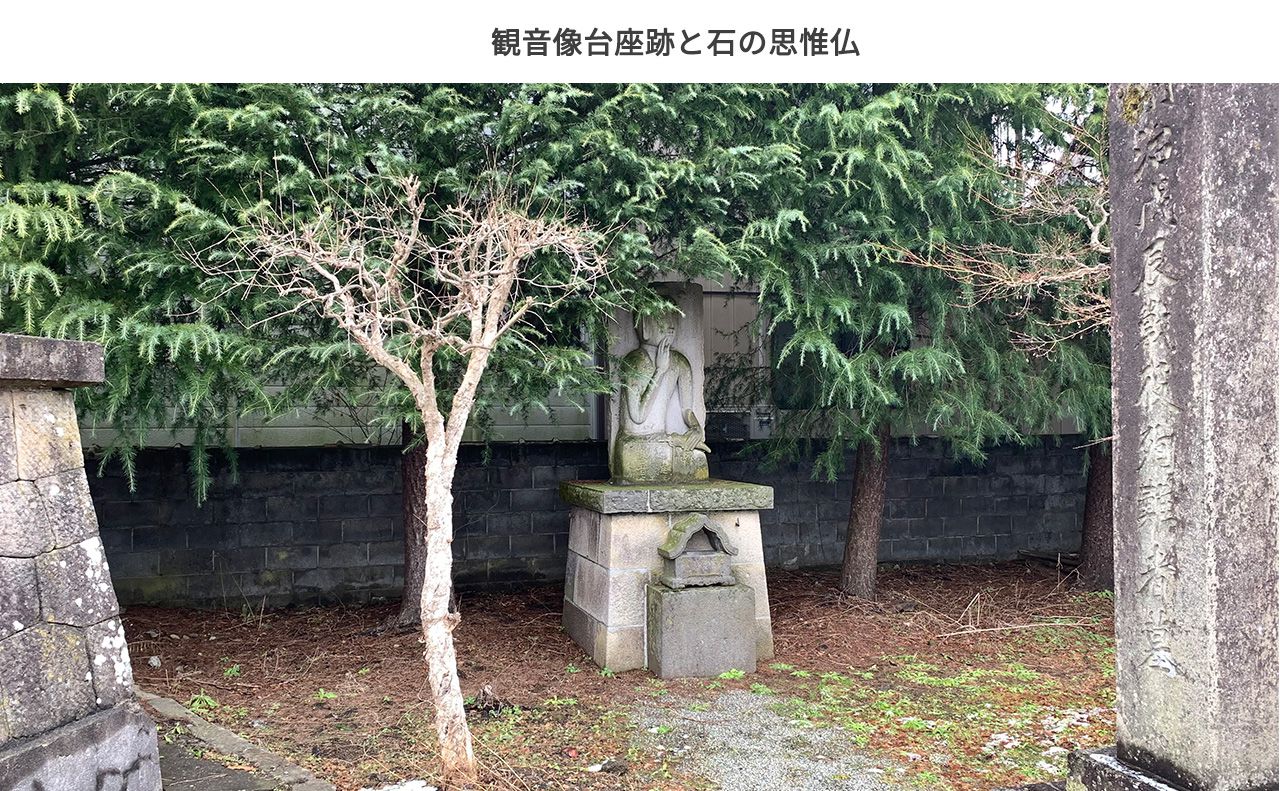 10. Kannon statue pedestal remains and stone contemplative Buddha
Beside the stone pillars of the Meiji Boshin War martyrs' grave, there is a stone pedestal approximately 5 shaku (1.5 m) tall, upon which a stone contemplative Buddha is enshrined.
Once, a bronze Kannon standing figure approximately 7 shaku (2.1 m) tall stood on this pedestal. However, it was requisitioned during the Pacific War.
The reverse of the pedestal bears the following inscription.
(literary rendition)
Having received life in this world, I give thanks for the grace of heaven, earth, and humanity. I pray for the prosperity of the nation and peace in the world, and for the posthumous welfare of my ancestors through the generations and all spirits. I previously erected a bronze Buddha, but it was seized by the military during the Pacific War, and its form was lost. I therefore establish a stone Buddha here anew, to express my humble devotion.
2,500th year of the Buddha's birth
May, Showa 34, erected
Donor — Ikenai Chigo, inscription
Enokida Bunsuke, carver
(modern translation)
I received life in this world, and I give thanks for the grace of heaven, earth, and humanity. I pray for the prosperity of the nation and peace in the world, and for the posthumous welfare of my ancestors through the generations and all spirits. I previously erected a bronze Buddha, but it was requisitioned by the military during the Pacific War, and its form disappeared. I therefore establish a stone Buddha here anew, as a small expression of sincerity.
2,500th year of the Buddha's birth
May, Showa 34 — erected
Donor — Ikenai Chigo
Inscription and carving — Enokida Bunsuke
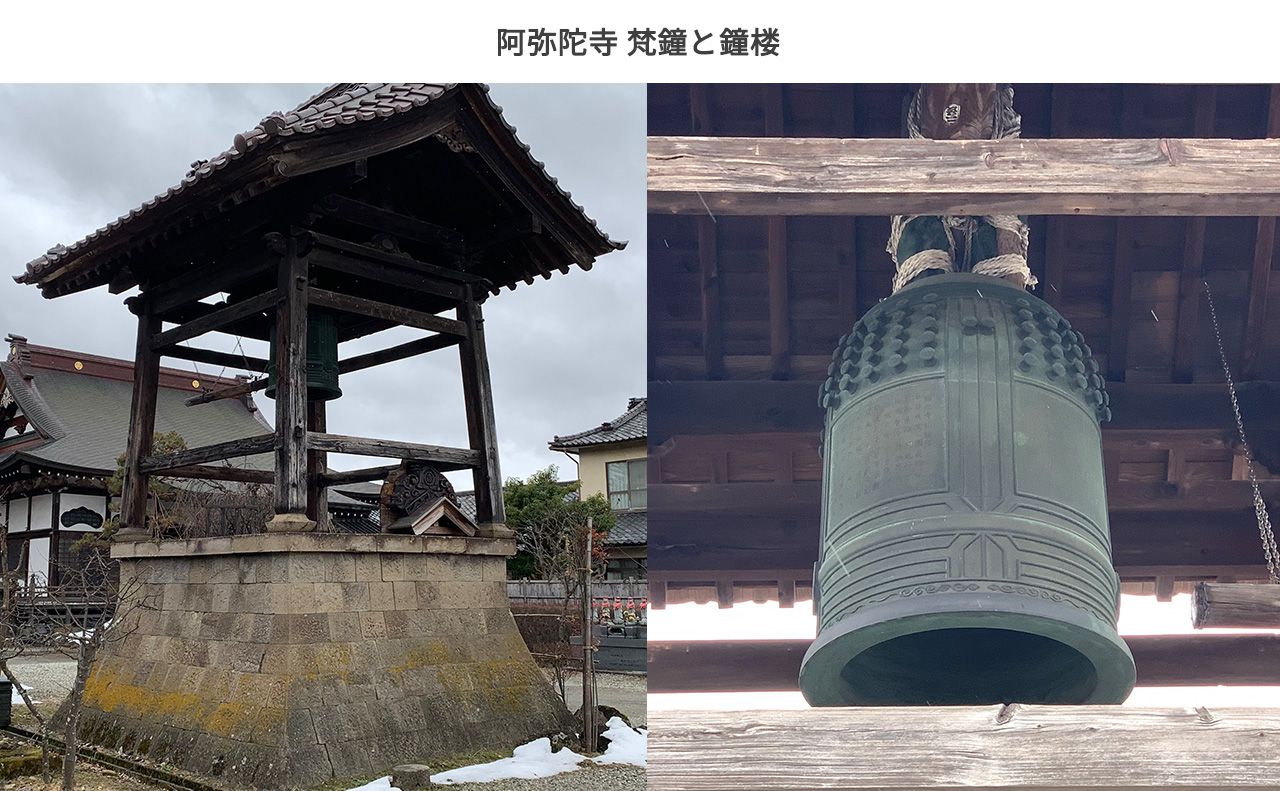 11. Bonsho bell and bell tower
Beside the burial mound, there is a bonsho bell and bell tower. These were initiated at the personal expense of Kashiwa Nanahei, a sake brewer formerly of Hara-no-cho in Wakamatsu City.
When the plan became widely known, people of all ages and genders contributed copper coins, gold coins, bronze mirrors, silver hairpins, and more. This bonsho and bell tower, carrying the wishes of so many people, took from Meiji 31 (1898) to Meiji 35 (1902) to complete.
Around the bonsho, the origins, the composer of the inscription, those involved in the casting, and a poem by Nanahei's son Kashiwa Nanabe Toshimoto are engraved.
Because this bonsho was dedicated with the devotion of so many people in memory of those who died in the Boshin War, it was specially exempted from metal requisition during the Pacific War.
Inscription around the bonsho
Origin of the bell
In the Boshin War, our Aizu samurai gave their lives amid arrows and stones, numbering some three thousand. In the circumstances of the time, they could not each be given a proper burial, and so they were interred together at the tower of Wakamatsu Amida-ji Temple.
My late father Kashiwa Nanahei grieved deeply and, wishing at least to honor the departed, spent his own funds to have a bell cast and a tower built, placing it at the temple.
Thus he sought to comfort their spirits and pray for their peace in the afterlife. This story reached far, and from the temples Chion and Zozo, the Six-Character Myogo and the Master's Dharma Collection were bestowed — a most rare honor in this world. Wishing to pass down our father's aspiration for all time, Kashiwa Naonosuke had a brief account inscribed upon the edge of the bell.
March, Meiji 35, year of Mizunoe Tora
Kurita Nobuhide, carver
Origin of the bell (modern translation)
In the Boshin War, our Aizu samurai gave their lives on the battlefield, their number reaching three thousand. Under the circumstances, they could not each be given individual burials, and so they were interred together at the tower of Wakamatsu Amida-ji Temple.
My late father, Kashiwa Nanahei, grieved deeply and, wishing at least to honor the departed, spent his own funds to have a bell cast and a tower built, placing it at the temple.
This was driven by the desire to comfort the spirits of the departed and pray for their peace.This story spread far, and the temples Chion-ji and Zojo-ji bestowed the Six-Character Myogo and the Master's Dharma Collection — a most rare honor. Wishing to pass down our father's aspiration for all time, Kashiwa Naonosuke had this account recorded and carved upon the edge of the bell.
March, Meiji 35, year of Mizunoe Tora
Kurita Nobuhide, carver
Inscription on the hanging of the bell at Amida-ji Temple (literary rendition)
In former times, in the Boshin year, the national order was in turmoil. Armies gathered in east and west, and the chaos of battle spread like clouds.
Our Aizu Domain was sincere and purely loyal.
The lone castle did not yield; it was not merely like Zhang Xun.
Alas, parents wept for children; alas, children lost parents.
Three thousand bodies were buried in this field.
The age gradually opened, and the ends of the earth became neighbors.
In the Meiji era, the groups scattered and returned to one origin.
Where the humble one cries out, the spirits observe clearly.
Long live the Emperor — peace to the nation.
Donor — Kashiwa Nanabe Toshimoto
Inscription on the hanging of the bell at Amida-ji Temple (modern translation)
In the Boshin year, the national order was in chaos, and armies gathered in east and west, the turmoil of battle spreading like clouds. Our Aizu Domain was sincere and purely loyal. The lone castle did not yield; it was not merely like Zhang Xun (the Tang general). Alas, parents wept for children, and children lost parents. Three thousand bodies were buried in this field. The age gradually opened, and even distant lands became neighbors. In the Meiji era, groups scattered and returned to one. Where the humble one cries out, the spirits observe clearly. Long live the Emperor — peace to the nation.
Donor — Kashiwa Nanabe Toshimoto
At that time, 21st generation
Hagyuda Kanno, proxy
Inscription — Sahara Sumisumi
Careful copy — Kawase Hachisaburo Masayoshi
Engraving — Hayashi Eizaburo Terutoshi
Also — Hayashi Shuzo Mitsuo
Casting — Hoshino Munasa Tomotaka
Contribution of 10 kan of bell metal — Yamaguchi Eigo
Repair — Yoshiyo Tsukudai
Also — Abiko Kimesaburo
Also — Oshima Hatsutaro
Also — Oshima Teijiro
Also — Takaki Kamezo
Carpenter — Okubo Yosaku
December 7, Meiji 31
"Even boundless sins and retribution shall vanish in the resonance of the Dharma bell — Toshimoto"
Modern translation: "Even boundless sins and retribution shall vanish in the resonance of the Dharma bell — Toshimoto"
Inscriptions on the stone walls of the bell tower
Donated by Kashiwa Nanabe, Hara-no-cho, Wakamatsu City
Lumber yard — Yanagibashi Moto, Okubo Zensaku
Carpenter — Okubo Seisaku, Yoko-Sannichi-cho, Wakamatsu City
Stone mason — Yagi Koshi no Yoshi, Ishiyama Village
Stone mason — Yagi Hikotaro, Ishiyama Village
Tile worker — Watanabe Kyutaro, Ishiyama Village
Earthwork — Kigiwa Sojiro, Dojo-Koji-cho, Wakamatsu City
12. Great Buddha foundation
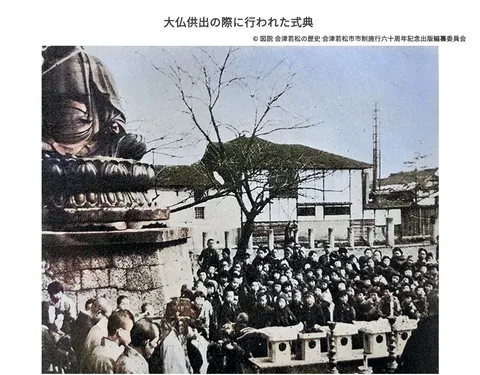
To the left of the burial mound, there is a foundation 1 jo high (1.8 m) and 7 shaku in diameter (2.1 m). An open-air Great Buddha once stood here.
See also Amida-ji Temple and the Great Buddha
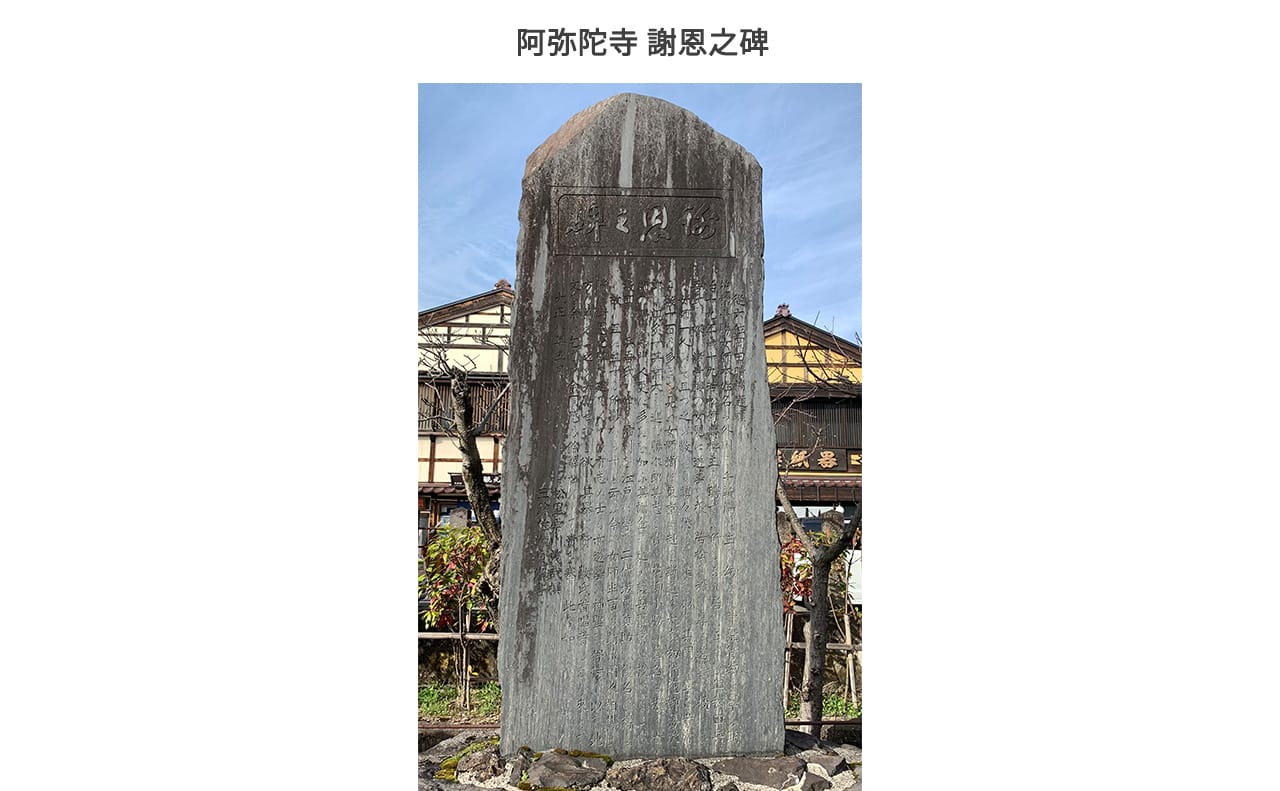 13. On of Gratitude stele
Facing the Nanukamachi-dori side from behind the Amida-ji Temple buildings and burial mound, there remains a stone stele titled "On of Gratitude stele."
This honors the achievements of "Karyu Koshin," who taught the arts to the women of the Nanukamachi pleasure quarter, then the most prosperous district in Wakamatsu City.
The Aizu Shokaki (1922) records: "Among the Wakamatsu geisha, the Nanukamachi geisha were disciples of master Karyu Koshin, and they aspired to present refined hand dances unlike those of Higashiyama (present-day Higashiyama Onsen), performing pieces such as Aizu Hakkei and Shikunshi."
This stele was erected by her students to commemorate her 50th birthday.
Title inscription by Junior Sixth Rank Okuda Sekkyo
Karyu Koshin, female teacher. Original name: Togawa Michi, born in Niigata. From childhood, she studied song, dance, and music.
In Meiji 19, at age 19, she was engaged by the proprietor of Kikuju-ro in Wakamatsu and stayed there for several years. She married Matsuda Heigo and taught the arts to women of the pleasure quarters.
She was the only woman in Wakamatsu to teach the arts professionally, and taught with such dedication that her students numbered from dozens to hundreds.
The teacher traveled to Tokyo to study under the great master of this art, the first Karyu Katsujir.
Her art greatly improved, and Katsujir appreciated her dedication, granting her the art name Karyu Koshin.
Upon her return, even more students joined. She donated her teaching fees to charitable causes several times. Heigo also studied theater in Edo and received the stage name the second Bando Hina.
The two often shared drinks together. Now the teacher has passed fifty years of age. Her students discussed building a stele of gratitude. Those with aspirations also wished to preserve the sacredness of the arts and encourage them for the region, supporting the endeavor. Several became sponsors and came to ask me for the inscription. Unable to decline from sympathy, I accepted this responsibility. As such.
May, Taisho 8
Matsusato Sosawa Shigeya, composer
Sanyo Sasa Teikai, calligrapher
(modern translation)
Junior Sixth Rank Okuda Sekkyo wrote the title inscription.
Karyu Koshin's real name was Togawa Michi. Born in Niigata, she studied song, dance, and music from childhood.
In Meiji 19 (1886), at age 19, she was invited by the proprietor of Kikuju-ro in Wakamatsu and stayed there for several years.
She married Matsuda Heigo and taught the arts to women of the pleasure quarters.
She was the only woman in Wakamatsu to teach the arts professionally, and taught with such dedication that her students numbered from dozens to hundreds.
She traveled to Tokyo to study under the great master of this art, the first Karyu Katsujir.
Her art greatly improved, and Katsujir appreciated her dedication, granting her the art name Karyu Koshin.
Upon her return, even more students joined. She donated her teaching fees to charitable causes several times.
Heigo also studied theater in Edo and received the stage name the second Bando Hina.
The two often shared drinks together. Now the teacher has passed fifty years of age. Her students discussed building a stele of gratitude.
Those with aspirations also wished to preserve the sacredness of the arts and encourage them for the region, supporting the endeavor. Several became sponsors and came to ask me for the inscription.
Unable to decline from sympathy, I accepted this responsibility.
May, Taisho 8 (1919)
Matsusato Sosawa Shigeya, composer
Sanyo Sasa Teikai, calligrapher
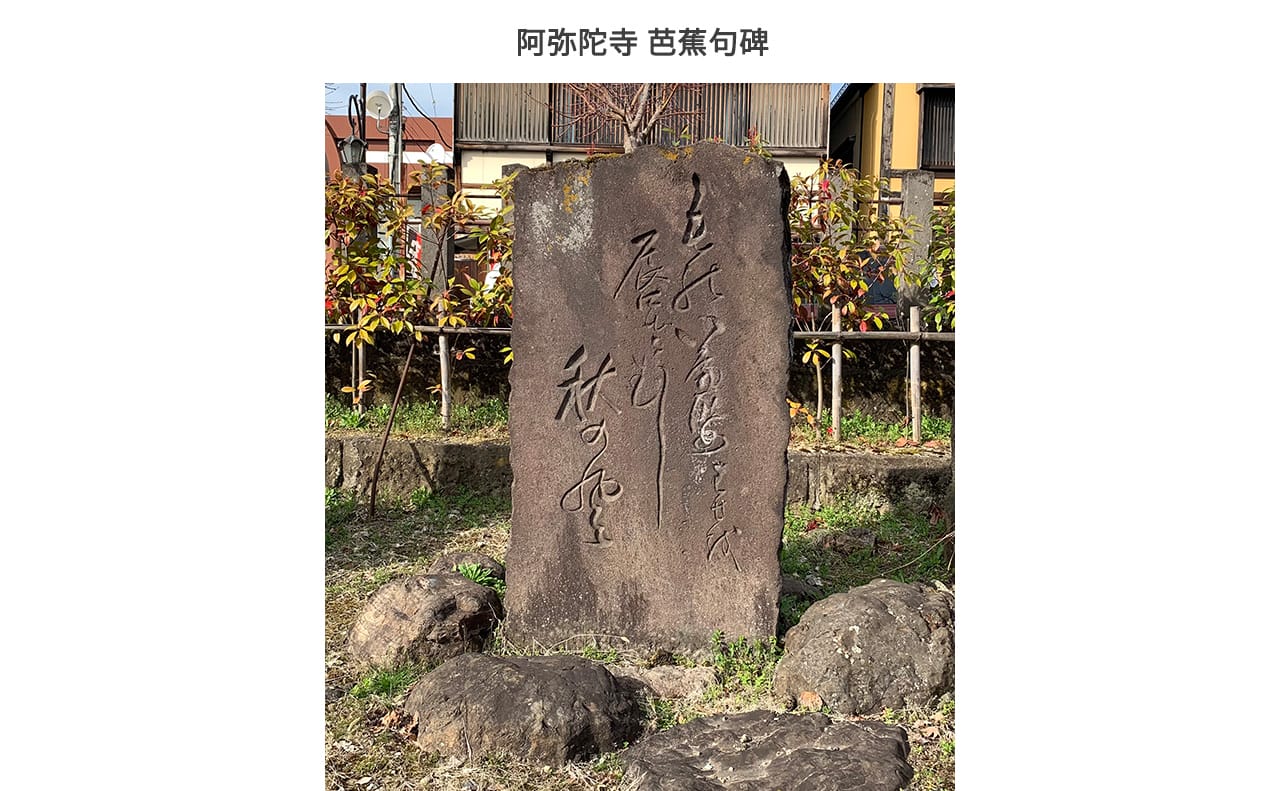 14. Basho kuhi (haiku stele)
"Speaking — how cold the lips, autumn wind"
This haiku stele of Matsuo Basho is said to have been erected in 1893 (Meiji 26), the 200th memorial year of Basho's death. A Basho haiku stele also remains at nearby Nanukamachi Jizoson.
The founding and prosperity of the templeThe encounter of Ryonen and Itakura ShuriThe founder of Amida-ji Temple in Keicho 8 (1603) was Ryonen (Kakurensha Ryonen Shonin), born in Shimotsuke Province Makabe-gun (also called Higashi-Makabe-gun, corresponding to much of present-day Haga-gun in Tochigi Prefecture, including present-day Mashiko-machi, Ichikai-machi, Motegi-machi, and parts of Utsunomiya City and Moka City).
Ronen resided as the head priest of Zendoji (1-1-23 Shimizudai, Koriyama City, Fukushima Prefecture) in Mutsu Province Asaka-gun (covering parts of present-day Koriyama City and Nihonmatsu City). However, Ryonen fell ill and came to Higashiyama Onsen in Wakamatsu for recuperation.
At that time, Itakura Shuri, a retainer of Gamo Hideyuki who governed Aizu, sought to keep his dear friend Ryonen in Aizu. He petitioned Hideyuki for land and worked to establish Amida-ji Temple.
The name of Itakura Shuri appears in the "Gamo family register" (Gamo-ke Buke-cho), which serves as a roster of Gamo retainers. It shows his rank as "Uma-mawari 9th unit, 700 koku."
Given that only about 10 percent of Aizu Domain retainers earned over 500 koku, Itakura Shuri held a senior position and had the means to found a temple.
See also "Column: On the name of Itakura Shuri"
The support of Kurata TamezaneBeyond Itakura Shuri, many others cooperated in founding Amida-ji Temple.
One such supporter was Kurata Shin'emon Tamezane (later Kurata Doutaku, after taking the tonsure). Kurata Tamezane maintained a residence near Omachi Yotsukado and held the position of kenden (an official responsible for public order, including police and judicial duties) as well as being a wealthy merchant.
The Kurata family is said to have entered Aizu from Hino (present-day Hino-cho, Shiga Prefecture) around the same time that Gamo Ujisato was transferred to Aizu.
However, according to the "Kurata-shi Kaho" (compiled by Kurata Shuji, 1971), Kurata Tamezane had already moved to Aizu at age 18 in Eiroku 5 (1562), 28 years before Ujisato's arrival. The reason for the Kurata family's move to Aizu is unknown, but records show that at age 18, Tamezane came with his elder brother Yozaemon to Kurokawa (near present-day Kanasashi-cho, Aizuwakamatsu City) and visited Yanagitsu-cho Fukuman Kokuzo-son Enzoji, after which Yozaemon settled in Date-gun while Tamezane remained in Aizu.
Tamezane's family trade was matchlock gun manufacturing. In Bunroku 1 (1592), he participated as an assistant in the major castle town reorganization by the Gamou, and in recognition received land near Omachi Yotsukado, becoming a town elder (later kenden) of the Omachi district.
Thus, by the time of Amida-ji Temple's construction, the Kurata family already held considerable influence.
Given the Kurata family's power and their devout faith in Jodo Buddhism, they aided in the temple's construction. The name "Amida-ji" is said to have been chosen after the Amida-ji Temple in Tamezane's hometown.
At age 29, Tamezane married the daughter of Shiroishi Jiro, a craftsman from Kurokawa (then 19). His wife died on February 25, Keicho 9 (1604).
Tamezane's grandson, Yokota Toshimasu, recorded: "The temple was first completed, and his late wife was buried." This serves as evidence that the temple was completed by Keicho 8 (1603) or Keicho 9 (1604).
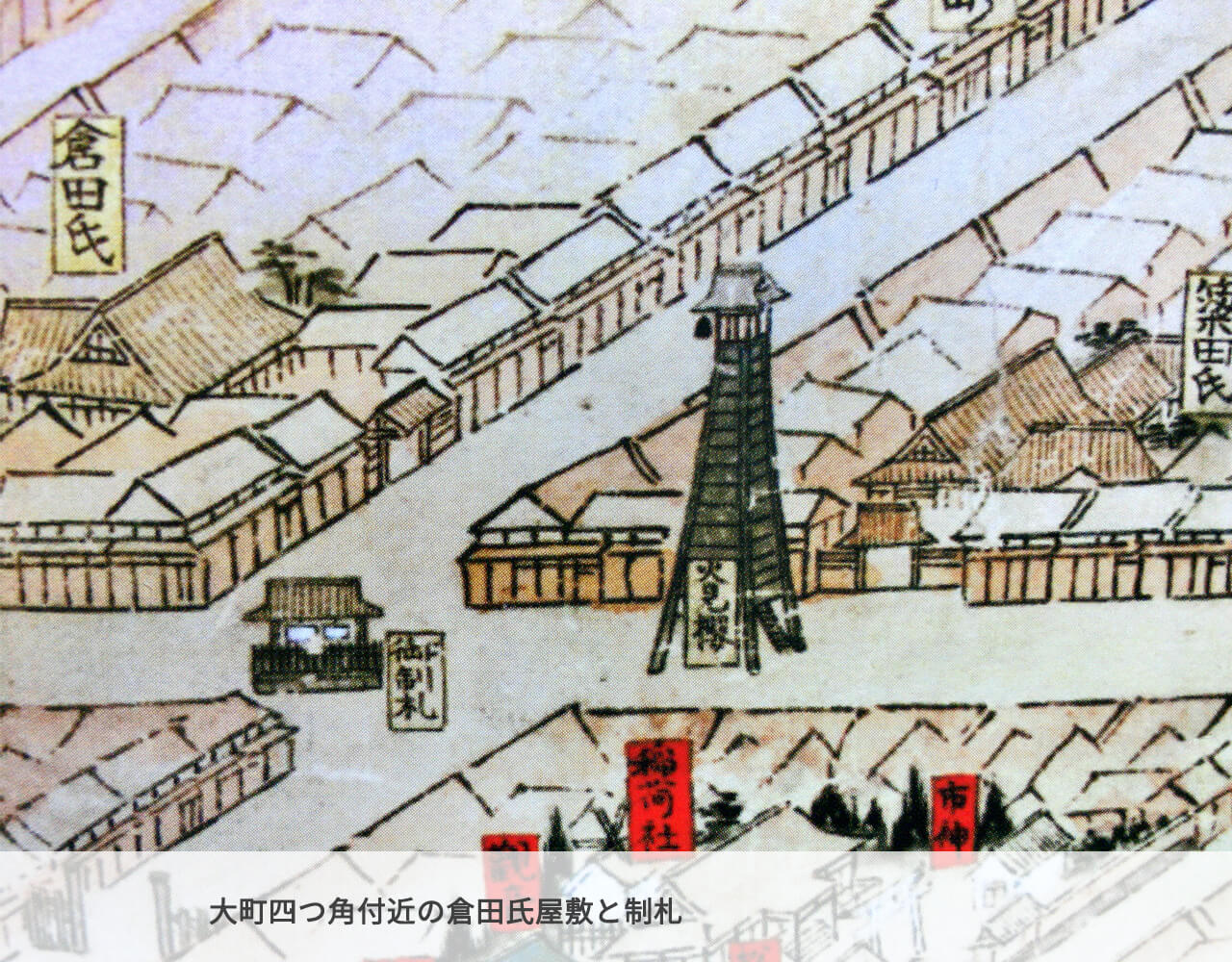 The present-day Kurata family residence near Omachi Yotsukado. The Yanada family residence, which also served as kenden alongside the Kurata, is also depicted.
Completion of Amida-ji TempleThrough the efforts of many people, the grand buildings of Amida-ji Temple were completed.
The temple was beautifully equipped with a Buddha hall (for enshrining and worshipping Buddhist statues), a monks' hall (for sutra chanting, sermons, and tea gatherings), a hojo (priest's residence), and small subsidiary temples. It was recognized by Shimotsuke Osawa Entsu-ji (1770 Osawa, Mashiko-machi, Haga-gun, Tochigi Prefecture) and became its branch temple.
Ronen possessed an Amida Buddha statue 2 shaku 7 sun 5 bu tall (approx. 104 cm), which was installed as the temple's principal image.
In Genna 4 (1618), more than 130 monks gathered for a great dharma assembly. From April to July, a three-month summer ango (secluded training period) was held. The completed Amida-ji Temple attracted many people and flourished. It also served as a Jodo sect training center.
The following year, Ryonen opened Gankozan Kensho-ji (16-36 Nisshin-cho, Aizuwakamatsu City, Fukushima Prefecture) to the west of Amida-ji Temple as his retirement temple. He passed away at Kensho-ji on April 10, Genna 8 (1622).
See also "Column: Temples associated with Ryonen"
The second head, Ryosen, who succeeded Ryonen, further expanded the buildings. By Kanei 10 (1633), the temple had become one of the largest in the Aizuwakamatsu castle town.
However, during the time of the fourth head Ryodon, a fire that broke out at midnight on January 29, Shoho 2 (1645) became a great blaze and destroyed all the temple buildings. The only thing that survived was the principal Amida triad (with Kannon Bosatsu and Seishi Bosatsu as attendant figures). A new hall was built in the summer of the same year, but the former splendor could not be restored.
Conflict between the Amida-ji Temple head priest and the Kurata familyLater, when the head priest of Amida-ji Temple was Soeki, frequent conflicts arose with parishioners and other temples in the castle town. One such conflict was with the Kurata family, who had worked to establish the temple.
At that time, the Kurata family was led by Yokota Toshimasu (grandson of Kurata Tamezane; son of Kurata Toku, Tamezane's daughter, and her husband Yokota Toshitsugu; he was given the name Yokota, the original surname of the Aizu Yokota Sannai/Sannouchi family).
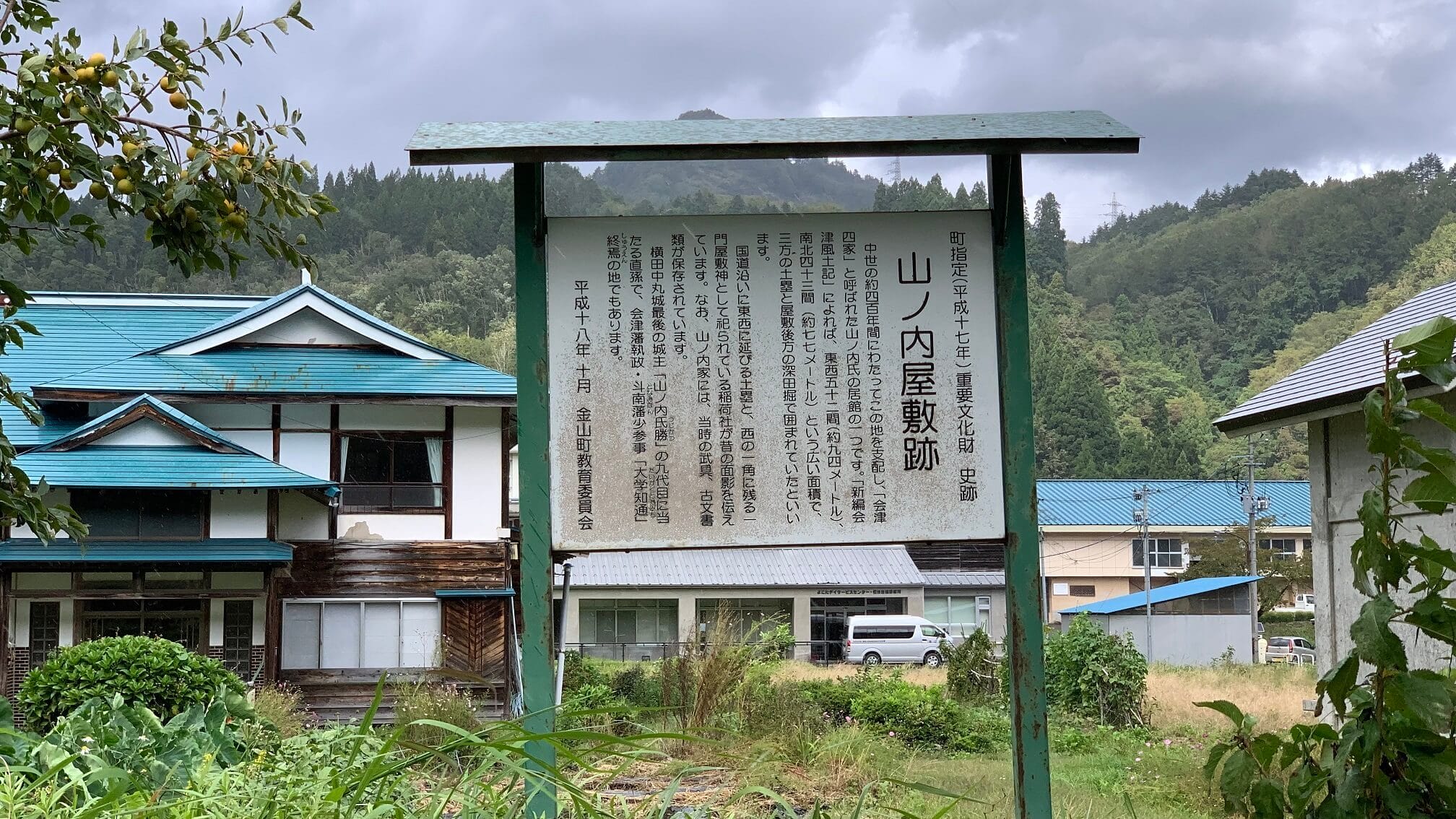 Sannouchi residence site, Yokota, Kanayama-cho, Fukushima Prefecture (658 Iehira, Yokota, Kanayama-cho, Onuma-gun, Fukushima Prefecture)
Prefecture-designated (Heisei 17) Important Cultural Property — Historic Site
Sannouchi Residence Site
One of the residences of the Sannouchi clan, who ruled this area for approximately 400 years during the medieval period and were called one of the "Four Houses of Aizu."
According to the "Shinpen Aizu Fudoki," the site measured 52 ken east-west (approx. 94 m) and 43 ken north-south (approx. 77 m), surrounded by earthen walls on three sides and a deep moat behind the residence.
The earthen walls extending east-west along the national road and the Inari shrine enshrined as a family deity at the northwest corner still convey the appearance of those days. The Sannouchi family preserves period arms and historical documents.
This is also the place where Tomomichi, a direct ninth-generation descendant of the last lord of the Yokota Nakamaru Castle, "Sannouchi Ujikatsu," and the final head of the Aizu Domain regency and Tono Domain junior councilor, met his end.
October, Heisei 18 — Kanayama-cho Board of Education
Through Tamai Un'an, Yokota Toshimasu conveyed the following to the Amida-ji Temple head priest Soeki:
"Since my ancestor Kurata Tamezane founded Amida-ji Temple, I have buried my grandparents and parents there and offered annual memorials. However, from youth I studied Confucianism and devoted myself to its way. I serve Lord Masayuki, who favored Confucianism, respected the way of the kami, and left a testament that funerals should depart from Buddhist practice. If I too die, I wish to be buried according to Confucian rites. Now, monks act out of self-interest, causing disputes with descendants after death. Therefore, I prohibit Buddhist chanting and recitation in my household going forward. If there is objection to this decision, I will move my ancestors' graves elsewhere and sever all future contact."
The head priest Soeki did not raise objection at the time, but this incident would have lasting consequences.
Yokota Toshimasu's sister was married to Kimura Kyusai, and she had been ill for a long time. As her death approached, her husband Kimura Kyusai considered that Amida-ji Temple's low-lying, damp ground would make burial difficult, and decided to bury her at Okuboyama (913 Kuroiwa, Aizuwakamatsu City, Fukushima Prefecture), the official cemetery of the Aizu Domain. He requested Soeki to perform the yudo (final rites guiding the deceased to the Pure Land).
However, Soeki refused, saying he would not perform yudo for anyone not buried at Amida-ji Temple.
Kimura Kyusai pleaded, citing past cases of monks performing rites outside the temple, but Soeki continued to refuse, adding that he would not even allow Kimura to set foot in Amida-ji Temple thereafter.
Hearing of these events, Yokota Toshimasu stated that if Soeki directed his anger at his sister and her husband Kimura Kyusai, he too would not enter the gates of Amida-ji Temple. On July 7, Tenwa 2 (1682), he had Hattaba Gen'oku deliver notice that he and his relatives would no longer visit the temple.
Thus, the conflict between the Kurata family (Yokota family) and the Amida-ji Temple head priest Soeki became decisive.
After these events, on February 22, Genroku 7 (1694), Soeki filed a lawsuit against the temples of Aizuwakamatsu. However, he lost the case and was expelled by the domain.
In June of the same year, a monk from Sendo-Kobama Nishinen-ji came to Amida-ji Temple as his successor. On August 11, Yokota Toshimasu visited the temple with his family and paid respects at the graves of his grandparents and parents.
On August 18, Yokota Toshimasu's eldest son, Yokota Toshimasa, also visited Amida-ji Temple, and reconciliation between the Kurata family (Yokota family) and Amida-ji Temple was finally achieved. It was the 13th year since the conflict began.
On February 8, Genroku 9 (1696), Yokota Toshimasa invited the Amida-ji Temple head priest to his home and hosted him. His father Toshimasu was also present at the gathering.
Thus the Kurata family (Yokota family) and Amida-ji Temple were reconciled, but from the next generation, Yokota Samasa, they were buried elsewhere rather than at the temple. It was not until the 9th generation, Teimi, that the Kurata family (Yokota family) returned to being buried at Amida-ji Temple.
Thus, Amida-ji Temple experienced various events, but its influence gradually declined.
By the late Edo period, the temple had fallen into ruin beyond repair, and the once-flourishing Amida-ji Temple was but a shadow of its former self.
It was not until Showa 50 (1975) that the present main hall was built, after a period of using the Osangai (described below) as a temporary main hall.
These historical details about Amida-ji Temple are also recorded in the "Shinpen Aizu Fudoki," compiled between Kyowa 3 (1803) and Bunka 6 (1809).
The "Aizu Fudoki" was completed in Kanbun 6 (1666) under the name of Hoshina Masayuki, lord of the Aizu Domain. The "Shinpen Aizu Fudoki" was a revised edition that supplemented the original with additional information.
Volume 19 of the "Shinpen Aizu Fudoki," section "Wakamatsu 5, Shimomachi," describes Amida-ji Temple as follows:
Amida-ji Temple
Located in a lane leading from this town (Nanukamachi) to Kitakoji-cho, it was called Shogaku-zan.
A branch temple of Osawa Entsu-ji in Makabe-gun, Shimotsuke Province (present-day Mashiko-cho, Haga-gun, Tochigi Prefecture), of the Jodo sect.
The founding monk was Ryonen, born in Makabe. He lived at Zendoji in Asaka-gun (including parts of present-day Koriyama City and Nihonmatsu City), but came to Aizu for medical treatment and stayed temporarily for several years.
Among the retainers of Gamo Hideyuki was Itakura someone (Itakura Shuri). Having been a friend of Ryonen from before, he petitioned Hideyuki and founded this temple in Keicho 8 (1603).
At that time, Kurata someone (Kurata Tamezane) had come from present-day Shiga Prefecture and established a residence here, providing funds to assist in the effort.
The Buddha hall, monks' quarters, and multi-purpose buildings were all large and magnificent, fully equipped.
Thus it became a branch temple of Entsu-ji.
In Genna 4 (1618), more than 130 high-ranking monks gathered for a great dharma assembly.
Ceremonies were held from April to July, becoming a grand event that continues to this day.
Ryonen later opened Kensho-ji as his retirement temple.
After that, Amida-ji Temple was destroyed by fire, and the Buddha hall and monks' quarters were not restored. Only the Amida image survived and was enshrined in the guest hall. It is said that Ryonen himself had preserved it.
[Shinpen Aizu Fudoki, Volume 19, Wakamatsu 5, Shimomachi]
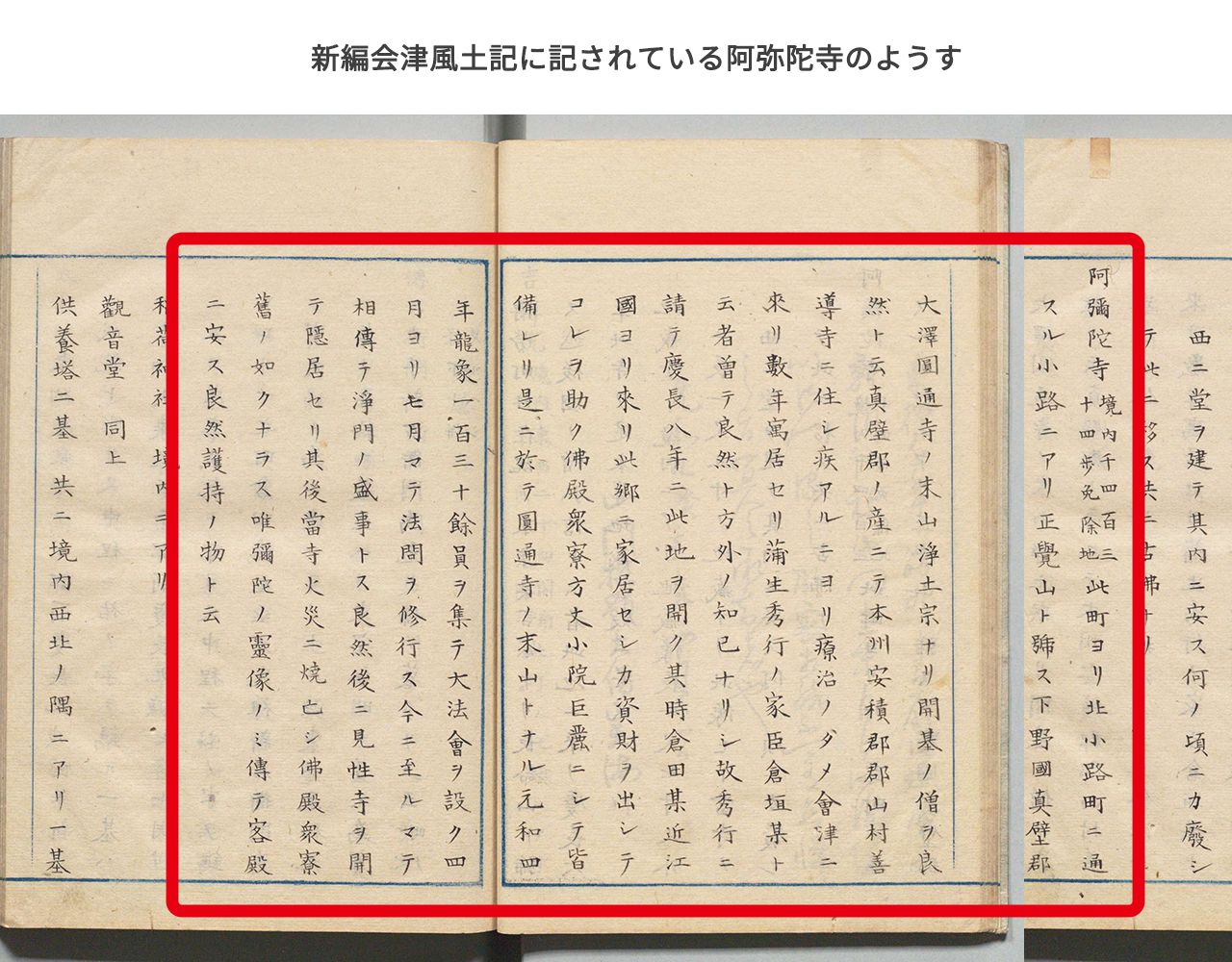 Amida-ji Temple, precinct of 1,434 bu exempted land
(Amida-ji Temple, precinct of 1,434 bu exempted land)
Located in a lane leading from this town to Kitakoji-cho, called Shogaku-zan
(A located in a lane leading from this town to Kitakoji-cho, called Shogaku-zan)
In Makabe-gun, Shimotsuke Province — branch mountain of Osawa Entsu-ji, Jodo sect
(In Makabe-gun, Shimotsuke Province — branch mountain of Osawa Entsu-ji, Jodo sect)
The founding monk was called Ryonen, born in Makabe-gun. He lived at Zendoji in Asaka-gun, Mutsu Province. Due to illness, he came to Aizu for treatment and resided there for several years.
(The founding monk was called Ryonen, born in Makabe-gun. He lived at Zendoji in Asaka-gun, Mutsu Province. Due to illness, he came to Aizu for treatment and resided there for several years.)
A retainer of Gamo Hideyuki, called Itakura someone, had previously been a friend of Ryonen. He petitioned Hideyuki and opened this place in Keicho 8.
(A retainer of Gamo Hideyuki, called Itakura someone, had previously been a friend of Ryonen. He petitioned Hideyuki and opened this place in Keicho 8.)
At that time, Kurata someone came from Omi Province and made his home in this village, providing funds to assist.
(At that time, Kurata someone came from Omi Province and made his home in this village, providing funds to assist.)
The Buddha hall, monks' quarters, hojo, and small temples were all magnificent and fully equipped.
(The Buddha hall, monks' quarters, hojo, and small temples were all magnificent and fully equipped.)
Thus it became a branch mountain of Entsu-ji.
(Thus it became a branch mountain of Entsu-ji.)
In Genna 4, more than 130 dragon-elephants (high monks) gathered for a great dharma assembly.
(In Genna 4, more than 130 dragon-elephants (high monks) gathered for a great dharma assembly.)
From April to July, they practiced the dharma gate. This has been transmitted to the present as a great event of the Pure Land gate.
(From April to July, they practiced the dharma gate. This has been transmitted to the present as a great event of the Pure Land gate.)
Ryonen later opened Kensho-ji and retired.
(Ryonen later opened Kensho-ji and retired.)
Thereafter, the temple was burned by fire, and the Buddha hall and monks' quarters were not as before. Only the sacred Amida image was transmitted and placed in the guest hall. It is said that Ryonen had protected it.
(Thereafter, the temple was burned by fire, and the Buddha hall and monks' quarters were not as before. Only the sacred Amida image was transmitted and placed in the guest hall. It is said that Ryonen had protected it.)
The Boshin War and Amida-ji TempleBurial of the war deadAs time passed, by the late Edo period Amida-ji Temple came to be enveloped in an uneasy atmosphere.
In the Boshin War, in which the former shogunate forces (including the Aizu Domain) fought against the New Government Army, the remains of war dead were reinterred at Amida-ji Temple.
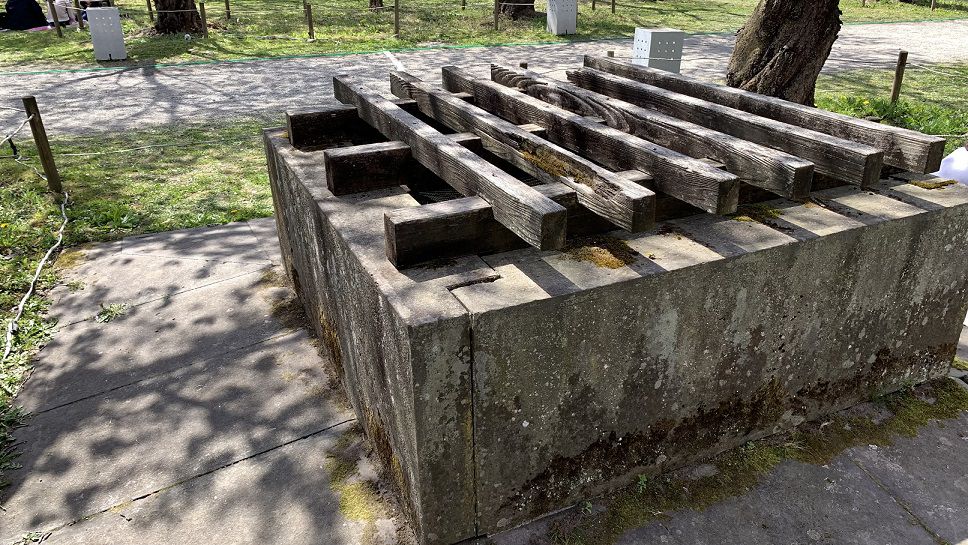 The current well in front of the Weapons Storehouse site
The day after the Civil Affairs Office was established, on the 2nd, an order was issued to bury the bodies left inside and outside Tsuruga Castle (Aizuwakamatsu Castle), and work began on the 3rd. This was 10 days after the Aizu Domain's surrender.
The bodies found inside the castle were thrown into two empty wells within the castle grounds, and when those were full, they were buried at the Fukko-kuruwa of the Ninomaru (the Nashien, near the present-day tennis courts).
"The dead inside the castle were thrown into the empty well in front of the weapons storehouse and filled in. The bodies of samurai and ladies of the inner household were buried in the Ninomaru pear field."
[Arakawa Ruiemon Katsushige, Meiji Diary]
"There are two empty wells in the Ninomaru, each several tens of shaku deep, filled with corpses, and all the others were temporarily buried in the pear garden."
[Hiraishi Benzo, The Aizu Boshin War]
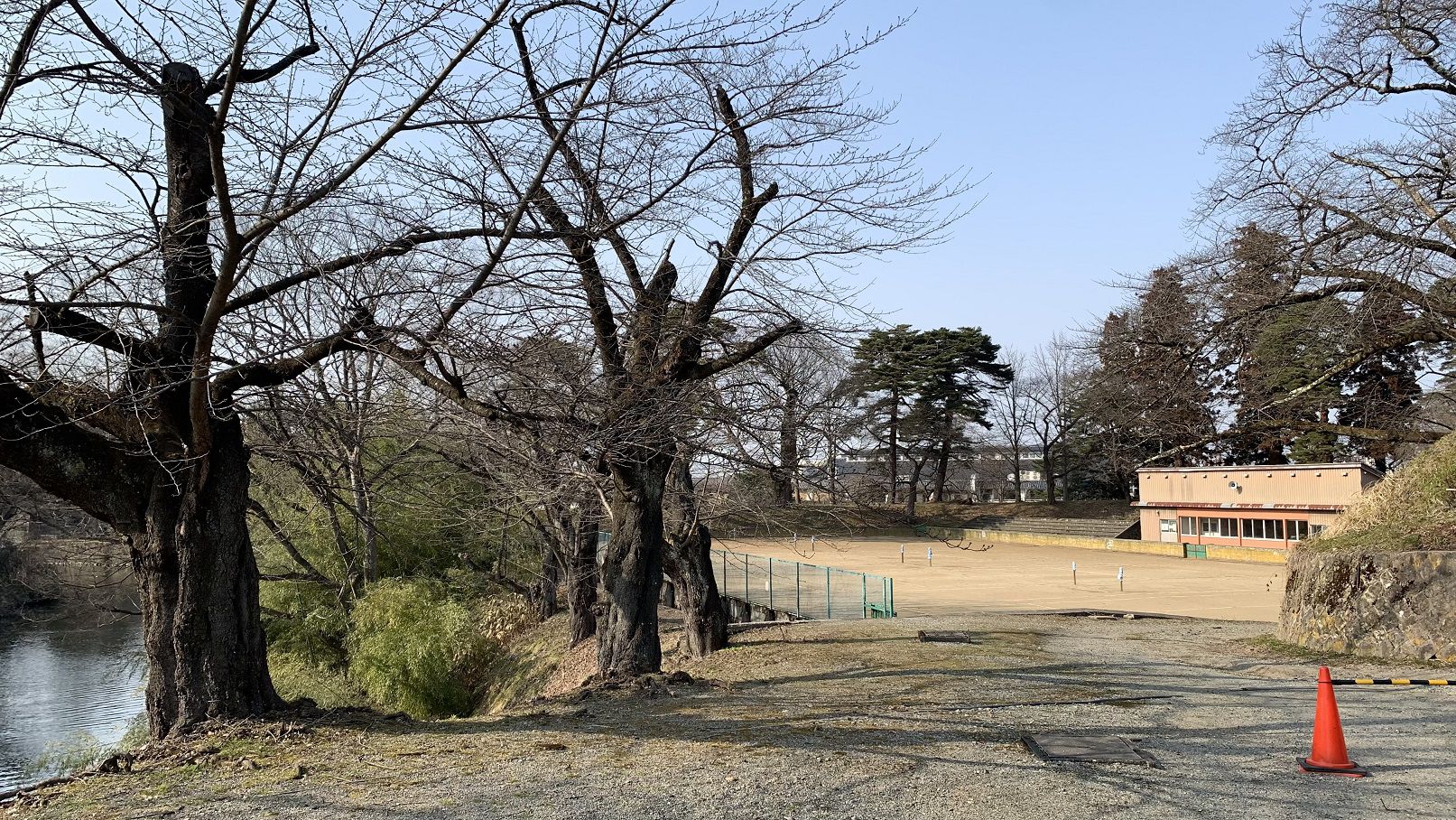 Present-day Ninomaru of Tsuruga Castle, site of the Pear Garden
According to this record, 103 bodies found within the castle enclosure were buried in seven locations within the Koutoku-ji Temple (2-12 Sakae-machi, Aizuwakamatsu City, Fukushima Prefecture) grounds. Other remains found elsewhere were buried in 64 locations near their discovery sites, such as temples.
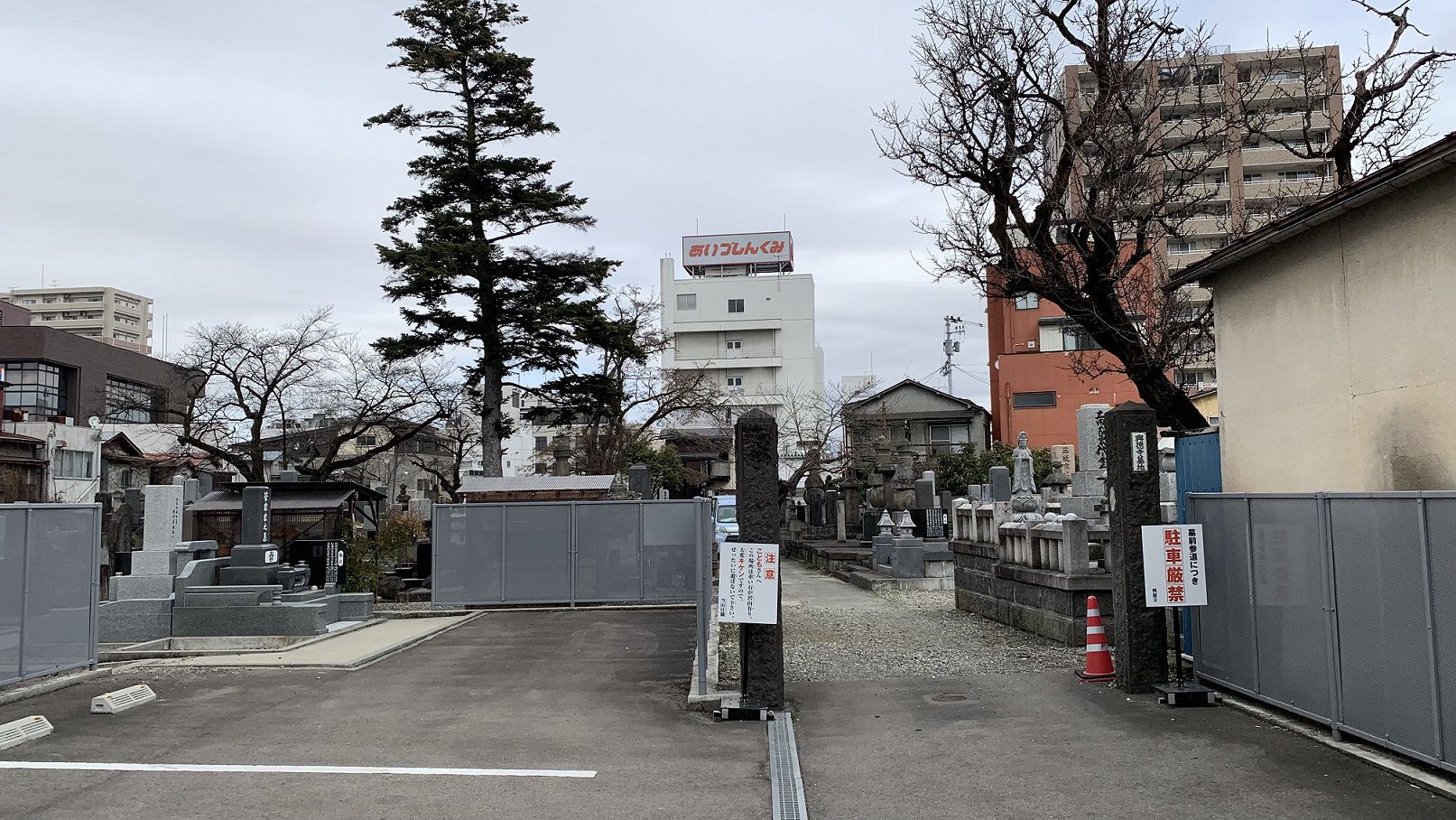 Koutoku-ji Temple today
Akabahiko Sakusaku: 227 buried in castle enclosure/outer areas (Nanukamachi, Yamato-machi, Koga-machi, Yotsuya) and suburbs (Nakanoake).
Takeda Genzo: 184 buried in outer areas (western/southern) and suburbs (Ichinoseki, Iidera).
Saito Mosuke and Mizuno Hachim: 134 buried in outer areas (Daino-machi) and suburbs (Tonoguchihara, Sasayama, Kyoshimizu, Kanahori, Takizawa Yanagibashi).
Additionally, 22 new government soldiers were buried in the western field of Komatsusha Shrine (2-1 Kaimori-machi, Aizuwakamatsu City).
The total cost of burial was 74 ryo, 2 shu, 630 mon, with a total workforce of 384. The name of Shiga Reinosuke, a Yonezawa Domain samurai, is also recorded as having borne lodging and lunch expenses.
The "Koyo Boseki" document preserved in the Yanada family also retains the order issued by the Civil Affairs Bureau to the eta kimoiri (historical terms used at the time; kimoiri was the community leader of the eta class) to clean up the remains of war dead.
Item: Summon the eta kimoiri Sayonosuke and inform him about cleaning up the dead in the castle. Since Sayonosuke asked how to proceed, he was instructed as follows, to be taken to Murata Misaburo.
Item: About two hundred of the eta workers are to be assigned to duty; about one hundred may return home. Of these, first thirty are to be sent. Furthermore, for passage through the castle, the kendan is to make wooden passes and submit a request that they be delivered to the Civil Affairs Bureau. As before, they are to be kept inside the castle. Once the bodies in the castle have been cleared, the bodies inside and outside the castle are to be cleared as well. Regarding the places where the bodies are buried, the kendan is to inform the nearest temple. If there are any difficulties, the eta kimoiri is to report them to the kendan.
Note: those who receive the pass should report at three o'clock on the third day. Those who clear the bodies from the castle should report on the fourth day.
October, Civil Affairs Bureau
[Yanada family documents, Koyo Boseki]
Since the recent war, bodies have been left lying within the castle and throughout the city, and those who see them find it unbearable. Therefore, make every effort to dispose of them promptly. In accordance with the imperial compassion that shall follow, those found cleaning the city shall report to the appropriate authorities without omission.
the tenth month of the old calendar in the Tatsu (Dragon) year (1868)
[From the Yanada Family Documents, Koyo Boseki]
Although some burial work for Aizu Domain bodies had been carried out in October, the Civil Affairs Bureau ordered the reinterment of once-buried remains. The reasons are believed to have been as follows:
- Odor from bodies left in wells.
- The hasty work meant some bodies could not be buried deeply enough.
- The Aizu Yonaoshi Ikki (Ya-ya Ikki) — outbreaks of long-simmering discontent against the Aizu Domain — occurred frequently across the former Aizu Domain territory, causing confusion.
- The burial period coincided with the snowfall season.
- In many cases it was unclear who was buried where, and a location was needed for family members to visit graves.
Reinterment at Amida-ji TempleUnder these circumstances, the new government ordered reinterment, designating as the new cemetery a site near Odabayama in Aizuwakamatsu — or the Yakushidogawara / Kurokawa execution ground criminal mound (near Namida-bashi bridge, Hashimoto, Aizuwakamatsu City, Fukushima Prefecture) — land where Aizu Domain horses and criminals had been buried and which was considered impure. The Aizu domain samurai strongly protested this.
Furthermore, within the common class system of the time, there were people classified as senmin (outcastes) below the shi-no-kosho (warrior-farmer-artisan-merchant) hierarchy. These people were tasked with burying criminal bodies, among other duties. It is said that the burials performed by the senmin treated the bodies of Aizu domain samurai the same as criminal remains — casting stones and tiles at them.
For these reasons, the Aizu domain samurai repeatedly petitioned for a change in the reinterment location and for burials to be performed by people other than the senmin. As a result, one of the newly designated reinterment sites was the then-neglected Amida-ji Temple.
At Amida-ji Temple, reinterment began on February 24, Meiji 2 (1869) (April 5 by the new calendar). Bodies that had been temporarily buried at nearby temples were also reinterred at Amida-ji Temple.
From March 9, bodies within Tsuruga Castle that could be identified were reinterred at their family temples, while unidentifiable remains were reinterred at Amida-ji Temple. According to the "Boshin Senshisha Igai Maiso-ki," Takeda Genzo and Hyakuetsu Ban directed the reinterment as reinterment officers.
During these reinterments, large holes measuring 1.5 meters square were dug within the Amida-ji Temple grounds, and bodies collected from the castle town were buried. The bodies were laid out, covered with straw mats, and more bodies were piled on top, reaching a height of 4 shaku (approximately 1.2 meters).
Additionally, soil was gathered from temples throughout the castle town where burials had taken place before reinterment, and a yohaijo (worship hall) was constructed measuring 2 ken 1 shaku 5 sun square (approximately 4 meters) and 7 shaku high (approximately 2.1 meters). At the center of this altar stood a pillar inscribed "Choshi-hyo" (Memorial Marker). Around it, a tamagaki (boundary fence) was erected measuring 4 ken east-west (approximately 7.2 meters) by 4 ken 2 shaku north-south (approximately 7.8 meters).
Hyakuetsu Ban, who directed the reinterment, also issued instructions for reinterment at approximately 16 other locations besides Amida-ji Temple. As a record of this, he left the "Senshi no Bosho Soezu" (Rough Map of Fallen Soldiers' Grave Sites). The appearance of Amida-ji Temple is also depicted in the "Senshi no Bosho Soezu."
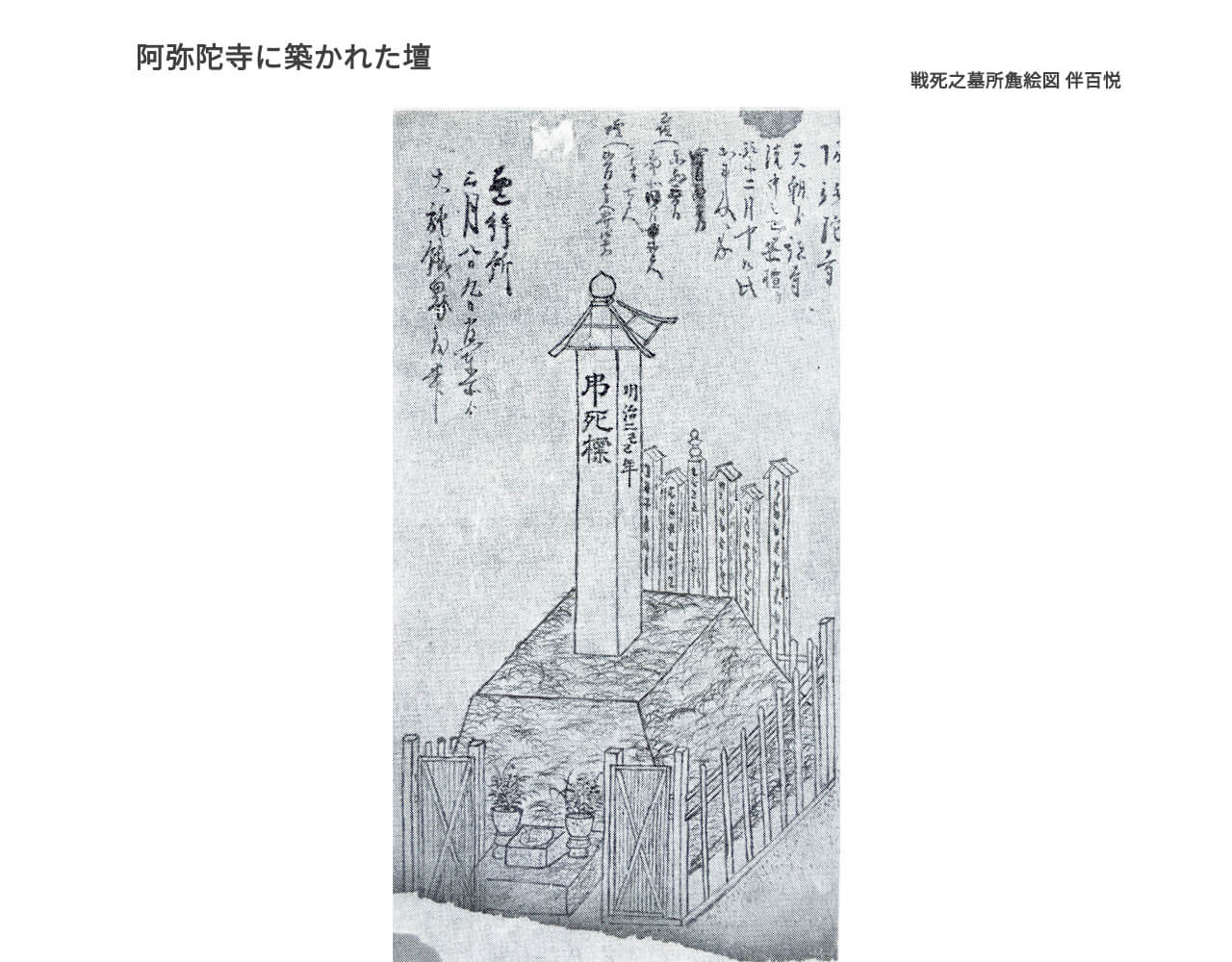 Amida-ji Temple
Soil was collected from various temples by order of the Imperial Court, and altars were
constructed, reaching this state by the second month.
Ogaki (3 ken east-west, 4 ken 2 shaku north-south)
Altar (7 shaku high, 2 ken 1 shaku 5 sun square)
Yohaijo, Great Segaki ritual performed on the 8th and 9th of the third month from the government army location.
On March 2, Meiji 2 (1869), a notice was issued from the Civil Affairs Bureau, and from March 4 to 9 a Great Segaki-e (daisegakie — dharma assembly for the repose of unconnected spirits) was held.
During these memorial services, reinterment at Amida-ji Temple continued, and the reinterment work was completed on April 22 (June 2 by the new calendar).
An altar was constructed at Amida-ji Temple measuring approximately 4 ken east-west (approximately 7.3 meters) by 12 ken north-south (approximately 21.8 meters) and 4 shaku high (approximately 1.2 meters). However, reinterment work to other locations continued, and the collection of remains scattered across mountains and fields proceeded.
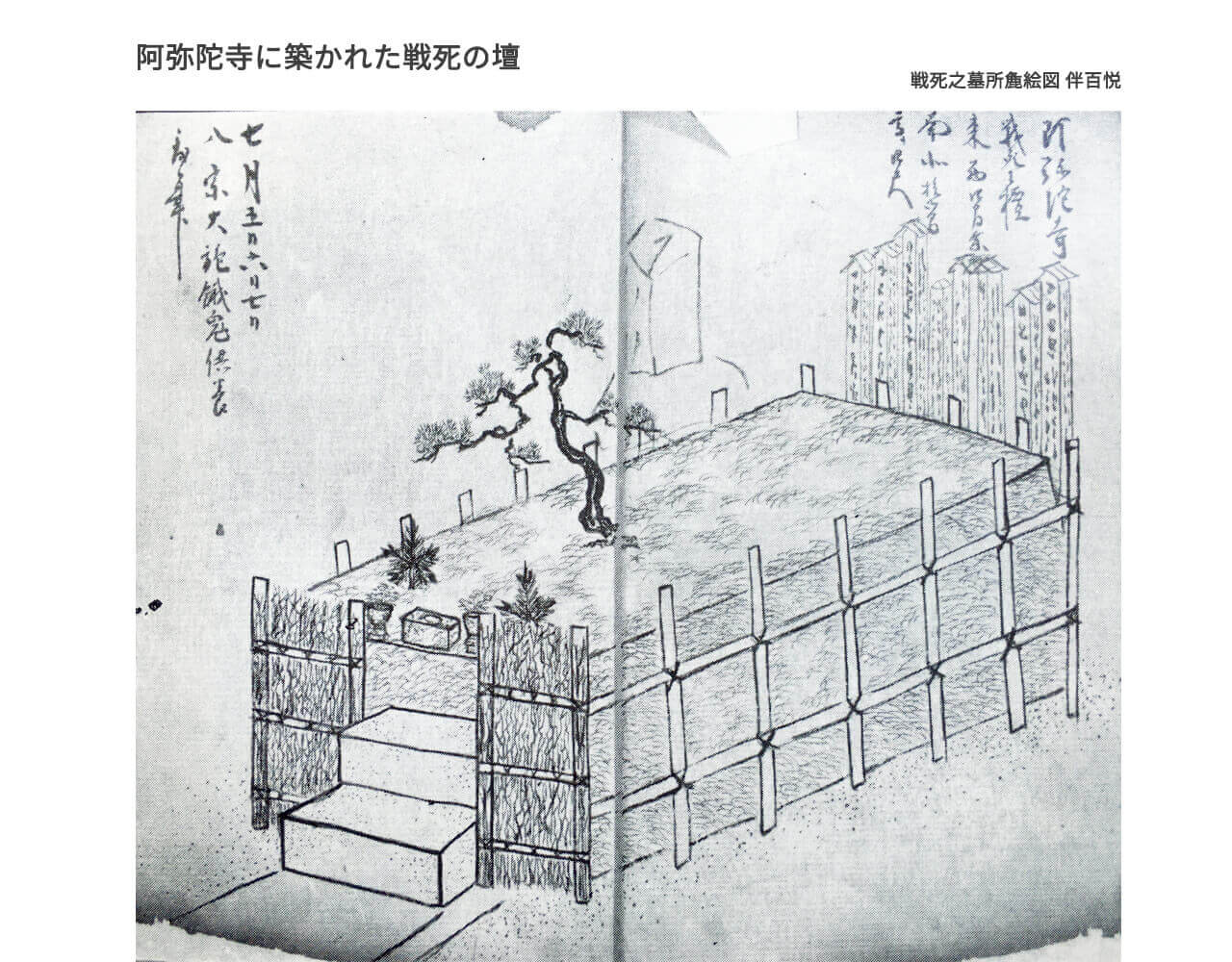 Amida-ji Temple
Altar of the war dead, approximately 4 ken east-west
Approximately 12 ken north-south, 4 shaku high
Fifth, sixth, and seventh days of the seventh month
Great Segaki of eight sects
Memorial services performed
From the fifth to the seventh day of the seventh month of the same year, monks of various sects from within the castle town of Wakamatsu and neighboring villages gathered at Amida-ji Temple to perform memorial services.
On the 23rd day of the eighth month, marking exactly one year since the new government army had entered the castle town of Aizuwakamatsu, a broad announcement was sent to former Aizu domain samurai, and grand memorial services were held over three days.
Mase Mitsu (second daughter of Aizu domain samurai Mase Shinpei. During the Boshin War at age 36, she was besieged within Tsuruga Castle. She later recorded the Goto Zatsuki, documenting the siege, transfer to Tonami, and return to Aizu from a woman's perspective) wrote the following in her "Goto Zatsuki" about that time:
"On the 23rd day of the 8th month of Meiji 2, the first anniversary of the war dead, three days of offerings were made. Great Segaki services were held at Amida-ji Temple and Chomei-ji Temple. Women, children, and the entire household gathered for worship. A splendid temporary hall was erected, and after the dharma assembly, sekihan (red rice) was cooked."
Hyakuetsu Ban, who directed these reinterments at Amida-ji Temple, later killed Kubo-mura Bunshiro, a Civil Affairs Inspector and judge with a notorious reputation, at Tsukamatsu Pass (Aizubange-machi, Fukushima Prefecture) and fled toward the Echigo region, but lost his life in Daianji-mura (Akiha-ku, Niigata City, Niigata Prefecture).
See also "Column: The Grave of Hyakuetsu Ban — Image Gallery"
Construction and evolution of memorial facilitiesAlongside burials at Amida-ji Temple, facilities to mourn the victims were also constructed.
During the aforementioned reinterment at Amida-ji Temple, a yohaijo was established and memorial services were conducted, with Amida-ji Temple serving as the central place for mourning the Boshin War victims.
In Meiji 3 (1870), relocation to Tonami, the new territory of the Aizu Domain, began. Because visiting graves at Amida-ji Temple became difficult, segaki memorial services were held on May 10. Additionally, the third anniversary memorial services were conducted from August 22 to 24.
By the time of the third anniversary, the altar at Amida-ji Temple had subsided, so approximately 1 shaku (about 30 cm) of soil was added on top, upon which stone towers and stone lanterns were erected, surrounded by a fence.
On the 25th, as in the previous year, Matsudaira Katamori and Katatoku (Katamori's adopted heir) were unable to attend due to their confinement, so former Aizu domain samurai visited in their place, and Katatake (Katamori's eldest son) himself visited Amida-ji Temple.
In July of Meiji 4 (1871), the han system was abolished and the domains disappeared, including the name of Tonami Domain. Former Aizu domain samurai who had relocated each chose their own paths — some remaining in place, some migrating elsewhere, and some returning to Aizu.
In the same year, the Osangai tower from within Tsuruga Castle was relocated to Amida-ji Temple and used as a temporary main hall.
Matsudaira Katamori attended the memorial services at Amida-ji Temple held in Meiji 7 (1874).
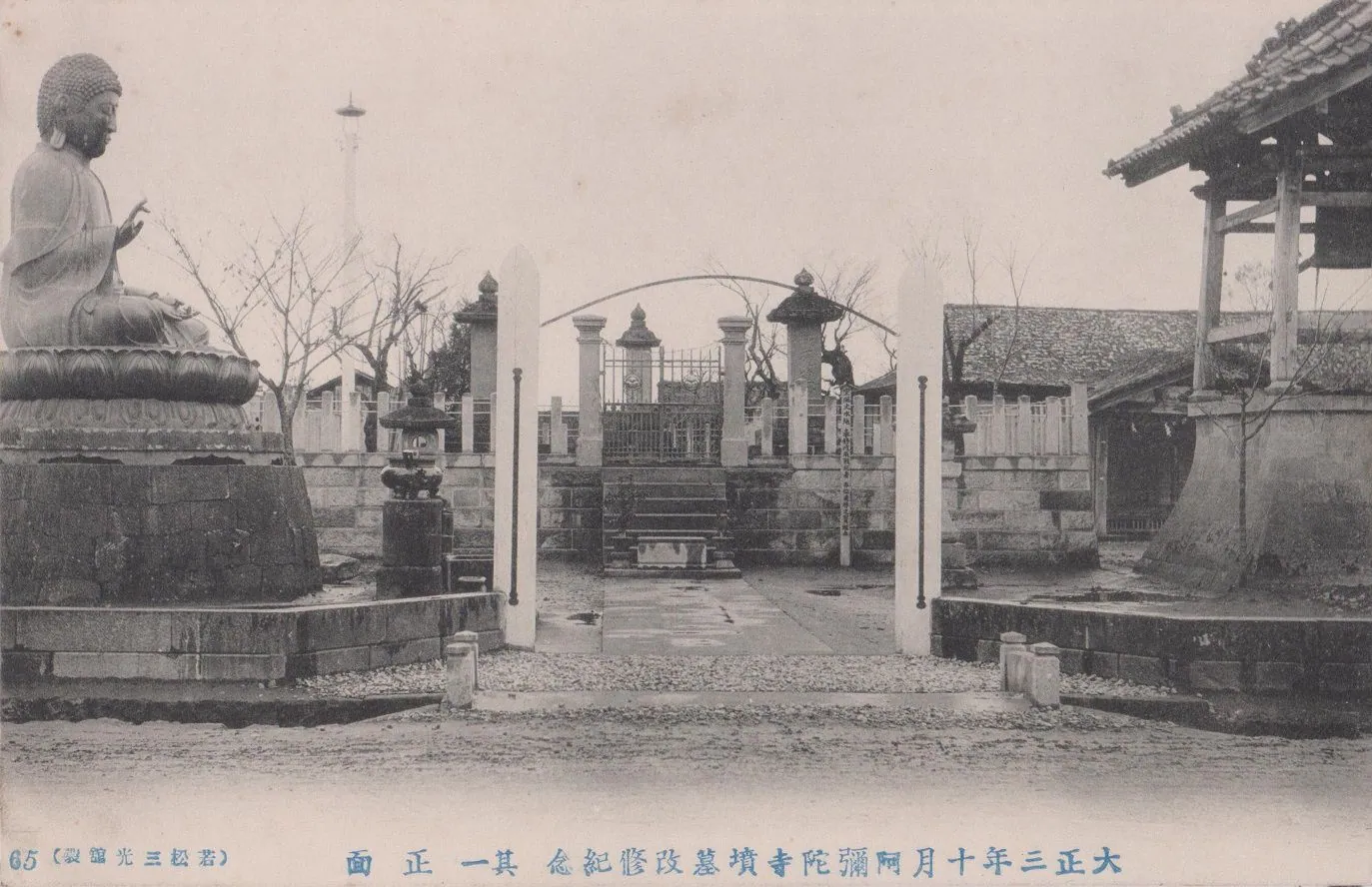
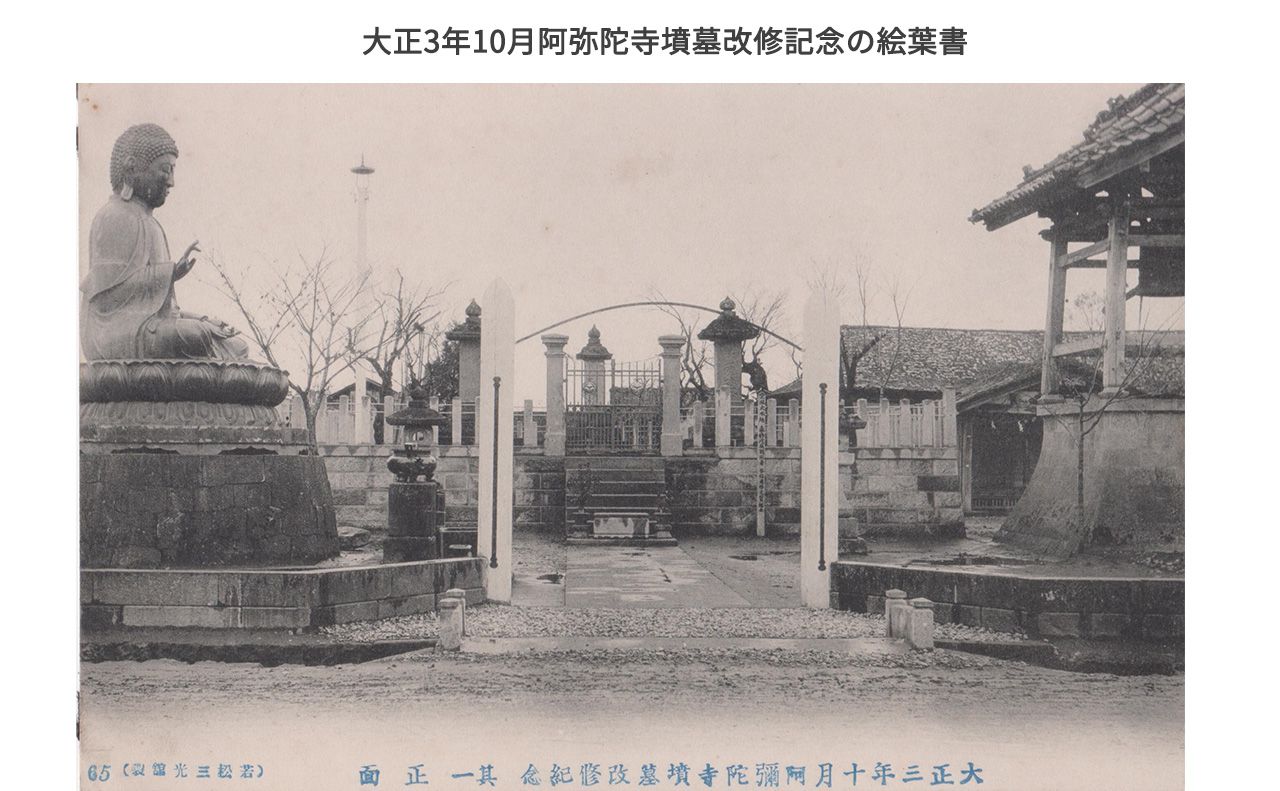 A postcard commemorating the renovation of the Amida-ji Temple cemetery in October, Taisho 3 (1914). Photographed from the front.
Nanukamachi.com Digital Archive: Amida-ji Temple Cemetery Renovation Memorial, Taisho 3 (1914) October
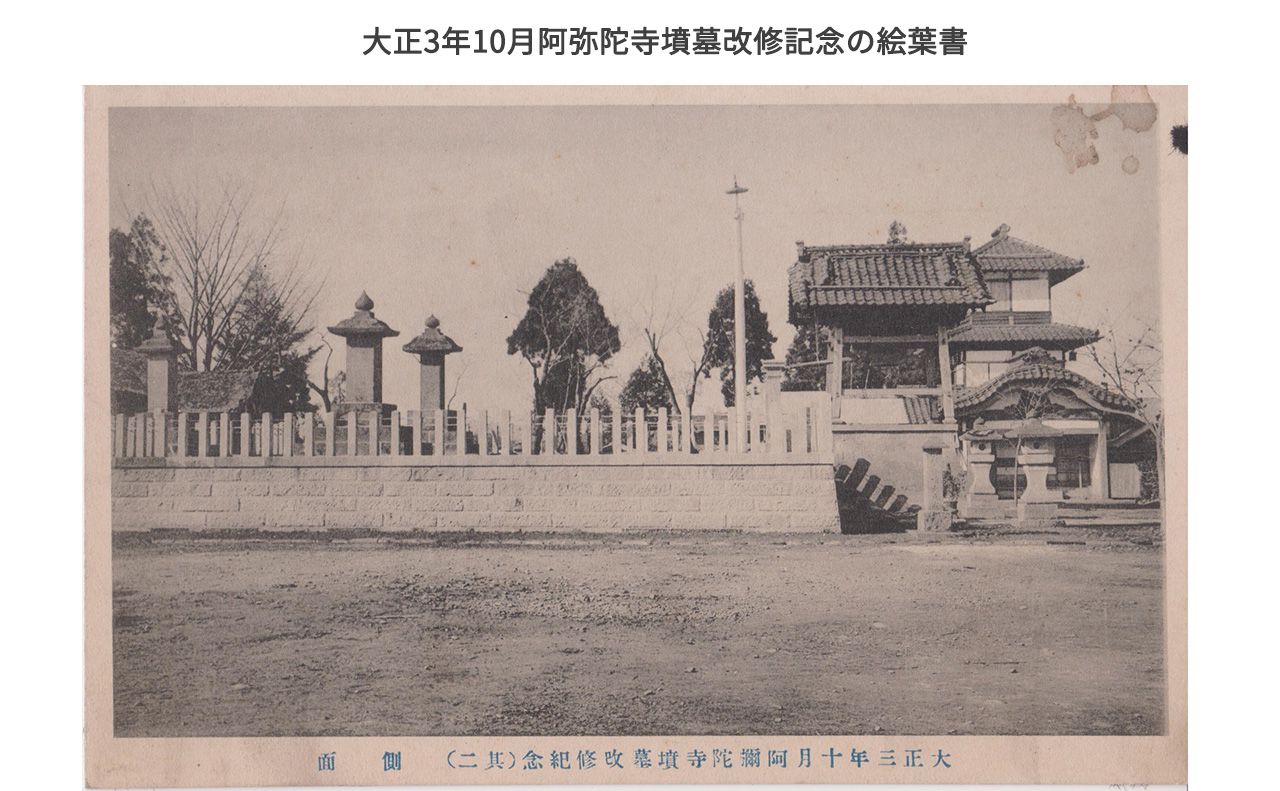 A postcard commemorating the renovation of the Amida-ji Temple cemetery in October, Taisho 3 (1914). Photographed from the side. This was before the Osangai was relocated within the Amida-ji Temple grounds, so its position differs from the present. Currently, because a private residence is adjacent to the site, it is difficult to view the side of the cemetery from this distance.
Nanukamachi.com Digital Archive: Amida-ji Temple Cemetery Renovation Memorial, Taisho 3 (1914) October
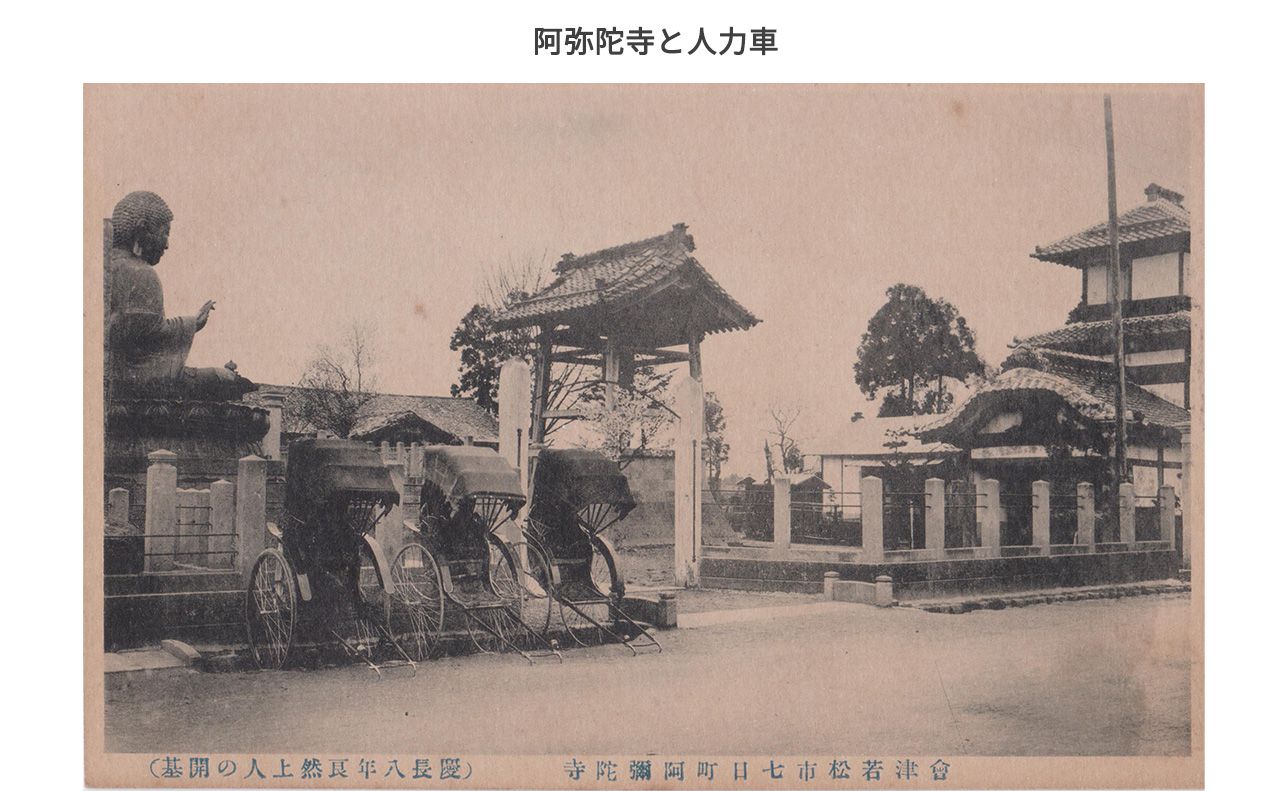 As there is a fence at the boundary of the precinct, this photograph is believed to have been taken after the renovation of the Amida-ji Temple cemetery in October of Taisho 3 (1914). The Osangai on the right has since been moved to the position behind the Great Buddha. There is a ditch along the edge of the road, and the rickshaw wheels are cleverly fitted into it for parking.
Nanukamachi.com Digital Archive: Amida-ji Temple on Nanukamachi, Aizuwakamatsu City (Founded by Ryonen Shonin in Keicho 8 (1603))
Construction of the first HairyodenBy around Meiji 7 (1874) or Meiji 8 (1875), a Hairyoden (Hall of Worship) was built by Matsuda Ikkai (a former Aizu Domain samurai who opened the first milk shop in Sapporo, Hokkaido). This facility was a permanent structure allowing the use of the yohaijo (worship hall) indoors.
In September of Taisho 2 (1913), the "Aizu Churei Gikai" (Aizu Memorial Society) was founded (first president: Machino Mondono).
Around the same time, as the Hairyoden building had aged, on April 15, Taisho 7 (1918), the Aizu Churei Gikai decided to construct a new Hairyoden on the site of the former Amida-ji Temple main hall. This construction plan progressed, but due to World War I and the resulting global recession, construction was temporarily suspended.
While construction was suspended, the Hairyoden continued to deteriorate, so in November of Taisho 13 (1924), the decision was made to resume construction, and fundraising was also restarted. Despite the difficult circumstances, the building was completed in December of Taisho 14 (1925), and its official name was designated as the "Boshin Junnan Hairyoden" (Memorial Hall for the Boshin War Martyrs). The plaque was calligraphed by Yasuo Matsudaira, the 12th head of the Aizu Matsudaira family, on a keyaki (zelkova) board measuring 3 shaku (approx. 90 cm) vertically and 1 shaku 5 sun (approx. 35 cm) horizontally.
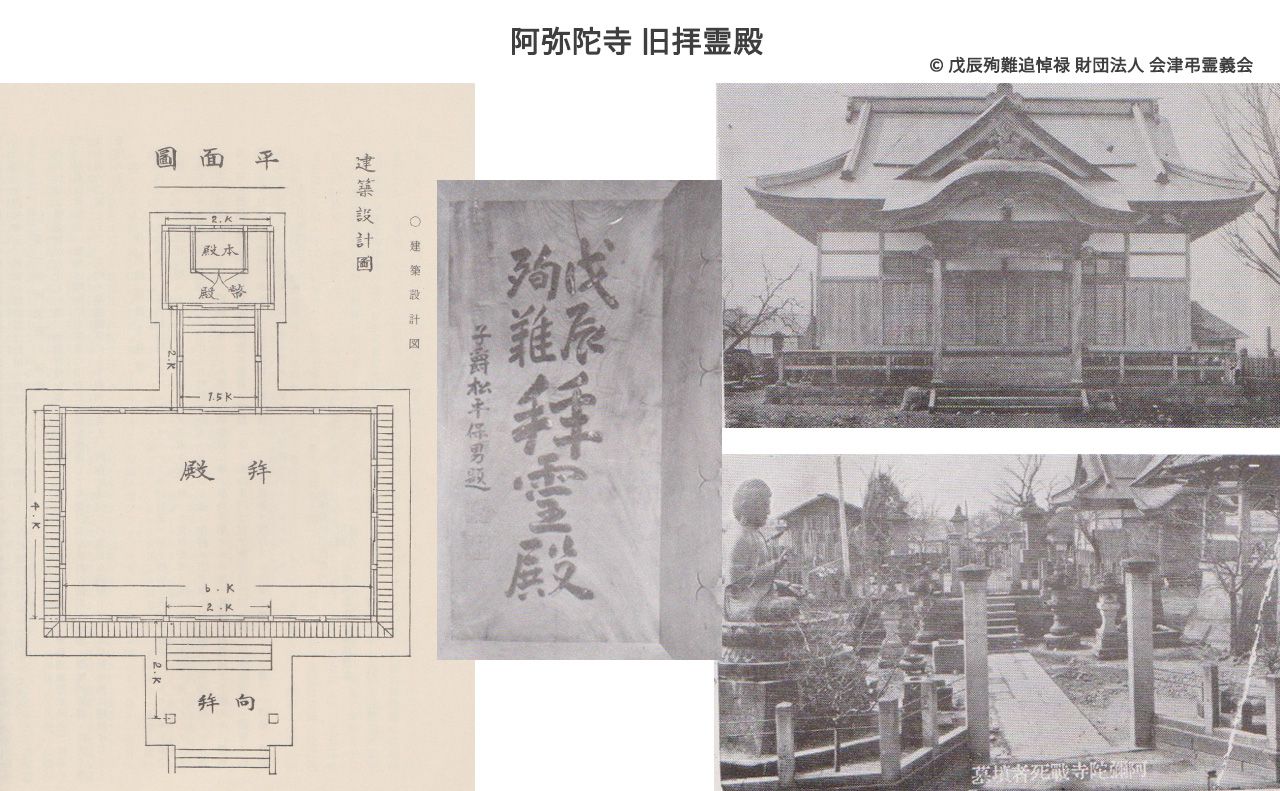 Floor plan of the former Hairyoden, the plaque, a photograph of the Hairyoden, and the state of the Amida-ji Temple precinct at that time.
Construction of the second HairyodenDuring the construction of the Hairyoden in Taisho 14, an agreement was made between the Aizu Churei Gikai and Amida-ji Temple that "if the main hall of Amida-ji Temple is rebuilt, the Hairyoden will be relocated."
Later, when it was decided to rebuild the Amida-ji Temple main hall, the decision was made not to relocate the Hairyoden but to incorporate it within the main hall. This was on January 12, Showa 49 (1974).
During the construction of the first and second Hairyoden, donations were received from many people and various organizations, including the Tokyo Aizu-kai and Tono Aizu-kai, along with heartfelt support.
These donations were made in reverence for the ancestors who had been labeled enemies of the court during the Boshin War and had endured harsh treatment even after the war.
Fundraising launch: June 20, Showa 49 (1974)
Fundraising conclusion: December 31, Showa 50 (1975)
Total amount raised: 27,792,500 yen
Breakdown:
Aizu region: 20,992,000 yen
Tokyo region: 5,367,000 yen
Tono region: 938,500 yen
Other regions: 495,000 yen
The main hall and Hairyoden newly built at this time are still in use today. And the memorial service for the Boshin War dead continues to be held every spring and autumn, spanning two days each, without fail to this day.
Currently, the Amida triad associated with Ryonen is enshrined at the back of the north-facing main hall's inner sanctuary. In the guest hall to the left of the principal image stands a large memorial tablet inscribed with "Senshi Shokon Reii" (Spiritual Places of the War Dead). To its left stands a wooden statue of Kayano Nagamitsu (Kayano Gonbe Nagamitsu) and memorial tablets of allied domain war dead. These are ten white wood tablets: Tokugawa samurai war dead, Kuwana Domain, Nagaoka Domain, Nihonmatsu Domain, Sendai Domain, Iino Domain, Mito Domain, Tanagura Domain, Shonai Domain, and Shinsengumi.
Amida-ji Temple also contains the graves of two former mayors of Aizuwakamatsu City.
Matsumoto Tokimasa (October 15, 1906 - October 10, 1912; June 21, 1915 - May 15, 1922), the 4th, 7th, and 8th mayor, who served as chairman of the "50th Anniversary Memorial Service for the Boshin War Martyrs of Both Armies" held at Tsuruga Castle's Honmaru on August 23, 1917 (Taisho 6).
Yokoyama Takeshi (March 28, 1948 - March 27, 1952; March 28, 1956 - March 27, 1968), the 19th, 21st-23rd mayor, who worked to rebuild Tsuruga Castle.
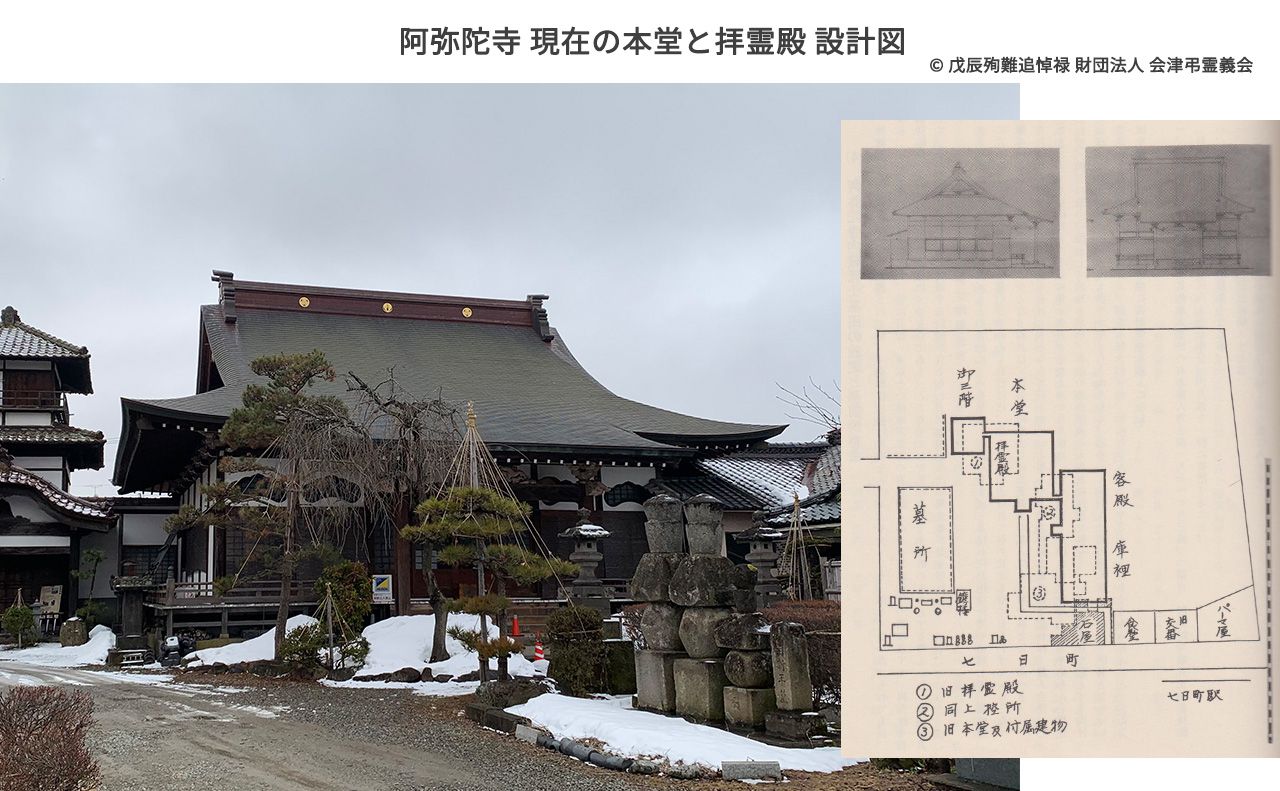 Floor plan of the current Amida-ji Temple and building layout.
Shinsengumi's Hajime Saito and Amida-ji TempleAs a person associated with the Boshin War and Amida-ji Temple, there is Hajime Saito, captain of the third unit of the Shinsengumi.
Hajime Saito fought in the Boshin War alongside Aizu.
As Western forces approached Aizuwakamatsu Castle and defeat became certain, Toshizo Hijikata decided to transfer the fight to Sendai to regroup.
However, at that time, Hajime Saito, who had become temporary commander due to Hijikata's injury, argued that he could not abandon the Aizu Domain, which had protected the Shinsengumi since Bunkyu 3 (1863). Saito, who had served as Hijikata's right-hand man, resolved to remain in Aizu.
It is said that more than ten Shinsengumi members remained with Saito, but they lost their lives in subsequent battles such as the Battle of Nyora-do.
Although Hajime Saito fought with swift and unpredictable tactics, his efforts proved in vain. When Tsuruga Castle fell and the Aizu Domain surrendered, the Aizu domain samurai were ordered to exercise self-restraint in Shiokawa and Inawashiro. Saito was confined to Shiokawa, but was later entrusted to the Takada Domain in Echigo along with other Aizu domain samurai, where he assumed the name Ichinose Denpachi.
When the Aizu Domain was transferred to Tonami, Saito also relocated there. Around this time, he was adopted into the Fujita family of the Aizu Domain and changed his name to Fujita Goro. He then married Takagi Tokio, the daughter of Takagi Kojuro, a senior official (Ometsuke) of the Aizu Domain.
Tokio Takagi, Hajime Saito's wife, was also close to Yae Niijima, and it is said that during the Boshin War, Tokio styled Yae's hair.
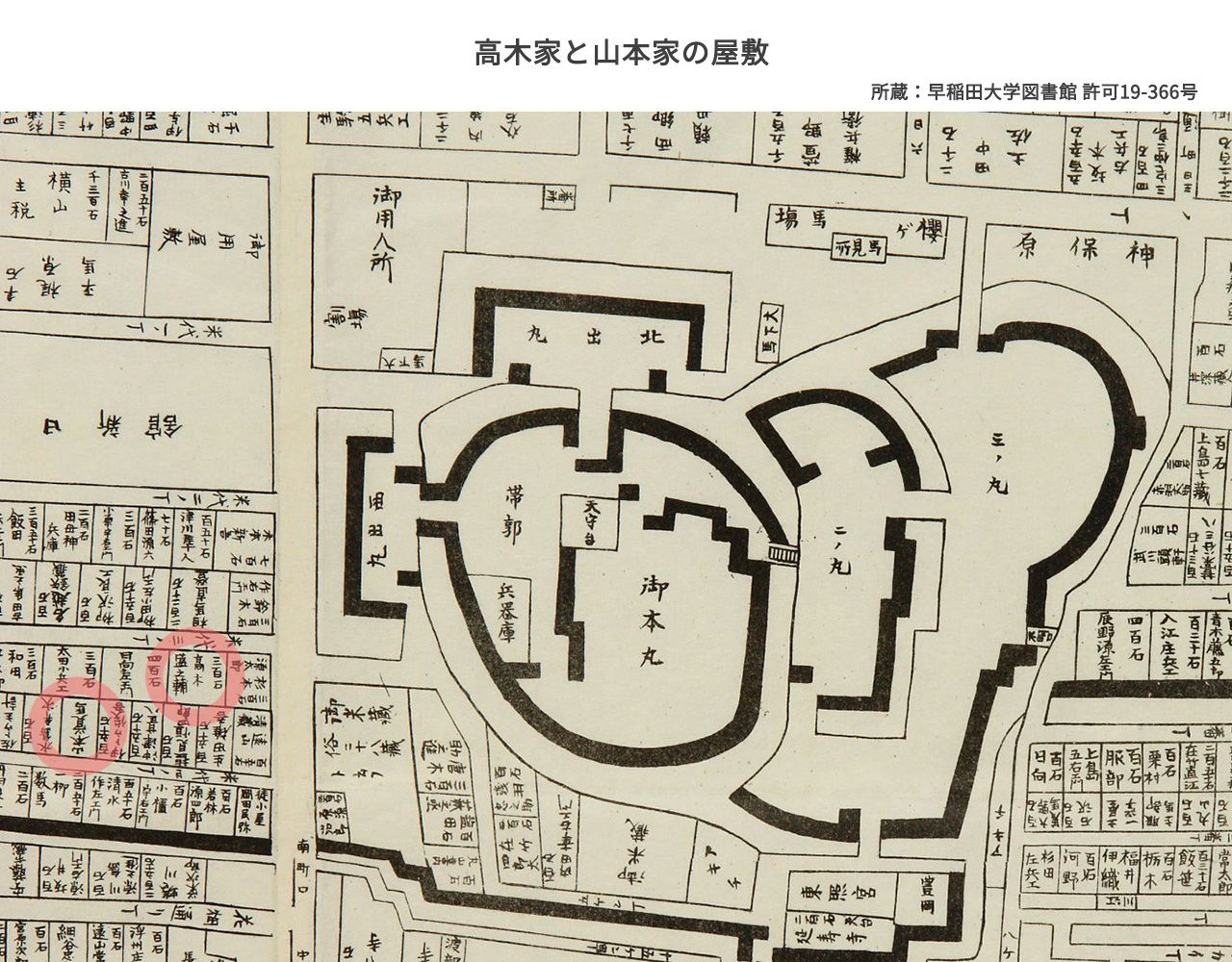 The "Boshin Wakamatsu Castle Town Detailed Map" showing samurai residences in the castle town of Tsuruga Castle.
The residence of Tokio Takagi bears the name of her younger brother Takagi Seinosuke.
Directly behind it stands the residence of Yae Niijima, with the name of her older brother Kakuma Yamamoto. Tokio Takagi and Yae Niijima had a close relationship.
He later joined the Metropolitan Police Department and distinguished himself in the Satsuma Rebellion, and worked at the Tokyo Educational Museum, among other positions. He died of a gastric ulcer on September 28, Taisho 4 (1915). Per his wish to be buried in Aizu after death, he rests in the Fujita family grave at Amida-ji Temple.
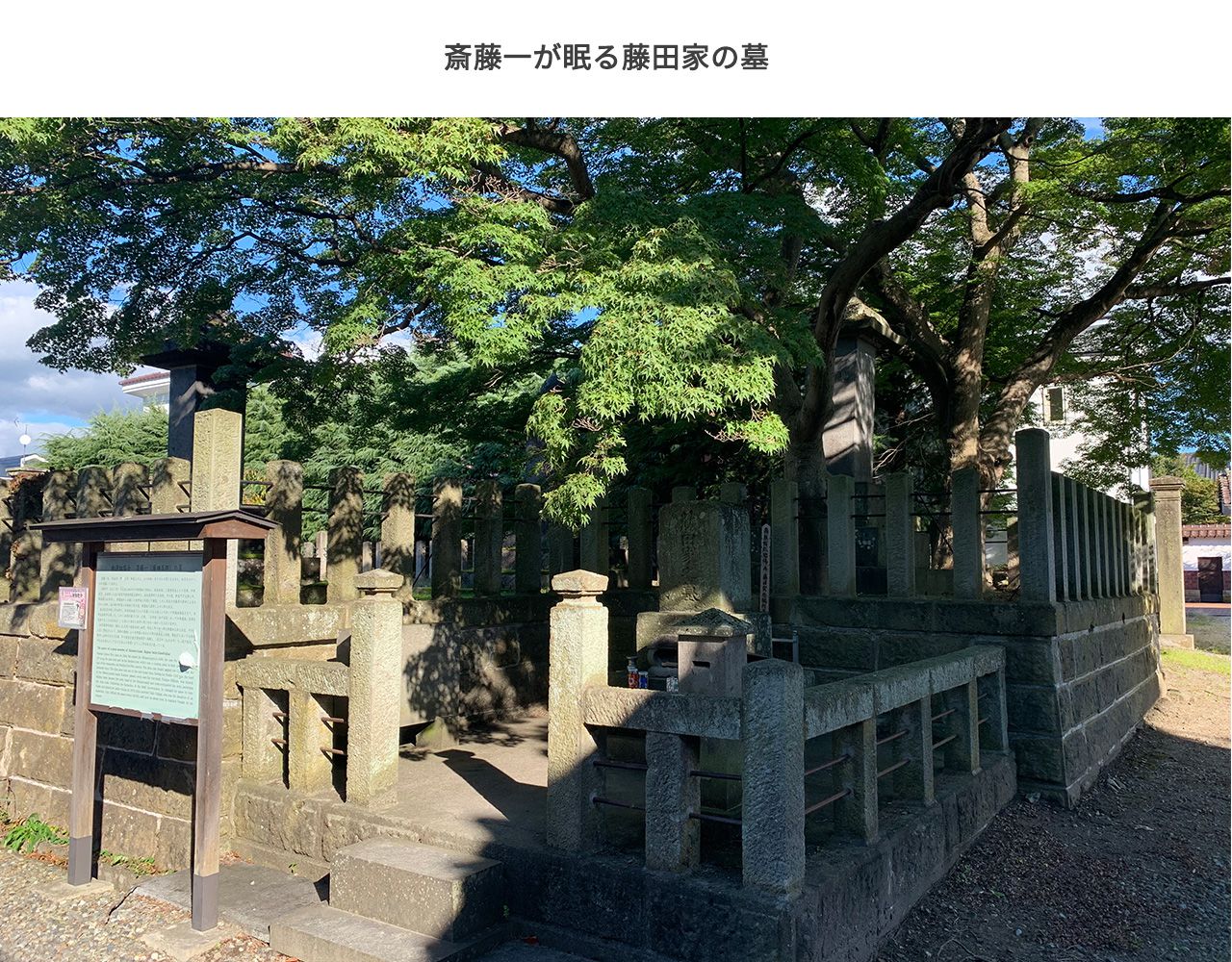 The Fujita family grave standing in autumn dappled sunlight. Per his last wish, Hajime Saito is buried in this grave.
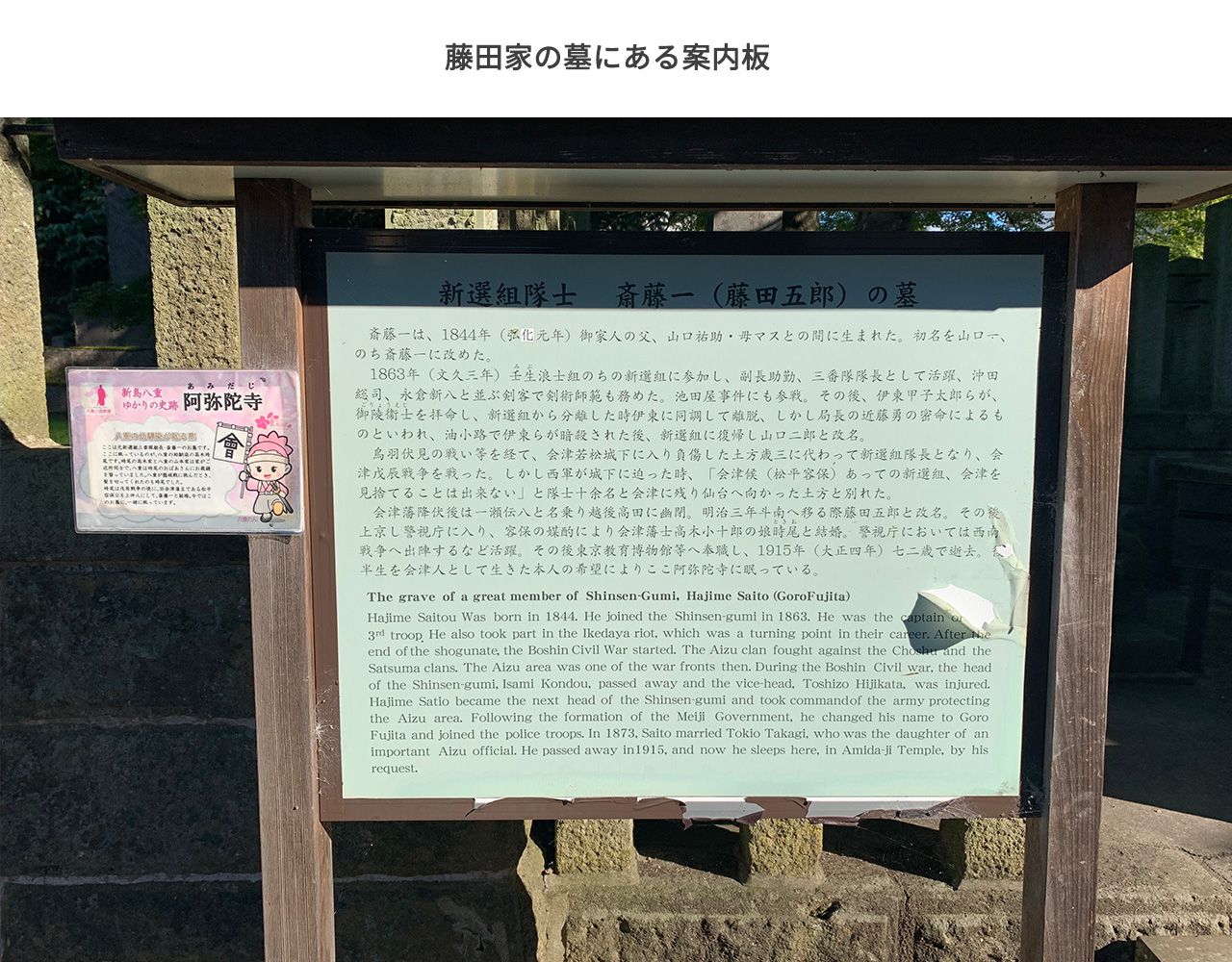 An information board in front of the grave.
The Grave of Shinsengumi Member Hajime Saito (Fujita Goro)
Hajime Saito was born in 1844 (Koka 1) to a gokenin father, Yamaguchi Yusuke, and his mother Masa. His original name was Yamaguchi Hajime, later changed to Saito Hajime.
In 1863 (Bunkyu 3), he joined the Miburoshigumi, later the Shinsengumi. He served as Fukurochojokin (assistant vice-commander) and captain of the 3rd Unit, and was renowned as a swordsman alongside Soji Okita and Shinpachi Nagakura. He also served as a swordsmanship instructor. He participated in the Ikedaya Incident.
Later, when Kisaburo Ito and others received the imperial order to form the Goryo Eishi (Imperial Tomb Guards) and separated from the Shinsengumi, Saito followed Ito and left. However, it is said this was under a secret order from Commander Isami Kondo. After Ito and others were assassinated at Aburanokoji, he returned to the Shinsengumi and changed his name to Yamaguchi Jiro.
After fighting in the Battle of Toba-Fushimi and other engagements, he entered the castle town of Aizuwakamatsu and became captain of the Shinsengumi in place of the injured Toshizo Hijikata, fighting in the Aizu Boshin War.
However, when the Western army approached the castle town, he parted from Hijikata, who headed for Sendai, declaring, "The Shinsengumi exists because of Lord Katamori Matsudaira. We cannot abandon Aizu." He remained in Aizu with more than ten members.
After the Aizu Domain's surrender, he was confined under the name Ichinose Denpachi in Takada, Echigo. When relocating to Tonami in Meiji 3 (1870), he changed his name to Fujita Goro. He later went to Tokyo, joined the Metropolitan Police Department, and married Tokio, the daughter of Aizu domain samurai Takagi Kojuro, through Matsudaira Katamori's matchmaking. At the Metropolitan Police Department, he distinguished himself by fighting in the Satsuma Rebellion, among other exploits.
He later served at the Tokyo Educational Museum and other institutions, and passed away in 1915 (Taisho 4) at the age of 72. Per his wish to live his later years as an Aizu person, he is buried here at Amida-ji Temple.
The grave of a great member of Shinsen-Gumi, Hajime Saito (Goro Fujita)
Hajime Saito was born in 1844. He joined the Shinsen-gumi in 1863. He was the captain of the 3rd troop. He also took part in the Ikedaya riot, which was a turning point in their career. After the end of the shogunate, the Boshin Civil War started. The Aizu clan fought against the Choshu and the Satsuma clans. The Aizu area was one of the war fronts then. During the Boshin Civil War, the head of the Shinsen-gumi, Isami Kondo, passed away and the vice-head, Toshizo Hijikata, was injured. Hajime Saito became the next head of the Shinsen-gumi and took command of the army protecting the Aizu area. Following the formation of the Meiji Government, he changed his name to Goro Fujita and joined the police troops. In 1873, Saito married Tokio Takagi, who was the daughter of an important Aizu official. He passed away in 1915, and now he sleeps here, in Amida-ji Temple, by his request.
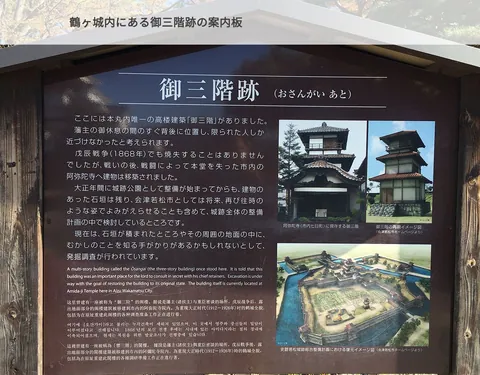
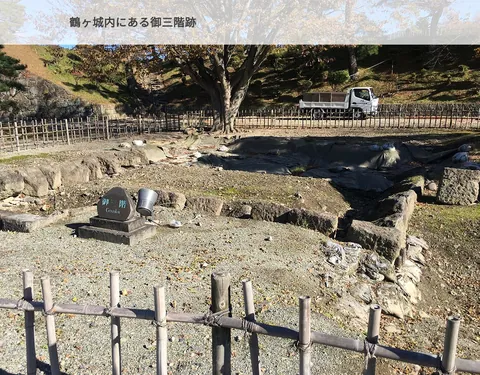
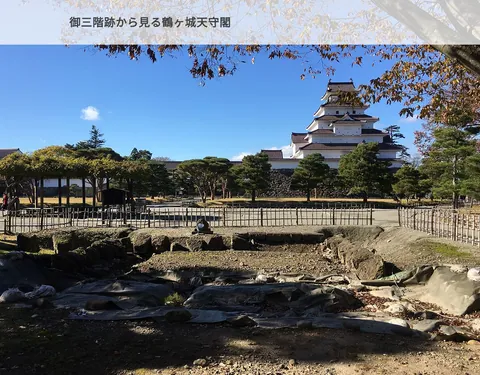
Relocation of OsangaiIn Meiji 4 (1871), the Osangai tower from Tsuruga Castle was relocated to this site. As the previous main hall had been lost to fire, the relocated Osangai served as a temporary main hall to mourn the buried souls.
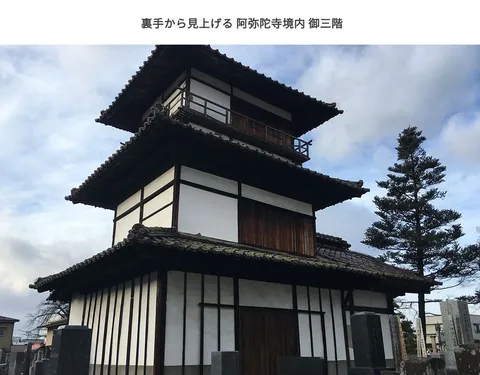
The Osangai appears as a three-story building from the outside, but has four interior floors, and is said to have been used for secret negotiations at times.
Since the Osangai was originally a turret of Tsuruga Castle, the entrance of the Oshoin audience hall from the castle's inner citadel was added and adapted to serve as the temple's temporary main hall entrance. For this reason, it is said that its dimensions do not match the stone walls remaining at the Tsuruga Castle inner citadel site.
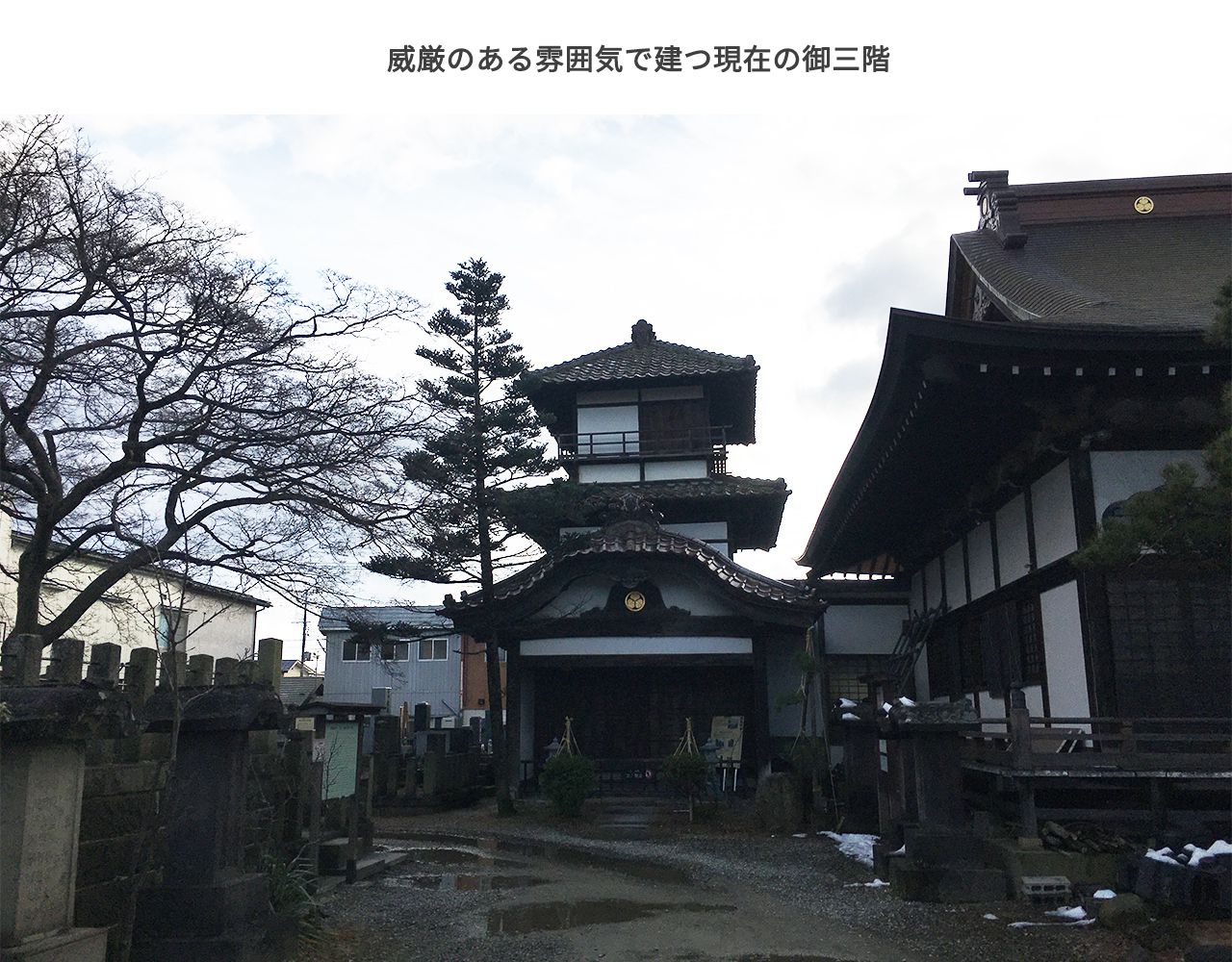 The Osangai tower within the Amida-ji Temple grounds. Comparing it to the height of the temple roof gives a sense of the Osangai's size.
Osangai tower in the Amida-ji Temple grounds, viewed from behind. From the outside it appears to be a three-story building.
Select a thumbnail image below to switch images.
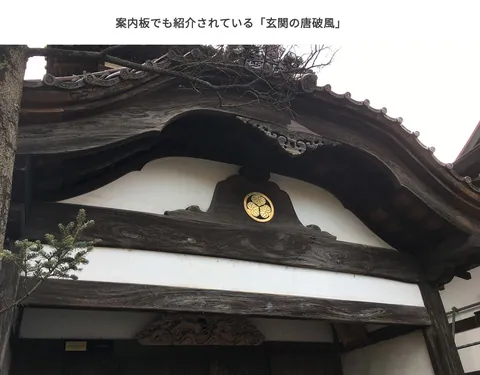
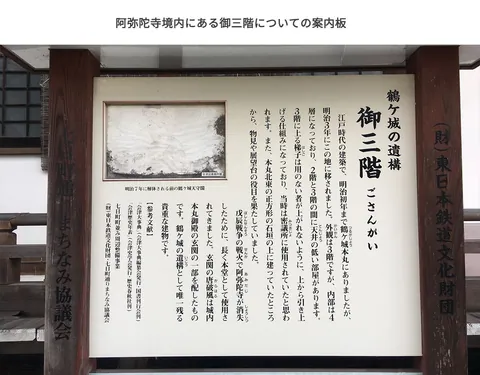
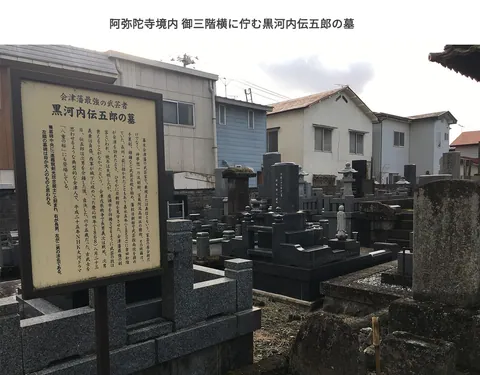
Information board at the former Osangai site within Tsuruga Castle (Aizuwakamatsu Castle).
Select a thumbnail image below to switch images.
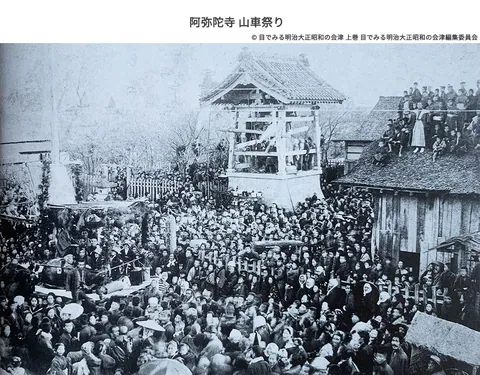
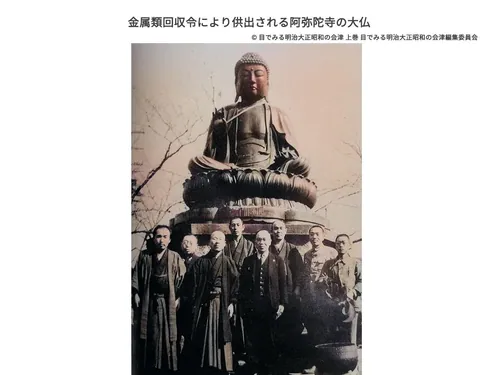
Here in Aizu as well, there was a Great Buddha (Vairocana Buddha, a Mahayana Buddhist statue) made of bronze (an alloy of copper and tin) standing 3.6 meters tall, cast in Meiva 4 (1767) by Kamono Kambesuke Tomotsugu. It had been located at the former Shoso-ji Temple on Iimoriyama (present-day Sazaedo, 155 Yatsumachi Hachiman Takizawa, Aizuwakamatsu City).
The "Shinpen Aizu Fudoki" Volume 26, Munakata Shrine section records: "The Great Buddha is located east of the temizu, on a slightly elevated platform. A stone platform approximately five shaku high is built, upon which a bronze statue of Shaka is placed. It is nine shaku tall, seated in the open on a lotus seat. The lotus seat is made of bronze, three shaku and four sun tall, cast in Meiva 4."
However, because it was nearly destroyed by the haibutsu kishaku movement, the Great Buddha was moved to Amida-ji Temple.
In "Aizu Boshin Senshi Zohu Hakutai Roshisha Koreisha no Kentou Kaitei Zohu Dai 3-han" (Revised and Enlarged 3rd Edition, 1937) by Benzo Hiraishi, the following episode about the Great Buddha at Amida-ji Temple during the Boshin War is recorded:
The Vairocana Buddha of Amida-ji in Nanukamachi was originally in front of the Nio Gate at Mount Iimori. When the western soldiers were smashing and packing every piece of it, a western officer came and said:
"What are you doing?"
"Yes, this is bronze, so we are going to sell it to foreigners in Yokohama at a high price."
"You people have laid hands even on the gods and Buddhas. It is outrageous. If you behave like this, I will not leave it alone."
Having been warned in this way, they left it as it was. But then Marukaku, the owner of a pot-casting workshop in Nanukamachi, Tani Hikozaemon, bought it cheaply. The hands, body, lotus pedestal and other parts were separated, and for about two years they were left exposed in a roadside field. Afterward he tried to melt them down into a pot, but for two or three days before that, every night at deep midnight, the Great Buddha began to groan, and the townspeople were greatly alarmed. They gathered urgently and discussed it, and considering it a waste, they bought the Buddha from him and joined the pieces together clumsily. That is the Great Buddha as it is today.
Even the Great Buddha suffered such cruelty, so it was natural for ordinary people to suffer hardship. The Great Buddha was made in Meiwa 4 (1767), the year of the Fire Boar (hinoe-i), 160 years ago, and was placed at Shoju-ji Temple on Mount Iimori.
[Hiraishi Benzo, "Aizu Boshin War: Expanded Edition of the Shirahata Tai and Female Corps and the Elderly's Heroic Struggle, Revised and Expanded Third Edition" (1937)]
The Great Buddha from the Osangai tower of Amida-ji Temple.
Select a thumbnail image below to switch images.
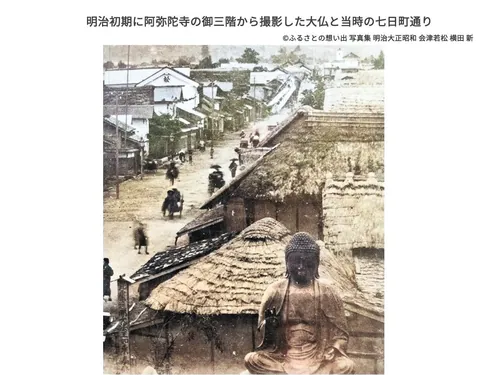
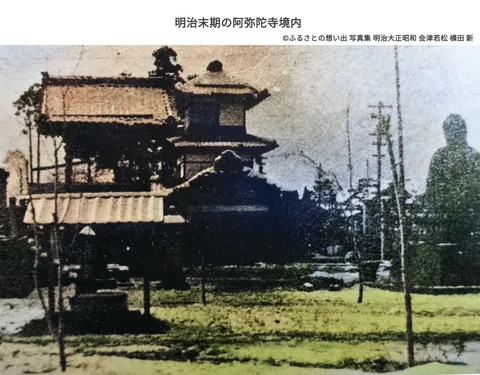
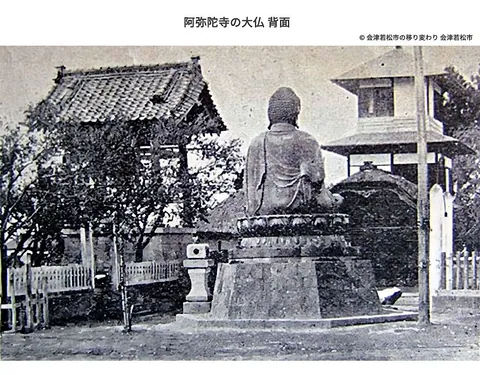
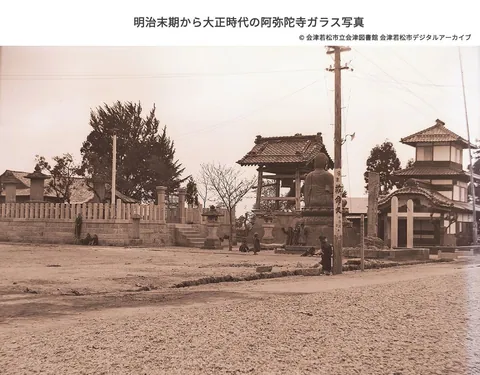
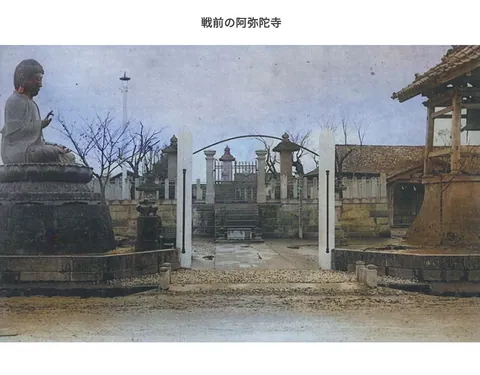
Amida-ji Temple in October, Taisho 3 (1914). This was when the long-cherished renovation of the cemetery grounds by the people of Aizu was completed. The Great Buddha is visible at the left edge, and the bell tower at the right.
Colorized and noise-corrected by deep learning
Select a thumbnail image below to switch images.
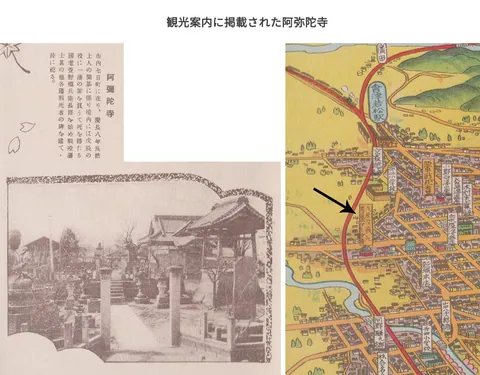
Why not take a moment to feel the history of Amida-ji Temple?
About goshuinAmida-ji Temple currently does not offer goshuin (temple stamps).
However, goshuin for the Aizu Togu Military Cemetery can be obtained at the Nanukamachi Tourist Information Center across from Amida-ji Temple.
Please check the official website for closed days before visiting.
TimelineMajor events related to Amida-ji Temple introduced in this article
-
Keicho 8 (1603)
Founded by Ryonen.
-
Genna 4 (1618)
A large-scale dharma assembly is held.
-
Shoho 2 (1645)
Buildings destroyed in a great fire.
-
Meiji 2 (1869)
Reinterment of Boshin War victims at Amida-ji Temple begins.
-
Meiji 4 (1871)
The Osangai tower is relocated.
-
Taisho 4 (1915)
Hajime Saito is buried at Amida-ji Temple per his last wish.
-
Showa 19 (1944)
The Great Buddha is requisitioned.
-
Showa 50 (1975)
The present main hall is constructed.
-Shinpen Aizu Fudoki, Aizu Domain (1803-1809)
-Senshi no Bosho Soezu (Rough Map of Fallen Soldiers' Grave Sites), Hyakuetsu Ban (1869)
-Aizu Hankoki (1922) info:ndljp/pid/964388
-Aizu Boshin Senshi: Zohu Hakutai Roshisha Koreisha no Kentou Kaitei Zohu-han, Benzo Hiraishi (1928) info:ndljp/pid/1908818
-Omihino-cho Shi, Volume Upper, Hino-cho Education Association (1930) info:ndljp/pid/9571648
-Gamo Chukoku-den, Genyu Saionji (1933) info:ndljp/pid/1112640
-Zusetsu Aizuwakamatsu no Rekishi, Aizuwakamatsu City 60th Anniversary of Municipal Establishment Publication Editorial Committee (1960) info:ndljp/pid/3008948
-Kurata-shi Kahu, Shuji Kurata (1971)
-Boshin Junnen Tsuito-roku, Aizu Choryo Gikai (1978)
-Aizu Bunkazai No. 4, Aizu Bunkazai Chosa Kenkyukai (1984) info:ndljp/pid/12419375
-Zaike Bukkyo 44 (517), Zaike Bukkyo Kyokai (1995) info:ndljp/pid/6064182
-Aizu Boshin Senshaisha Baiso no Kyo to Jitsu: Boshin Junnansha Saishi no Rekishi, Shinichi Noguchi (2017)
Column list for this page Return to original paragraph
Column: On the name of Osamu Itakura
Osamu Itakura, a Gamo family retainer who was a friend of Ryonen and played an active role in the construction of Amida-ji Temple. On this site, his surname is given as "Itakura."
The surname varies across historical documents, likely because the original vassal registers (bunken-cho/shihai-cho) were severely damaged and some entries are illegible.
Here, we present the names that appear to correspond to Osamu Itakura from the list of Gamo family retainers.
●Omihino-cho Shi, Volume Upper, Hino-cho Education Association (1930)
Within the Omihino-cho Shi, the "Gamo Shihai-cho" preserved in the Okazaki family is introduced. According to it, the original document was restored in Tenpo 15 (1844) due to insect damage.
This Gamo Shihai-cho compares the stipends of retainers during the era of Gamo Ujisato and approximately eight years later during the Hideyuki era.
Available for viewing at the National Diet Library Digital Collections.
https://dl.ndl.go.jp/info:ndljp/pid/1208250/226
https://dl.ndl.go.jp/info:ndljp/pid/1208250/228
https://dl.ndl.go.jp/info:ndljp/pid/1208250/246
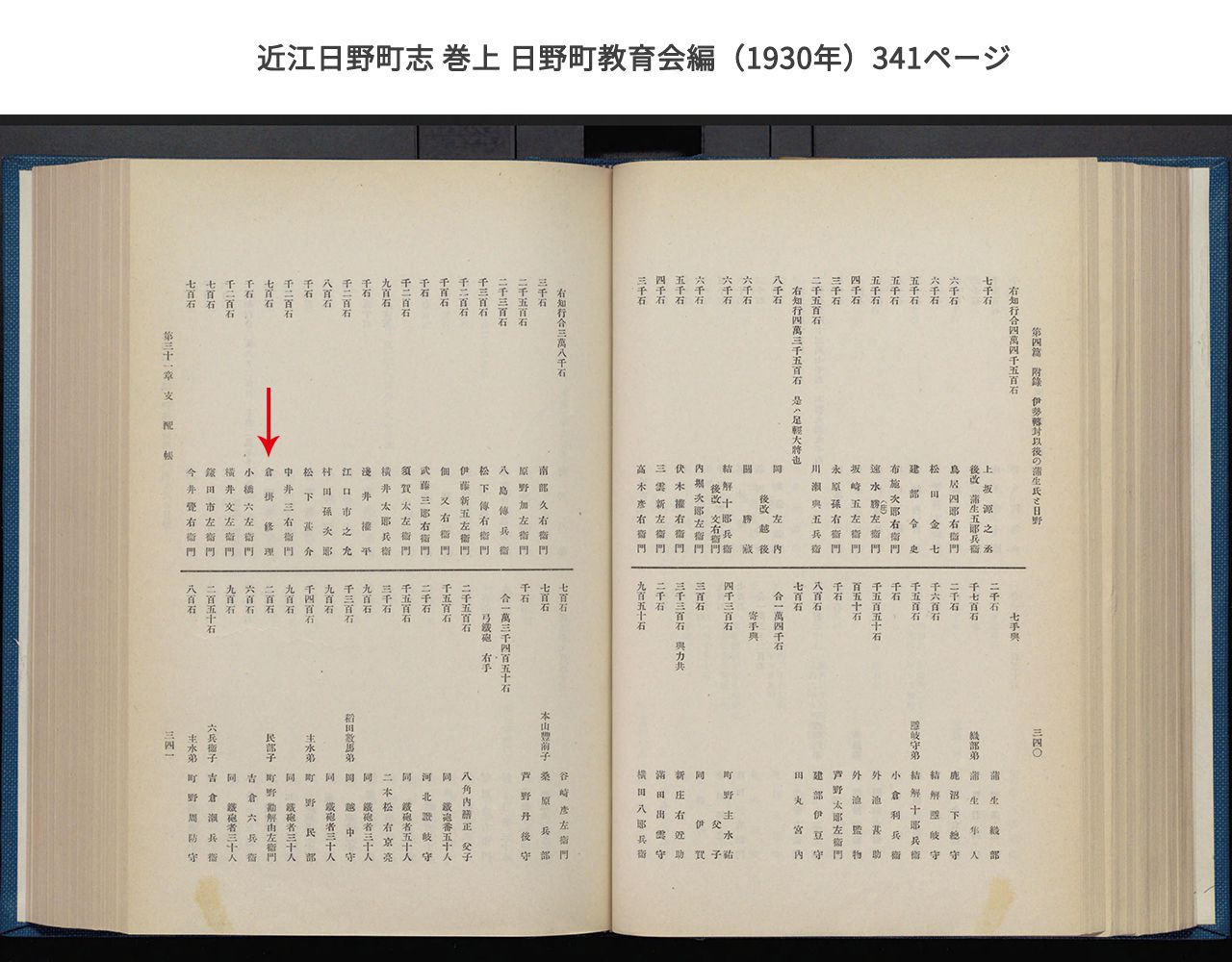 The name "Kurakake Osamu" appears as a retainer of Gamo Ujisato. His stipend was 700 koku.
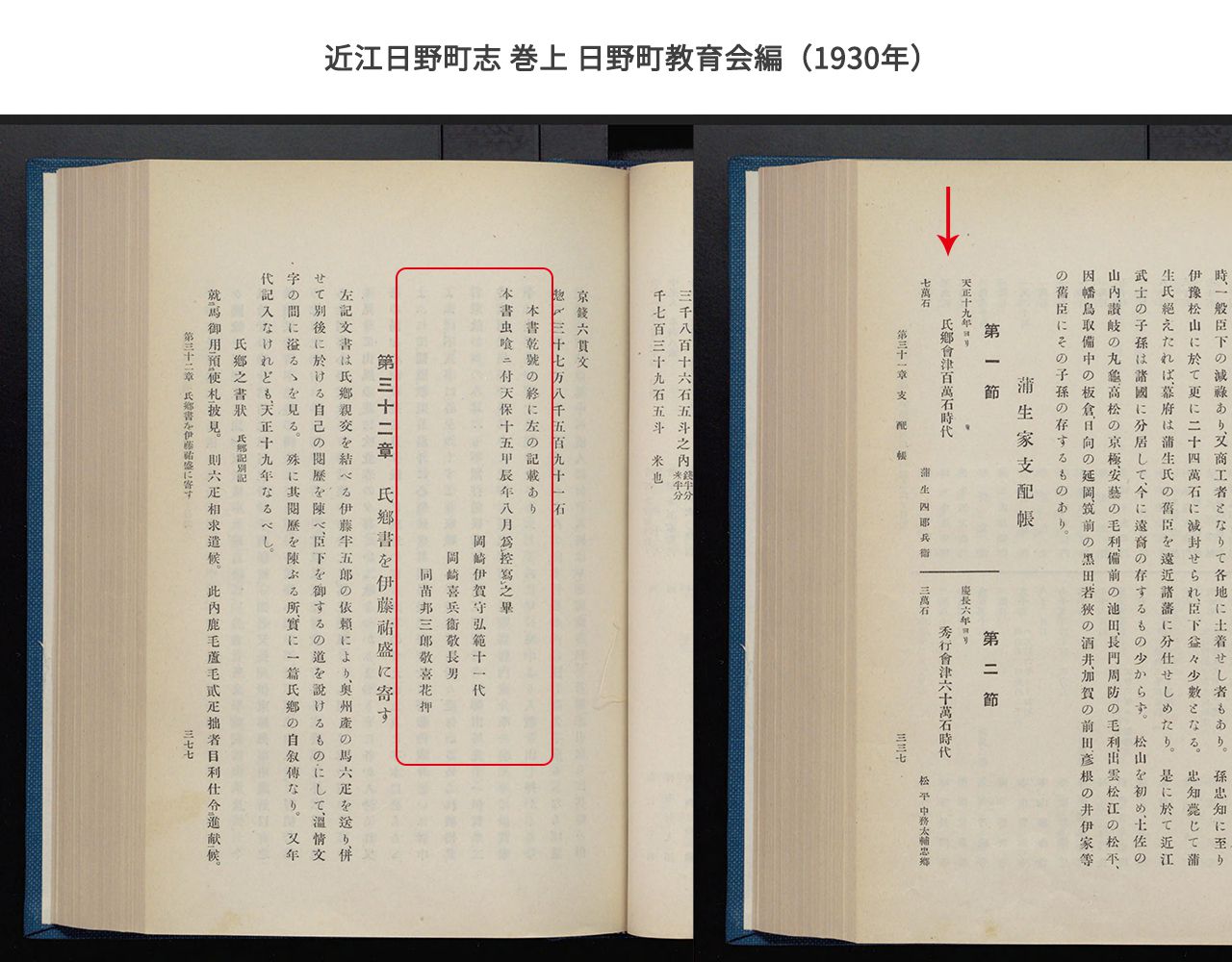 The upper section shows the Gamo Ujisato era and the lower section shows the Gamo Hideyuki era. The original document bears a note regarding insect damage.
●Gamo Chukoku-den, Genyu Saionji (1933)
Within the Gamo Chukoku-den, the knowledge of Gamo family retainers in Matsuyama and in Aizu is compared.
The original is stated to correspond to the "Gamo Shihai-cho" owned by Ryutaro Senba, and the "Gamo-ke Jakku" and "Bakufu Onmitsu no Ki" in the Jinaiko (Matsuyama Domain Library).
Available for viewing at the National Diet Library Digital Collections.
https://dl.ndl.go.jp/info:ndljp/pid/1112640/31
https://dl.ndl.go.jp/info:ndljp/pid/1112640/45
https://dl.ndl.go.jp/info:ndljp/pid/1112640/30
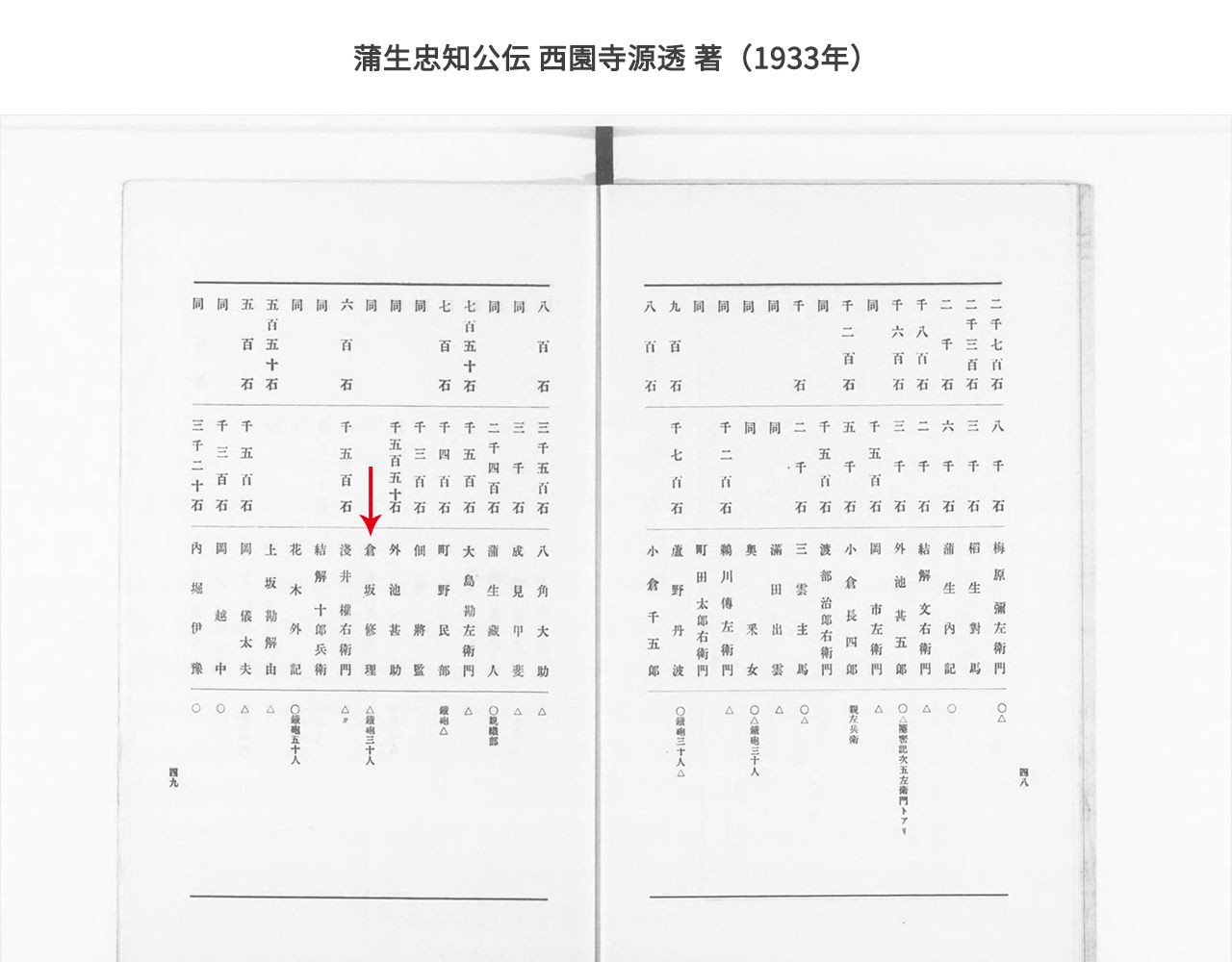 The name "Kurasaka Osamu" appears. His stipend was 700 koku.
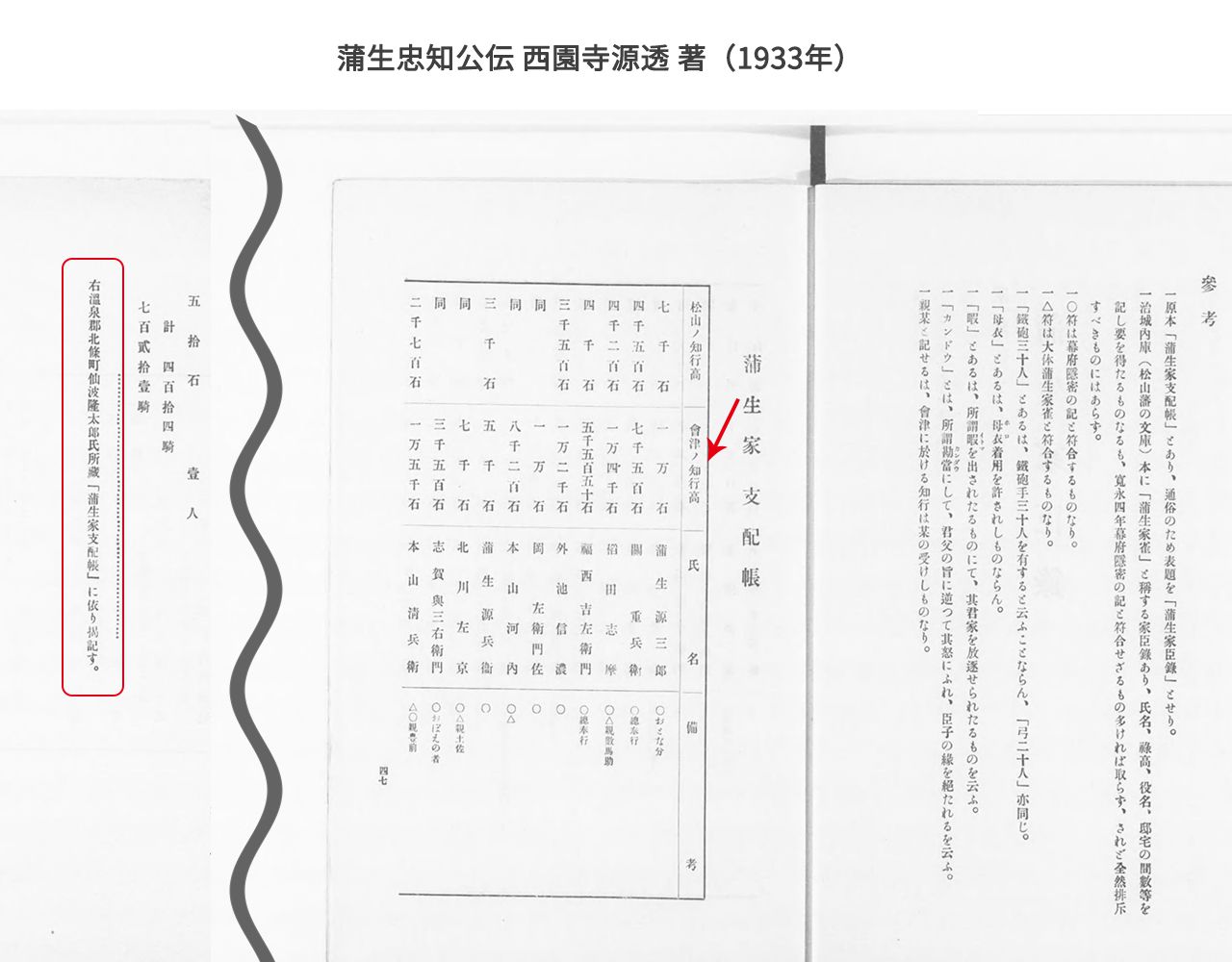 Comparison of Matsuyama and Aizu. It is noted that the original is the Gamo Shihai-cho owned by Ryutaro Senba.
●Aizu Bunkazai No. 4, Aizu Bunkazai Chosa Kenkyukai (1984)
In the special feature of this book, "Miroku-ji 'Gamo-ke Bunken-cho' by Mineo Yamanouchi," the Gamo family bunken-cho formerly kept at Miroku-ji Temple (1-5-1 Omachi, Aizuwakamatsu City, Fukushima Prefecture) is introduced, with the following explanation:
"In Bunkyu 1 (1861), on the occasion of the 250th memorial service of Gamo Hideyuki, the founding patriarch, the chief priest of Goshin-in compiled the Gamo family bunken-cho and bound it as a temple treasure. After the chief priest of Goshin-in transferred to Miroku-ji in Meiji 16 (1883), the documents of Goshin-in were also kept at Miroku-ji. However, in June of Meiji 29 (1896), Miroku-ji burned down and this bunken-cho was also lost. Fortunately, however, Choshiro Kato had made a handwritten copy of this bunken-cho, and at his request, a clean bound copy was made (around Meiji 42, 1909). This is the vassal register."
In the Miroku-ji "Gamo-ke Bunken-cho," it states: "Kuragaki Osamu, 700 koku."
In this way, the bunken-cho listing Gamo family retainers was severely damaged and repeatedly copied over time. As a result, transcription errors likely occurred and some names became illegible.
The surnames as they appear in each source introduced above are summarized below:
Kurakake Osamu (Omihino-cho Shi: Okazaki family's Gamo Shihai-cho)
Kurasaka Osamu (Gamo Chukoku-den: Ryutaro Senba's Gamo Shihai-cho, Jinaiko Gamo-ke Jakku and Bakufu Onmitsu no Ki)
Kuragaki Osamu (Aizu Bunkazai No. 4: Miroku-ji Gamo-ke Bunken-cho)
On this site, we use the notation "Itakura Osamu" based on the description of "Itakura-bou" in the "Shinpen Aizu Fudoki" (detailed later), which can be verified against the original document.
(Investigation ongoing)
Return to original paragraph
Return to original paragraph
Column: Temples associated with Ryonen
Ryonen, born in what is now Mashiko-machi, Tochigi Prefecture, was involved with many temples throughout Fukushima Prefecture.
Here are some temples associated with Ryonen.
●Confirmed ▲Under investigation
▲Baisho-ji Temple 3 Kojima Kitashizawa, Kawamata-machi, Idate-gun, Fukushima Prefecture
Founded in Tensho 4 (1576) by Ryonen
●Entsu-ji Temple 1770 Osawa, Mashiko-machi, Haga-gun, Tochigi Prefecture
Amida-ji Temple in Aizuwakamatsu was established as a branch temple of Entsu-ji
●Zendo-ji Temple 1-1-23 Shimizudai, Koriyama City, Fukushima Prefecture
Founded in Tensho 7 (1579) by Ryushui (Rokyuu), a disciple of Ryoshin, the 15th chief priest of Entsu-ji Temple (Tochigi Prefecture, Mashiko-machi)
▲Zendo-ji Temple 1 Shinmachi Sasenomiya, Nihonmatsu City, Fukushima Prefecture
Founded in Tensho 7 (1579) by Ryonen, but details are unclear
▲Muno-ji Temple 4 Uemachi, Kuwori-machi, Idate-gun, Fukushima Prefecture
Founded in Keicho 1 (1596) by Ryonen
●Amida-ji Temple (Nanukamachi, Aizuwakamatsu City)
Founded in Keicho 8 (1603) by Ryonen
●Kencho-ji Temple 16-36 Nisshin-machi, Aizuwakamatsu City, Fukushima Prefecture
Built in Genna 5 (1619) as Ryonen's retirement temple. He passed away at this temple in Genna 8 (1622)
Return to original paragraph
Return to original paragraph
Column: The Grave of Hyakuetsu Ban
After killing Bunkiller Kubo-mura Shiro, Hyakuetsu Ban sought refuge with Sakaguchi Tsuemon in Daianji-mura, Niigata Prefecture, and hid at Keiun-an.
A grave has been erected at the present location of that place (postal code 956-0813, Daianji, Akiha-ku, Niigata City, Niigata Prefecture).
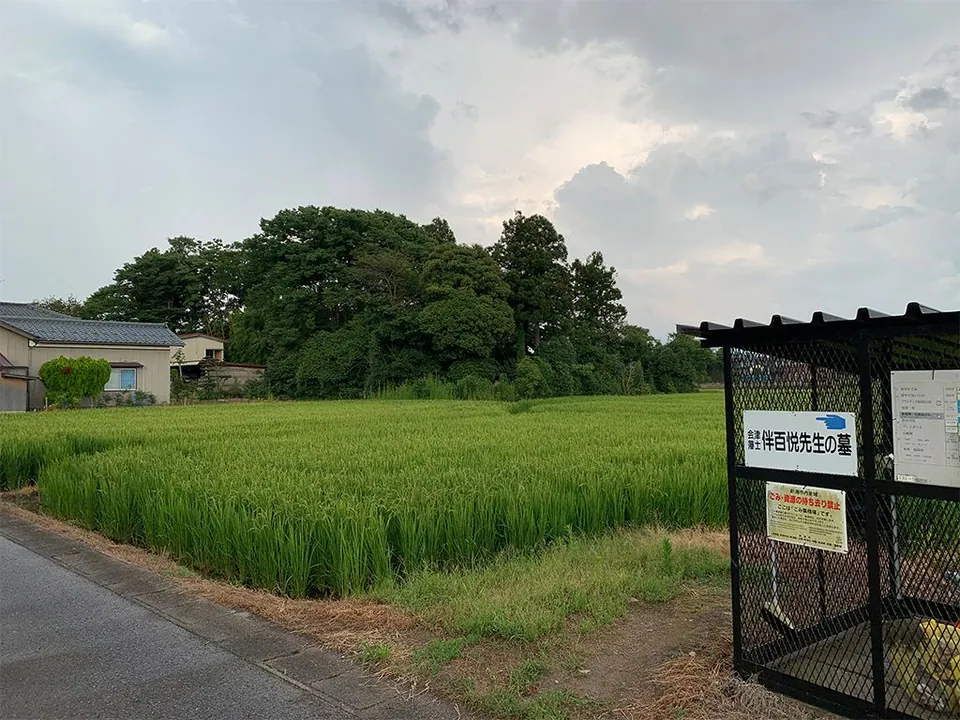 The grave of Hyakuetsu Ban at Daianji Temple (formerly Niitsu City) in Akiha-ku, Niigata City, Niigata Prefecture. A lush grove stands in a beautiful pastoral landscape.
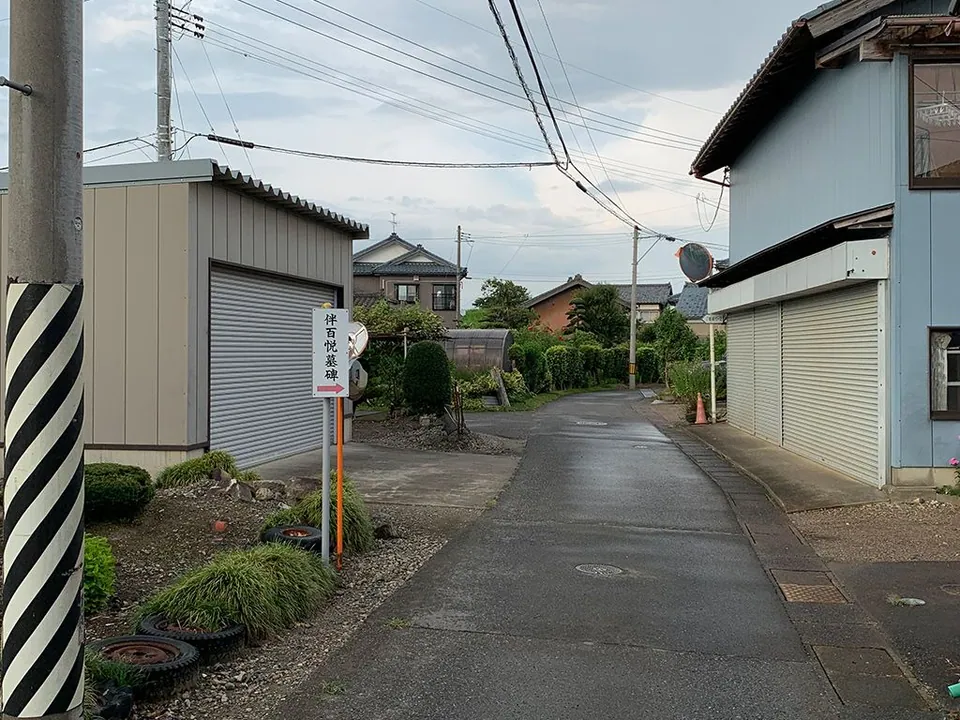 Signage on the road. Follow the narrow alleyway between private houses, using the signs as your guide.
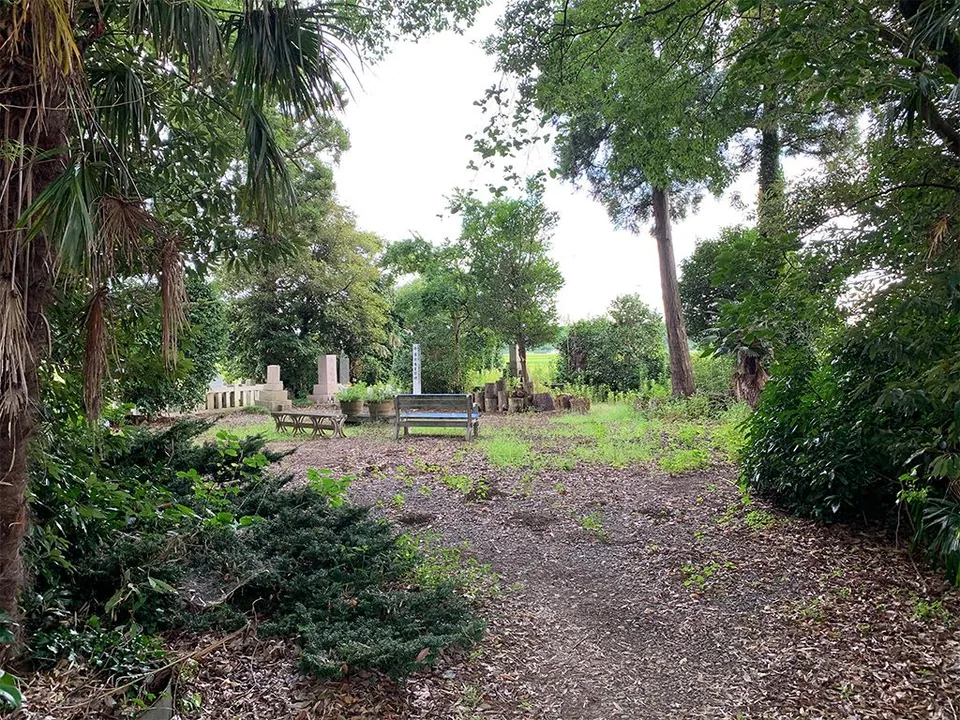 Beyond the alley, a cemetery clearing opens in the grove. Graves of local residents stand alongside that of Hyakuetsu Ban.
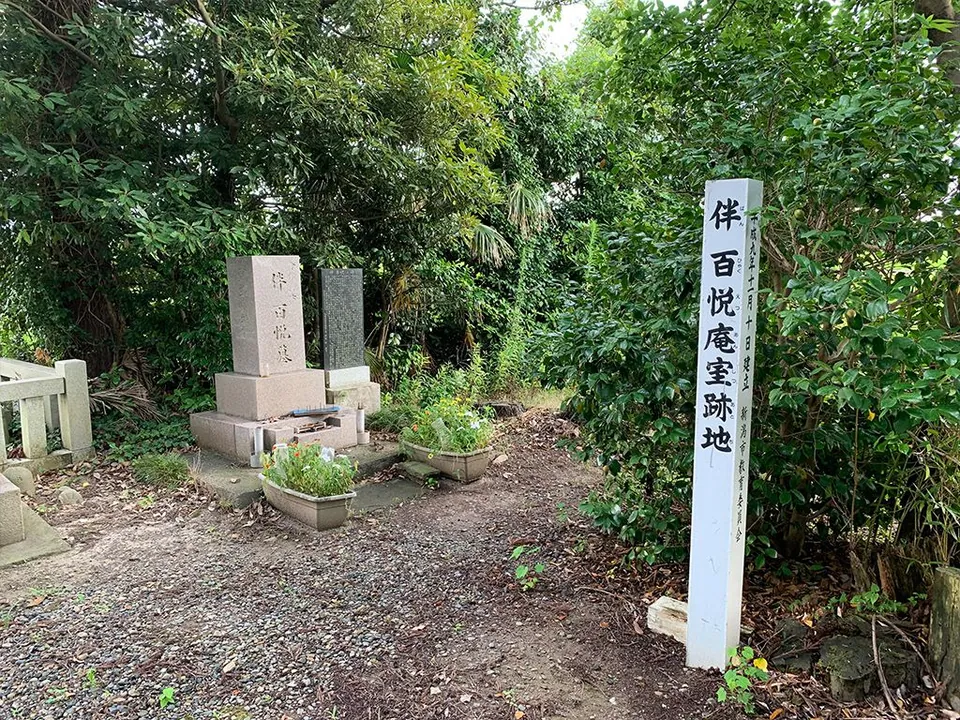 The gravestone of Hyakuetsu Ban and a sign marking the former site of Hyakuetsu-an.
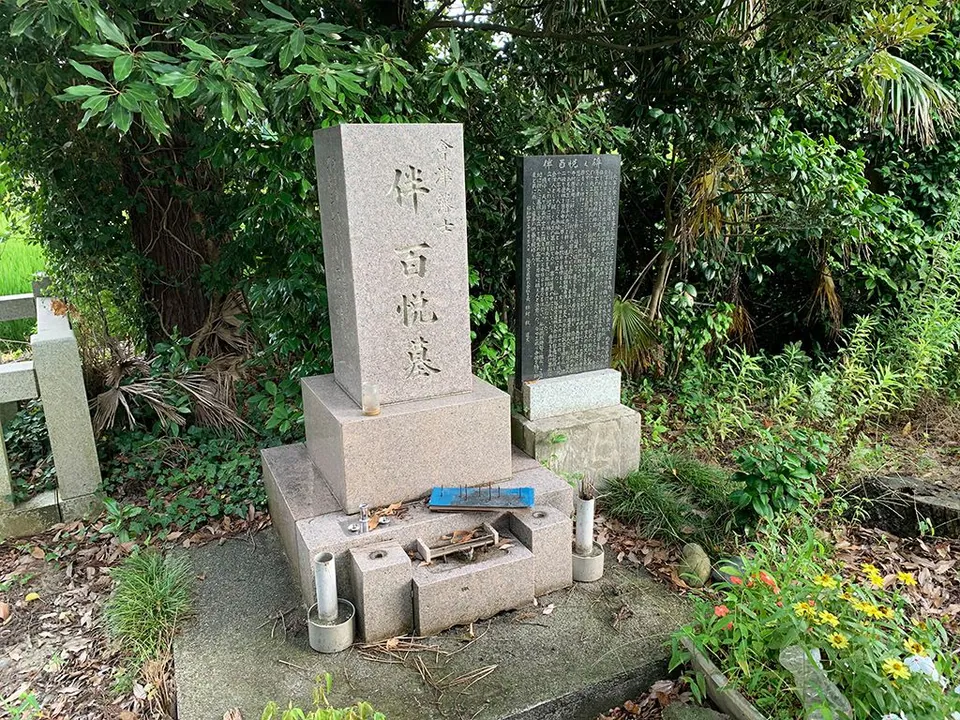 A new gravestone has been erected.
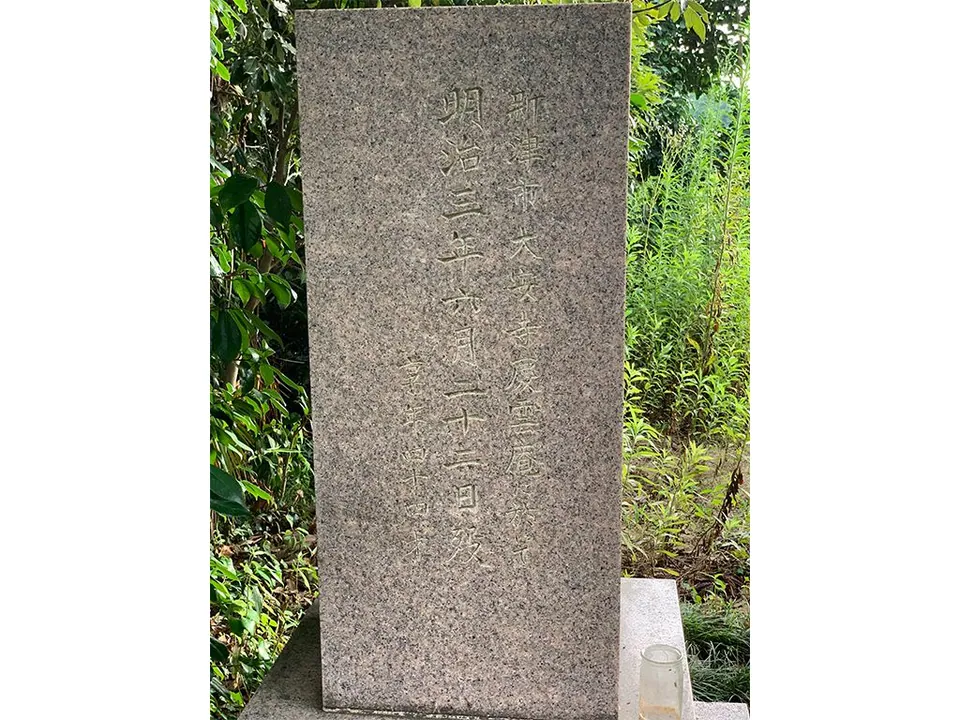 Inscribed: 'At Keiun-an, Daianji, Niitsu City. Died June 22, Meiji 3 (1870). Aged 44.'
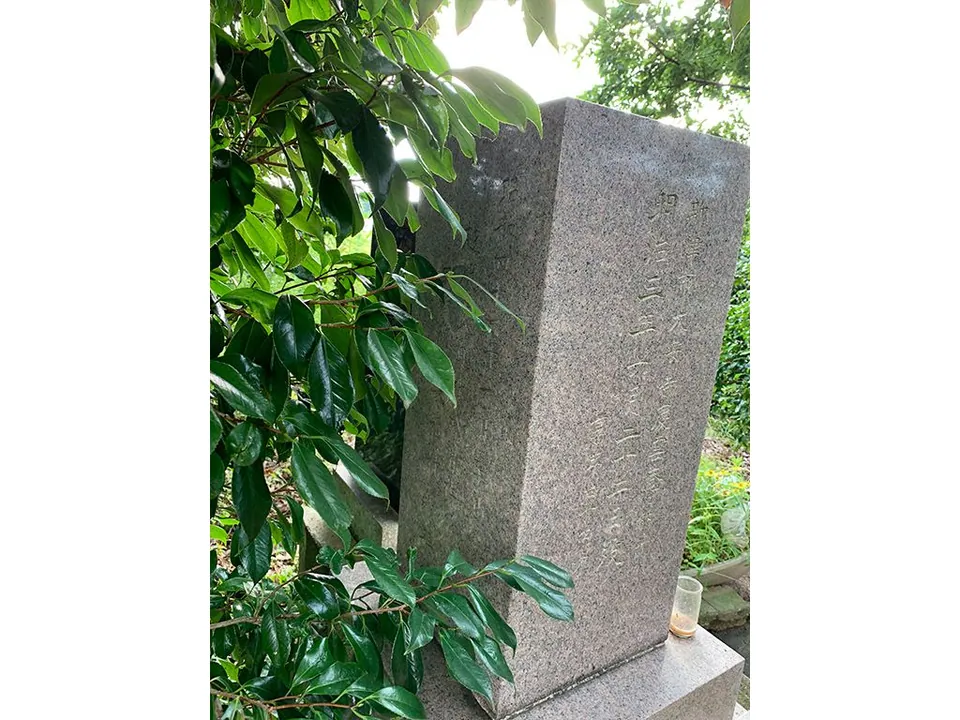 The side and back of the gravestone.
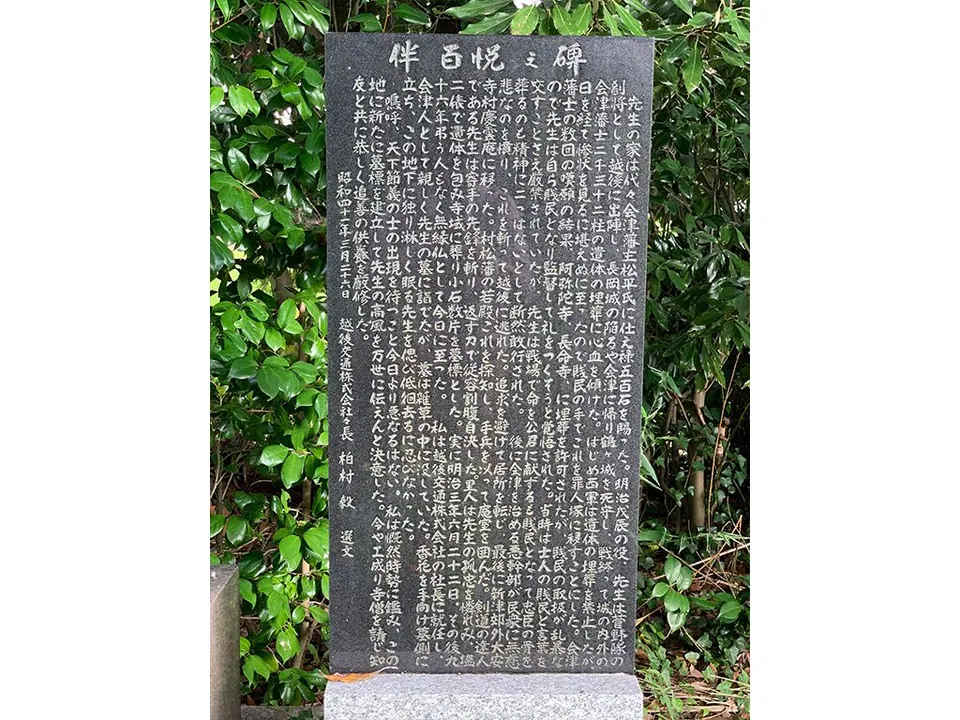 The site was maintained by the president of Echigo Kotsu, Takeshi Kashiwa.
 A view through the gaps in the trees of the cemetery.
Return to original paragraph
- Regular holiday
- Please check the official site for the latest holiday schedule.
None (View each shop's regular holidays)